Sunday, June 21, 2020

Lost Cause

Jeremiah 20:7-13


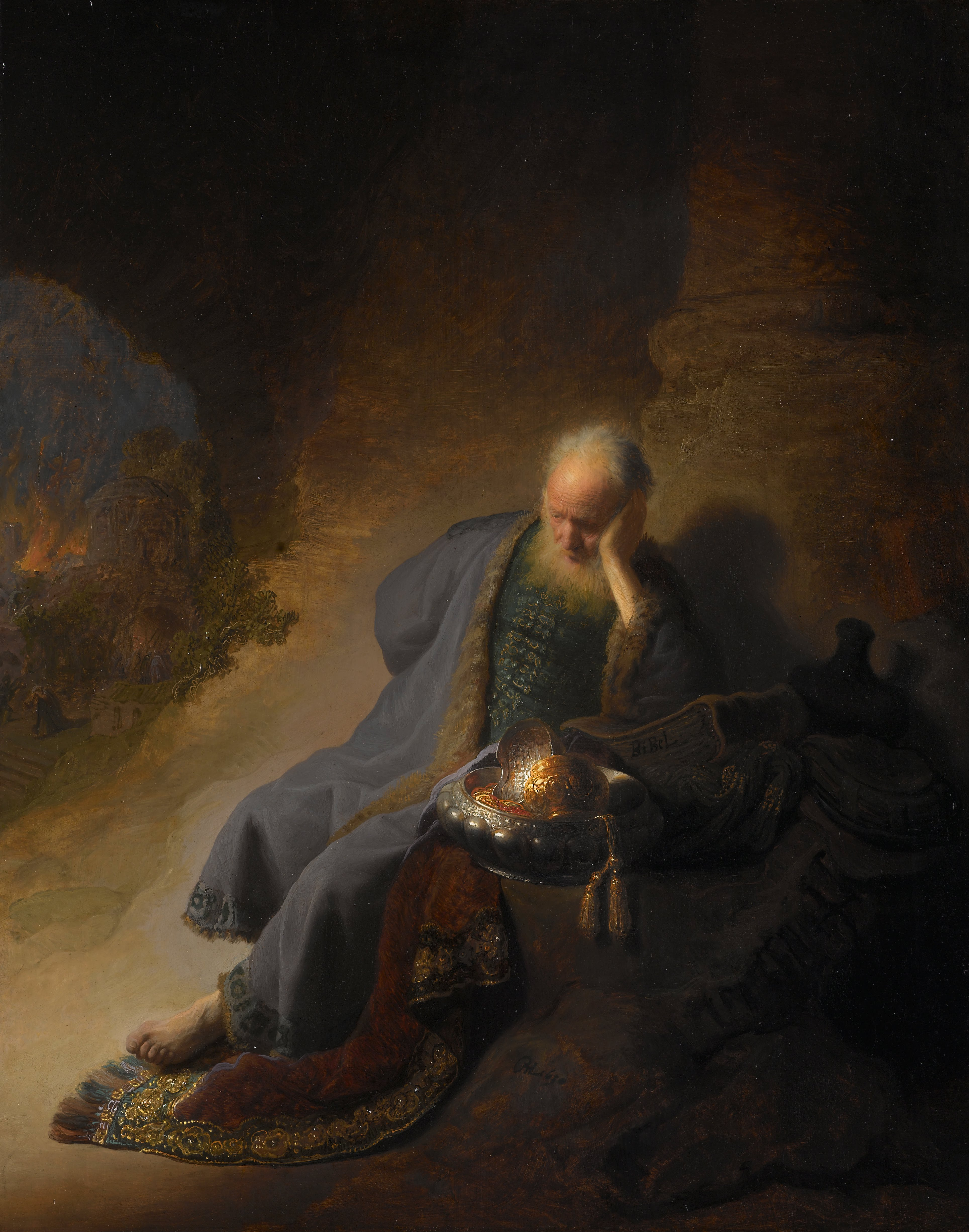
Jeremiah Lamenting the Destruction of Jerusalem
Rembrandt, 1630 (PD)

Being Prophetic was the predominant aspiration of most of my seminary classmates. 

We were certainly attending seminary at a crossroads in modern American history. 

Myself, having left the Marine Corps and police work to attend seminary, it was awkward to be surrounded by friends and classmates whose prophetic voices sounded interestingly like condemnation, and even damnation for my alleged sins. 

The places where I felt most welcomed were the places where people would ask me questions about what I had done, rather than providing me with an immediate scolding upon learning how I had earned a living up until that point. 

Questions like why I served and fought in a war that I may not have agreed with. 

Questions like how I could profess my role in making arrests, in poor urban communities predominantly occupied by systemically oppressed generations of black men and women. 

I began seminary in 2012, as all these questions were beginning to churn again, and visions of a revolutionary church providing the justice that uniformed police and military could not, filled my classmate’s agendas, heads, and hearts. 

I didn’t mock their idealism then, and I do not mock it today. 

I do, however, see it as an unrealistic vision of what it truly is to be prophetic. 

I have shared this before, perhaps too many times, but when I was interviewed for my first call, I was asked how I would serve as a charismatic leader for others to follow. 

I told them I didn’t want to be. 

There is only one charismatic leader for us to follow, and that is the Christ, Jesus. 

And it didn’t turn out so good for that guy, now did it?

I only got one awkward laugh, from the senior pastor, following that comment. 

The truth is, carrying any cross, or claiming the voice of a prophet, is not only a lonely position to occupy, but it can be a dangerous place to occupy as well. 

~

In the first lesson for today from Jeremiah, we hear the prophet’s reaction to humiliation and condemnation. 

He is responding to the sharpest rebuke and disgrace imaginable following a physical assault from the high priest, Passhur,  and having just been released from the stocks outside the Temple. 

Humiliated by the highest ranking religious leader, outside of the holiest place imaginable, all for passing an honest and ominous warning to the people, to his very own people. 

A warning no one really wants to hear. 

Perhaps because they don’t believe it, or perhaps because they just don’t want to believe it. 

The pure and simple fact is that the most accurate prophetic proclamations, are most often a sad fate that is ignored by the community to which they are delivered. 

Most prophets are condemned as pessimists or fools. 

Jonah, Isaiah, Jeremiah, John, Jesus, are all but a few examples of prophets who are doomed by the words that they spoke. 

Spat upon, laughed at, defeated and disheartened. 

Even the prophet Jeremiah that we hear from today is not known as Jeremiah the wise. 

Biblical scholars refer to Jeremiah today as “the weeping prophet.”

And while perhaps not intentional, it certainly conjures up an image of a whiner, does it not?

The role of a prophet is not a comfortable role to claim, and while many boldly make that claim, in attempts to gain notoriety and attention, the loudest prophets are perhaps the one’s we should be the most wary of. 

Those prophets whose quotes seem worthy of hallmark cards, best seller book lists, and framed motivational posters in the waiting rooms of many dental offices, are perhaps not really voices of prophets at all. 

Perhaps those are the voices of the opportunists who seek out the glory of their own two thumbs, rather than the uncomfortable justice and peace that God lays out before us in these stories, songs, poems, and histories we claim have so much power over us?

Prophecy in scripture is most often the ignored predictions of the damned and the defeated. 

But, that is where this story is so much different, because it is in the silenced lips of the true prophets that God can draw truth from lips that can no longer even draw breath. 

File:Hieronymus Bosch - Christ Carrying the Cross - WGA02556.jpg
Christ Carrying the Cross
Hieronymus Bosch, 1498-1516 (PD)
Carrying a cross is an overused idiom. 

It is a prophetic word that has been oversimplified, because I can truly say, that it is not all that it is cracked up to be. 

I proudly wear the cross on my uniform, and while it is not the first time I have worn this uniform, the past few years of wearing the cross on this uniform has taught me a valuable lesson about what it means to carry the cross, and what it means to speak an undervalued word. 

I joke often with friends, that the cross is placed above the rank, to allow those with whom you speak to know just how many times to demote you. 

As an O3 Lieutenant in the Navy, I usually assume that I function as an O1 Ensign. 

The formula is quite simple, you take the rank of the chaplain, and demote them by two. 

I’ve been under fire five times in my life while wearing the cloth of my nation, but as a chaplain I hold no tactical command in times of combat. 

I do hold the authority and role to give advice on what is moral, ethical, and contributes to the well being of those I serve beside. 

But that advice is nothing but a mere suggestion, which can be easily ignored. 

Luckily, I am rarity. 

I am an introverted chaplain and pastor, and although I try to speak truth, when it goes ignored, I don’t usually take it too personally. 

Thankfully, I have a good model to follow. 

I don’t seek out the most powerful or authoritative, I seek out those on the margins. 

Rather than the powerful, I seek out those tax collectors, those prostitutes, those beggars. 

On this last deployment, most of my congregants never saw the inside of the tent where I held worship, unless they were playing video games or watching a movie in that dual purposed space. 

But when they called home to speak with their families, many wives and girlfriends were shocked when they exclaimed “YOU’RE hanging out with the Chaplain?!”

When we have a prophetic word to share, it will likely be ignored by most, but we should always be aware of just who is listening, because that is the most fertile soil where the ignored seed is planted, the ignored soil is also by far the richest for us to till. 

~

Jeremiah’s words today, and the words that follow, all the way to verse 18 is a lament. 

Jeremiah laments for not only his condemnation, but he laments being chosen as God’s prophet. 

Jeremiah laments being enticed, in this poem, or perhaps a more accurate interpretation is being courted and wooed by God. 

Jeremiah voices regret over falling in love, passionately for God, only to walk down a road of heartache. 

At one point, in verse fourteen, which wasn’t included in today’s reading, he even voices regret for the very day he was born!

He curses his community, he curses God, he curses himself, and he curses the world, out of defeat, frustration, and a deep emotional and even a physical consequential pain. 

Now, who would choose this?

I have to admit, there are days I feel like Jeremiah, but I also give thanks that I am not a renowned prophet just yet, and I should count myself among the lucky ones. 

~

Martin Luther King Jr. was a prophet, and he was most definitely a renowned one, 
but perhaps one of the most significant prophets of the 20th century has escaped notice by most.

Although some know his name, very few know the significance of one particular prophet in the civil rights movement.  

Emmett Till was a young teenage boy, visiting his family in Money, Mississippi, all the way from Chicago, Illinois. 

Emmet and his friends went to the Bryant Grocery store to buy candy, where one of the shop owners, a 21 year old white woman, was working at the time. 

There was some kind of exchange at the store, but even the most serious claims amounted to the young Emmet Till taking her by the hand and cat-calling at her. 

The response to the story was severe. 

The woman’s husband and one of his friends recruited two other men to pickup the 14 year old boy, beat him within an inch of his life, shoot him, tie him to a fan, and leave his body weighed down in the middle of a river. 

Three days later, when Emmet’s body was discovered, naked and brutally disfigured, Mamie Till insisted he be transported back to Chicago, and be displayed for all to see at an open casket funeral. 

Even in death, Mamie, the wounded and grieving mother of Emmet knew he had work to do. 

Emmet’s death was so horrifying and brutal, that the barbarism of lynch mob justice, which had been ignored for so long was brought to the light. 

The Prophet Emmet, who never spoke from behind a pulpit, spoke words to the nation and lit a spark that ignited the civil rights movement. 

He also warned the nation of what was to come, what has come, what will come, and what will continue to occur if we do not listen to that prophet and so many other prophets who came before, after, and will continue to come. 

A few weeks ago, when I watched video of the Ahmaud Arbery killing, I heard Emmet’s voice again. 

The Emmet Till Memorial Triptych by artist, Sandra Hansen
1 June 2011 (CC)
I’m a runner, and during my time in Seminary at Gettysburg, one of my favorite memories was running along the battlefield. 

I used to run past the line where Confederate artillery batteries sat, pointing at the Union position. 

Early in the morning, while fog settled across the battlefield, I would hear the ghosts of the men who’d fallen. 

Some days, I would stop a mile and a half into my run, looking out over the sight of Picket’s Charge. 

Somehow that event became widely known as Picket’s Charge, even though it was General Lee’s decision to execute the attack, and make the greatest military blunder of all time. 

General Longstreet warned Lee of his predicted outcome, and it was ignored. 

Longstreet was not the first to warn of a confederate defeat. 

At the Constitutional Convention of 1787, the forebears predicted that the uneasy agreement between slave and free states would drive a wedge into our fragile republic. 

They predicted that the issue of slavery would bring the nation to the brink of collapse, and they warned that kicking the can down the road would only deepen the wound. 

Everyone knew from the nation’s birth that the original sin of slavery would wound the nation, but like Longstreet’s warning to Lee, those objections were not heard. 

Those warnings died on the lips of those who screamed words of warning. 

Those warnings died in halls of Congress. 

Those warnings died on the fields of battle.

Those warnings are still being shouted out as that war we thought ended long ago, still rages today. 

Those warnings cried out time and again of a lost cause, which was another title awarded to Picket’s Charge and in all reality, the civil war at-large; “The Lost Cause.”

It was all a lost cause, and it remains a lost cause that haunts us again and again. 

Yet the only prophetic word that rings out are the words that rise from the lifeless lips of the oppressed; 

Those who did not choose to be prophets, but those who’ve become the fertile soil of God’s warnings. 

I am capable of sharing prophetic words, but I am no prophet. 

We don’t need prophets. 

We need to listen.

We need to hear their words, because they rise from the grave. 

The longer we ignore their words the deeper that wound will cut. 

Ignoring the whispers of those prophets that haunt us is nothing but a lost cause, 

Let us allow the prophets to finally find peace. 

Let us heed their warnings, abandon the lost cause of ignoring their prophetic words, and find peace for them. 

Perhaps even work toward finding a peace for ourselves, where all the screaming will finally cease. 

Amen

Artillery piece overlooking "Picket's Charge" at Gettysburg
Photo taken by Author

*This is my personal blog. Thoughts and opinions are my own and are not necessarily those of the U.S. Government, Department of Defense, the U.S. Navy, Navy Chaplain Corps, or the Evangelical Lutheran Church in America.

Thursday, April 2, 2020

Where is God?

Edvard Munch, The Sick Child, 1885–86. (PD)
Where is God? This is the question that I am not only asked quite often as a Chaplain, but it is a question that I have asked myself. Throughout my life, I have been asked how I can view the world the way I do, sometimes being accused of being a pessimist. When I hear such criticisms, I always picture the scene in Monty Python’s “Life of Brian” where at the conclusion, several crucified victims of the Roman courts are hanging as they break out into song. They all begin to sing “Always look at the bright side of life.” I’ve often seen this as a metaphor for the church. The church sometimes seems to feel that its role is to proclaim that “yes, things are bad, but only because you’re looking at it that way.” So many Christians often proclaim that life is hard and suffering exists, because of the way people view the world. That vision of the world is pretty contrary to scripture, and it is contrary to the world around us. Suffering exists in the world, and we should never put the blame for their suffering on the faith of those who are suffering. It is heretical, and it is cruel. 

Ask anyone laid up in a hospital bed, a Soldier, Sailor, Marine, or Airman whose deployment is getting extended, a single parent who has just been laid off in the midst of a financial recession, or any other discouraging circumstance imaginable. How do you think they would respond to the advice; “C’mon, buck up now! Things aren’t that bad!” The plain and simple truth is that no one wants to hear that they are just a “Debbie Downer” when they lament. The Bible is full of lamentations. Very rarely does God respond to those laments with; “Oh, C’mon now, things ain’t that bad!” Sometimes things are that bad, but instead of telling people their attitude is the problem, maybe they just need to know they aren’t in it alone. God tells Moses that he isn’t in it alone. Moses in turn tells the Israelites that they aren’t in it alone. The Israelites complain incessantly, which we often view critically, but if it were us, I think we would be just as prone to complaining. 

In Romans 8:18 Paul says “I am reasoning that the sufferings of this present time are not worthy in contrast with the glory that will be revealed in us.” Paul goes on, linking the suffering of ALL of creation to the suffering of humanity (Romans 8:22), only furthering the notion that suffering is very real and an undeniable part of life. Paul writes this letter from the dank darkness of Roman prisons, to the bloody roads linking the corners of the empire, lined with those condemned by Rome, hanging from crosses, much like the one that ended Christ’s life. Do you think Paul traveled those roads telling the crucified that if they would just change their attitudes things wouldn’t be so bad? 

Christ is seen as a savior, not because he shows us that “life ain’t so bad,” but because God recognized that in order for humanity to know God truly cared, God would have to prove that suffering was experienced first hand. God suffers through Christ, and that suffering proves to us all that life can be dark and difficult, even for a savior. 

Elie Wiesel wrote a book titled “Night.” In his book, he describes the scene of an execution of a little boy. As the little boy is hung in a concentration camp by Nazi SS soldiers, a man asks the question “Where is God!?” Elie responds to that question with “hanging here, from this gallows…” Elie was a Holocaust survivor, and he wrote passionately about the existence of God. He struggled with knowing God in such a dark and dreary world, but in that passage, which is interpreted many different ways, I hear a recognition of God present in the darkest of places. 

As the news grows dreary and challenges continue to arise in the midst of these days ahead, many will question where God is in the midst of all these events. What we should all consider is that we are not the first to ask such questions. The first century church grew out of the ashes of persecution, following a crucified manifestation of God. They followed a man killed on a cross, not a man that abolished the cross. The cross remained in use, as a means to intimidate generations to come, but it didn’t intimidate them, it drove them closer to God. As things grow more challenging, I hope we can find ways to recognize God is with us. There is no easy answer to fixing our problems or fears, but God shares in them with us. And when God is daring enough to share in our problems and fears, God gives us the model to follow. We, too, need to share in each other’s fears and problems, caring for one another, loving one another, because we share in the suffering of one another. This gives us all strength to endure the sufferings of this life. And when we all share in that suffering, God isn’t so hard to find anymore, because God is in the face of our neighbor, suffering beside each of us. 

Amen. 


Pieter Bruegel the Elder, Christ Carrying the Cross, 1564 (PD)


Sources

Monty Python (Comedy troupe). Monty Python's The Life of Brian (of Nazareth). London :Eyre Methuen, 1979
Wiesel, Elie,Wiesel, Marion.Night. New York : Hill And Wang, 2006. Print.


*This is my personal blog. Thoughts and opinions are my own and are not necessarily those of the U.S. Government, Department of Defense, the U.S. Navy, Navy Chaplain Corps, or the Evangelical Lutheran Church in America.

Sunday, August 11, 2019

A Lamp in the Darkness


Genesis 15:1-6 and Luke 12:32-40
Uploaded from http://flickr.com/photo/83588790@N00/229844793 using Flickr upload bot

Don’t ask why, but I love a good healthy debate, also known more frequently as conflict these days.  

During my time studying in seminary, I had a theology professor who wanted to spark a little debate one day, so he threw some theological gasoline onto our little class of matchsticks. 

He asked us if God ever suffers, to which we all confessed our belief that God did in fact suffer. 

He then asked us if God changes, a characteristic to which everyone adamantly denied as a possibility. 

After telling us you couldn’t have your cake and eat it too, the whole room erupted into an existential crisis. 

The simple fact is, we all want to know the God that shares in our own suffering, 

Yet, we simultaneously long for a God who provides the consistency of a reliable and stable presence. 

In such a fast paced world that is always changing, we need to know that there is at least one sanctuary from the storms of change, 

and for many of the faithful, that is our trust and belief in the God of Abraham, the same God that we confess has died and is risen from the tomb. 

But what do we do about this conundrum? 

The God who has suffered upon the cross must also be a god that is susceptible to change!?

Yet, a god who does not change is also a god who cannot truly know the fullest extent of human suffering?

If this is true, what are we to do about the uncertainty of our own lives and our own world? 

Turn on cable news for 15 minutes and tell me that isn’t a terrifying prospect!

It is any wonder that uncertainty, skepticism, and mistrust are on the rise. 

Conspiracy theories and propaganda are injected into our politics and society, dividing us and sewing mistrust into every institution we once relied upon!

Both our first lesson and Gospel for today speak to this challenge. 
Abram, the father of monotheism, leaves a stable homeland and the gods of his people based solely upon a command and a promise from God. 

God promises Abram he will be the father of a people and a land. 

And in spite of the fact that many have spoken of the faith of Abraham, this man may not be as faithful as we make him out to be. 

Sarah has always gotten a bad rap for laughing at this promise, because as Abram waits for those children, he too will find himself falling on his face laughing, just five chapters later.
I can’t blame him. 

Abram picks up everything, moves into a strange land, abandons an old life and people, all on a very unlikely promise from God. 

The Departure of Abraham, József Molnár 1850 PD
If that isn’t anxious or uncertain to you, you’ve probably never had to relocate or move. 

After driving across this country a few months ago, to begin my ministry here, across a seemingly endless desert, I find myself a bit more anxious as I read of Abram’s impending journey. 

It’s a journey into uncertainty and instability, all for a promise that he and Sarai will find themselves waiting and waiting and waiting for. 

It is really and truly a story that any of us should be capable of relating to ourselves. 

Political, social, and global turmoil seems to be waiting just around every corner in our world today. 

Family conflict, legal or financial challenges, 

even at Churchwide Assembly this past week, the biggest conversation behind the scenes was the the underlying tension among that gathered church community. 

Daily we are reminded in the midst of shootings and polarized misleading social and political commentary, 

as we are being further driven out into a desert of uncertainty, all because we are seeking promises offered to us by false gods. 

The gods of certainty and security, the gods that promise we can have everything back to the way that it used to be. 

I cannot read this story without hearing that same anxiety in Abram’s voice as he looks back to Ur of the Chaldeans, longing for the old way, the certainty and security of those old god’s. 

The plain and simple truth is that if we honestly read and reflect on these stories that shape our understanding of God, we look to a God that promises us anything but certainty and security. 

We don’t really subscribe to a god that “won’t give us more than we can handle” or a god who throws a monkey wrench into our lives for the mere sake of fine turning things so that it’s all “just according to god’s plan”

These are just desperate phrases we use to ensure a false sense of security, because following THE God we find in the story of Abram, certainly doesn’t paint that picture, not if we are really to be honest with ourselves. 

And sisters and brothers, I shudder to imagine what Jesus would have said on the cross if the disciples would have looked up to him and assured our Lord, that God “doesn’t give us more than we can handle!”

The gospel for today paints another picture of anxiety, because it too illustrates the absence of certainty and security. 

Photo by Finding Dan | Dan Grinwis on Unsplash
It is a warning to us all, that we may find ourselves, much like Abram anxiously waiting with only one near certainty haunting us, the belief that God has left us all alone.

Waiting alone as the uncertainty and fear encroaches upon us, like the darkness of the night that encroaches on those lamps we’ve lit, to combat the impending shadows of our despair and unbelief.
Those lamps that we’ve lit which are fueled by this meal that will be set, 

our baptisms into God’s Church, 

the absolution we are assured following the confession of our sin, 
the gift of God’s Word, and the consolation of our church community charged with the care of one another. 

But, we cannot deny that the darkness does not still loom just beyond the light that our lamps cast.
It doesn’t mean we do not still fear, 

as our lamps flicker against the night, 

fear that the oil will not last until the dawn

or, it just isn’t as efficient or sufficient as those new solar powered LED lamps. 

It truly does not feel like the old days, my friends. 

I would be lying to you if I denied that I too find myself crying out for the security of those “good old days.” 

But the good old days are only good when we look back, and we realize that we were not as alone as we thought we were, in the darkness of those days. 

We look back and recognize that amidst the fear and anxiety, that light remained, 

even in the darkest of days when our faith wavered in the shadows. 
It isn’t a new fear, it is the same fear I was reminded of as I flew out to Milwaukee last week, discerning these texts, our world, and all the events that have been unfolding in our nation. 

It is a fear that I heard in the lyrics of an old album I hadn’t listened to in years. 

As I began to write this sermon, I listened to Green Day’s album, American Idiot, as Billy Joe Armstrong sang out in their ballad “Are we the waiting,” the lyric “the Jesus of Suburbia is a lie!”

It reminded me of the very same statement from another philosophical great, Friederich Nietzche, who proclaimed to the world “Gott ist tott!”

God is dead…

Neither of these statements are a denial of God’s existence, in spite of how they have been abused over the years. 

They are statements about what happens to our world and us, when we succumb to the certainty that God has left us, 

helpless and vulnerable before the darkness of this world that seems to be on the verge of overcoming the light. 

The truth is; God does change, not only in scripture, but in our lives, and in our world. 

And whenever anything changes, we are left to feel abandoned, uncertain, and waiting in fear, hovering around any light we can find. 

Let there be no doubt, there are a lot of superficial lights to which we can cling to out there. 

Lights of this world, like the talking heads of our own political echo chambers, 

Lights or this world, like the quick and easy solutions that only create deeper problems, because we were too impatient to consider how difficult those problems really were in the first place.
Some lights that can come on, with just the flip of a switch!

Switches like partisanship, hatred, anger, fear, blame, and bigotry. 

Switches that are flipped without even a passing thought for the humanity of our neighbor. 

But who can blame us as we cower in the darkness of this world?

After all, a God that changes, a God beyond our own human grasp, 
How reliable is THAT?!

Photo by DXL on Unsplash
God does change, because God suffers with us, 

on the cross and in our own lives. 

God changes because our world changes, so God seeks new ways for us to live in this world as Church together. 

But in the midst of all this change, there is one thing that is, was, and always shall be; 

The Love of God. 

The darkness of sin can separate us from God, and each other, but there is no darkness that can separate us from the light of God’s love. 

And even when we are foolish enough to invite in the darkness, 
succumbing to our own insatiable capacity for sin, 

or we are led into the darkness by those false lights of this world: 
Those bulbs that burnout, those batteries that die, those fuses that blow out in the middle of the night, 

Our lamps will overflow with the oil of God’s grace and love.

Through the Word, the meal, the grace of God’s forgiveness, the water of our baptisms, and the love God shares through us in our communities. 

We can be those lamps in this dark world! 

Or, we can succumb to our own desperate need to follow any light with a bulb and battery on the verge of burning out that comes our way, 

Just hovering around the false lights of this world, as we are lured deeper into the darkness. 

And this is why we should never deny the darkness that exists, because even if we are lured out into the darkness, the darker it gets, the brighter THAT LAMP + will always shine, calling us home.

Especially, when all the other lights go dim. 

Amen. 
Christ on the Cross, Eugène Delacroix 1846 PD


Sources

The Gay Science: With a Prelude in Rhymes and an Appendix of Songs by Friedrich Nietzsche; translated, with commentary, by Walter Kaufmann (Vintage Books, March 1974)


Green Day. American Idiot. Studio 880, Oakland, CA 2004