Sunday, October 22, 2017

All Dressed Up with Somewhere to Go

Matthew 22:1-14
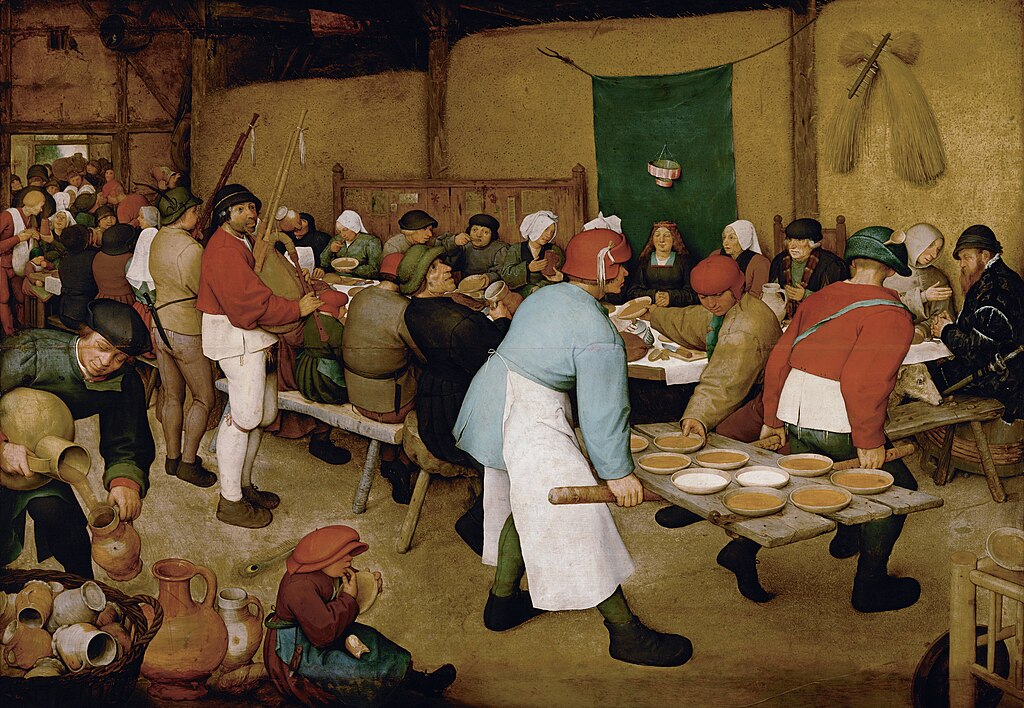
The Peasant Wedding, Peter Brueghel the Elder 1566-1569 (PD)

HOW’D I GET THIS PARABLE!?

I’ll tell you how!

My colleague played the shell game with the liturgical readings between this Sunday and last Sunday!

I’ll tell you EXACTLY how!

After attending a Synod wide conference with our Bishop, I met with some colleagues. 

While in that meeting, my phone started buzzing. 

I checked the messages which read something like this. 

*TEXT MESSAGE* “Hey, let’s switch the bulletins for GIFT Sunday and New Member Sunday”

“NO!” *TEXT REPLY*

*TEXT MESSAGE* “Yes, I have good reasons”

“NO!” *TEXT REPLY*

*TEXT MESSAGE* “Too late, its done”

*TEXT REPLY* CENSORED

This Gospel, just as many of the parables we’ve been dealing with these past few weeks, is often avoided because it is considered such an unpleasant portrayal of God and Jesus’ vision of God’s Kingdom. 

The fact is, that this isn’t really a story that Jesus just pulled out of his back pocket. 

It is a story that can be found in many Jewish teachings, teachings called the Talmud. 

Many of these stories are reflections on King Solomon and Israel under his reign. 

But Jesus applies these stories to God, God’s Kingdom, and how people, to include OURSELVES will be treated at such a banquet. 

And this is where the unpleasantness so often comes into play. 

We are really worried about what has two thumbs and doesn’t like what Jesus has to say, rather than what the parable is honestly pointing to. 

And how can we help but have such thoughts about this text with all the death and destruction, gnashing of teeth, outer darkness, and general abusive unpleasantries. 


But my friend was right, not just about GIFT Sunday but about New Members Sunday. 

This text is incredibly appropriate for this day, a day in which we receive new members into our midst. 

This is the moment when all our new members get pretty tense, their eyes start searching for the exits. 

That’s why we have ushers, folks, don’t even try it…

But before you start tensing up, waiting for the hazing to begin, let me point something out to you; 

This text isn’t intended to draw our attention to the punishment we hear in the parable, it is meant to draw our attention to the invitation of the King. 

It is meant to draw our attention to the OPPORTUNITY given by the King, a King whose invitation is consistently rejected. 

The slaves of the King aren’t sent out to some plain old road or even an intersection. 

All roads surrounding a kingdom or a city in the Ancient Near East funneled into one major thoroughfare which passed through that kingdom or city. 

In this parable, the King is sending the slaves to gather in anyone and everyone at the bottleneck where all travelers would be passing. 

Photo by Enrapture Media on Unsplash

And so, it is a collection of all kinds of people. 

Good people and bad people. 

Probably some who are faithful to this King. 

Perhaps some who are opposed to this King. 

Certainly some travelers who may not even know the King at all. 

Yet, they are all invited to enter into the feast. 

Just reading this story or having it read to us, something gets lost. 

Perhaps it is the fact that we are placing the King’s image onto God, holding God to our own standards rather than considering the immense sense of generosity involved in this parable. 

Within my own context, I can’t imagine such an invitation. 

When I take my kids to the bus stop, go for a run, or even a drive through my own neighborhood, I can’t help but cast a suspicious eye at anyone who doesn’t seem to belong there. 

As if anyone that I don’t recognize is a terrorist agent for Al Shabbabity Boop or Cobra Commander. 

That’s not just paranoia, sisters and brothers, that is a sense of mistrust that leads to complete inhospitality for one another. 

It keeps us locked in a state of silence and mistrust in grocery stores, traveling, even on the beach!

Preparing for this week I started reflecting on the number of times I’ve told my kids to leave other families alone on the beach this past summer, as if I am trying to discourage their own hospitality. 

Yet here in this parable, we find a King that opens up every opportunity to share the immensity of his wealth to all people, regardless of their worthiness. 

REGARDLESS OF THEIR WORTHINESS!

And yet, we still look to the punishment of this text as if that is its main theme. 

Even though we aren’t capable of THAT kind of hospitality. 

Even though we aren’t open to THAT kind of generosity. 

And if not because of our own greed, then at least because we are scared to make ourselves that vulnerable. 

After all, what kind of riff raff would that let in?

~

A man was entering into heaven, when he came to a large gate. 

Stopping at the gate, Peter came to meet him and proclaimed; 

“Welcome to Heaven! All I need you to do now, is spell the word love for me and you may enter!”

“Oh, that’s easy!” he said,

“L-O-V-E”.

"Great come on in!” replied Peter, who then asked,

“Could you watch the gate for me a moment? I need to go speak to Gabriel.”

“Sure!” responded the man.

“Great, just remember to ask anyone who comes to the gate to spell the word love and then let them in!” instructed Peter.

“Got it!” assured the man.

A few minutes later, the man’s wife came walking up to the gate.

“How’d you get here?” he asked

“I got in an accident leaving YOUR stinking funeral!” replied his wife.

“No worries,” assured the husband,

“You’re almost in, all you’ve gotta do is spell Czechoslovakia and I'll pop the gate right open!”

~

We don’t have the same standards as God when it comes to just about anything.

And when it comes to welcoming others, FULLY, into our lives, giving them access to all that is ours, truly taking them in as our own, we certainly don’t have the same standards as this King, much less God. 

But the point of the parable is not to extend the kind of invitation that God extends, it is to accept the kind of invitation God extends to us. 

Photo by Sweet Ice Cream Photography on Unsplash
Recognizing both the cost and the value of that invitation, and savoring it for the gift it truly is.

And here is where Pastor Nate uses the same old cliche’ he uses all the time…

At the font, at the table, in the forgiveness of our sins, in the Word. 

Blah blah blah, he used that last time. 

But that isn’t a line, I really mean it. 

THAT IS the oxen and fat calves, brought to this table for us. 

Yet it just doesn’t carry the same weight anymore. 

It doesn’t stand up to sports, sleeping in, having some alone time, or the late Saturday night that seemed to bleed into our Sunday morning. 

And I’m not sure when I became so out of touch with it all. 

I never saw when or where our faith became more about who we said we were, rather than showing up to receive the invitation extended to us. 

Showing up hungry for the feast, excited to extend our hands, hearts, and voices to the One who is responsible for all things bestowed upon us!

I don’t think that this is a recent development either, because Matthew speaks directly to this issue. 

Not only does Matthew’s telling of this parable begin with two extremes, it ends with two extremes. 

Those who are initially invited are a bit too busy, one managing a farm and one managing a business. 

They sound like pretty responsible folks, right? They get a pass don’t they?

Yet, they get lumped in with the rest of the group who commit an unequivocally evil act; MURDER!

Matthew takes a little of the edge off of this motif in the end when he plainly states that both the “good” and the “bad” are gathered into the banquet during the second round of invitations. 

But we can be assured by the language that these two groups of good and bad are about as distinguishable as the previous group that was lumped in together. 

And herein, Matthew clarifies this parable in a way Luke never attempts to, Matthew’s telling goes ahead and outlines the expectation. 

He does it with the part of the parable that no one likes, no one wants to hear, and we all seem to find personally offensive for one simple reason. 

The King seems like a petty snob!

~

Now every vocational call I have ever answered required a uniform, but only during the inspection of that uniforms care was it ever declared a possession of mine. 

If I ever failed to meet the standards or expectations of that uniform, I was warned that it represented something higher than me. 

I was warned that I needed to care for it because of what it represented, and if I failed to meet these expectations, it was a uniform that could be removed, because in all reality, it didn’t belong to me. 

My father and I in the first days of wearing one of many uniforms

It is why all Marine recruits dream of the day they can wear those coveted dress blues and all seminarians strive to don a stole upon their shoulders. 

But these uniforms do not really belong to the one that bears them on their back, because these uniforms represent something higher than the wearer. 

So does the wedding garment. 

This “friend” who becomes the center of attention for the King didn’t forget to pack his formal dinner wear and it isn’t because he can’t afford the right attire or doesn’t have a reasonable fashion sense. 

Just as those who were first invited to attend the banquet were unwilling to receive the King’s invitation, this guest is unwilling to wear the proper wedding garment. 

Some say that it was customary for the guests to be given wedding attire by the King, and in the Talmud, the King does in fact provide the garments to his guests. 

Regardless of the cultural or historical context, the language is clear; this guest has been less than willing to wear the expected garb BY CHOICE. 

Big deal! Right?

But this is a direct sign of outright disrespect to the King, it is the highest offense one can commit, because it only involves the simple act of willing participation. 

The community Matthew is seeing take shape is a smorgasbord of Gentiles, Jews, pagans, Zealots, and curious eyes on the fringes of the first century Christian community. 

Folks who have suggestions like, 

“This isn’t how we did it back when I went to Aphrodite’s temple!”

Or

“I liked the big tv screens and goat sacrifices at Zeus’s place!”

Matthew is painting a picture of radical hospitality and an open invitation to all, yet drawing the line that they are gathered together for the purpose of one thing alone; 

To worship the Lord God with a sense of reverence and authenticity for the identity they’ve received in the waters of their baptisms. 

~

I’ve said it time and again. 

All those who’ve visited and most of our new members who’ve spoken with me have heard me say it. 

I don’t work in sales, I work in customer service. 

I want people to worship God, and whether that is here or somewhere else, I DON”T CARE. 

Not because I don’t want to see us grow, not because I don’t think we have something here to offer. 

But because Matthew seems to say the same thing that the great theologian, Popeye, once said,

“I yam’s what I yam’s”.

And you are welcome to be part of who and what we are in this place because all are truly invited -and all means all-.

But make no mistake, we are here for the sole purpose of conformity, not to stand out or demand to be recognized individually but to conform to the One who first loved us, who willing died for us, and who wrapped that garment around our shoulders in the waters of our baptisms and will once again wrap us in that garment in our final breaths, 

Because that garment is the faith given to us through Jesus Christ that we are honored to wear daily, especially on this day. 

Amen 

Photo by Michael D Beckwith on Unsplash

Sources

Babylonian Talmud, Shabbath 153a

Sunday, October 1, 2017

Faith: Just DO it!

Matthew 21:23-32

Photo by Maja Petric on Unsplash

Last week, Pastor Stephen mentioned some pretty sound advice from his own parents. 

Advice that not only his parents shared, but so did mine. 

In fact, I continue to share it with my children; “LIFE IS NOT FAIR”

It’s not. 

My father gave me a variation of this advice throughout my life, and it stuck with me.

It sticks with me daily.

He asked me one day what the reward was for doing the right thing. 

“Not getting in trouble?” I responded.

“Nope, doing the right thing can still get you in trouble sometimes, so don’t count on that one!” he retorted.

“Being nice?” I asked.

“Doing the right thing doesn’t always mean it is the nice thing, sometimes people will like you less for doing the right thing, sometimes they’ll even hate ya for it,” he informed me.

Stumped, I just shrugged, to which my father responded,

“There is no guaranteed reward for doing the right thing, except knowing that you did the right thing”

So, why on earth would one want to do the RIGHT thing?!

When I asked my father that same question, he advised that knowing you’ve done the right thing -the thing that authentically expresses character, faith, conviction, principle, and courage- is itself a reward because no one can take that reward away when you face yourself in the mirror the next day. 

This week, I had to face this same question with my own children. 

At the bus stop, a child was being teased and humiliated. 

I wasn’t there but I got a full report from a few witnesses. 

As the first hurtful remark was hurled toward the child, my children pivoted on their heels. 

Performing a flawlessly executed about face, then they were like wolves surrounding a wounded deer. 

Like any wounded animal, the child who had made the comments turned their insults towards my own kids and the sibling of that little boy.

And so, the question as to whether or not their defense of that child was even worth their efforts was bound to arise. 

And it will come up again and again for the rest of their lives, because that is the question we all ask… daily; 

Is it really worth doing the thing that we are called to do, the “right thing”? 

Especially when it is at our own expense?
~

Matthew’s Gospel is a teaching gospel. 

Matthew emphasizes Jesus’ role as a teacher and a good teacher at that. 

Matthew also emphasizes Jesus as an authoritative teacher, and his authority is called into question in what we heard today. 

His authority is called into question following several disruptive actions. 

First, riding a colt and a donkey down the Mount of Olives, clear as day for the entire Temple, its leaders, and pilgrims to see. 

Assisi Frescoes entry into Jerusalem, Pietro lorenzetti 1320

Pilgrims had gathered from all around to be in Jerusalem at the Temple for the week leading up to Passover, so this causes quite a scene and an appalling one, considering the declaration being made by this action. 

But it is Jesus’ second action that may be the most disruptive, in fact, it is probably the second action that seals his fate on the cross. 

Jesus makes a B-line right into the temple, flipping tables, driving out vendors, and just causing general pandemonium. 

So, it’s a pretty audacious move for Jesus to head directly back to the temple -the scene of the crime- and hold court among his followers as a teacher among his students.

It’s a bold move, but if we take off our Christian lenses for just a moment; it is an offensive move!

Jesus has marched into town causing complete upheaval by the very manner he makes his entrance, leading the people to proclaim him as a king or some kind of messiah. 

And while many believe, I wonder how many came out in support as if this act was done in some satirical fashion. 

An act of mockery or defiance against the authorities of the temple or even Rome. 

Civil disobedience is not a new thing, nor was it something that was beneath the people of Palestine under Roman rule. 

But this isn’t an act of mockery, defiance, or some satirical jab at those in power. 

This is a legitimate declaration that the Christ event has begun.

An event that is not intended to just upset the given order for no reason, but an event intended to upset the very way we respond to the grace and love of God. 

So, when we hear the Chief Priests and the Elders question the authority of Jesus, of course we imagine them entering the scene like Darth Vader as the Imperial March from Star Wars drums on in the background.  

But who else is it that we find in this audience, this crowd gathered around Jesus?

Obviously, the crowd gathered is one that intimidates the Chief Priests and Elders. 

A crowd that seem to be pretty big fans of John the Baptist. 

A crowd that also seems to be pretty big fans of Jesus. 

At least, for right now. 

What gets me, is that we know exactly where the Chief Priests and the Elders are at in this passage. 

They’re no fans of Jesus, but the crowd on the other hand?

What an amazing cheering squad to have on your side!

Jesus has caused a complete state of disruption and disorder, he should be hauled away if he doesn’t have the common sense to flee Jerusalem!

But instead, he stands in plain sight of the authorities, indignant against their authority. 

And the authorities are too fearful to haul him away, because of the crowd that surrounds him. 

Here is where I find our gospel the most intriguing. 

Whose side will this crowd stand on in the next few days?

Who will they stand for?

Whose authority will they recognize?

Whose authority will they mock?

We all know where this story goes! +

But what changes among the crowd?

Perhaps there’s a reward for following this charismatic figure for that particular moment in time?

Perhaps it is the reward of following what everyone else is doing?

And is that truly an authentic sense of being a follower?

Is that a sense of “doing” for the right reason?

Or is the “doing” of following Jesus meant to be its own reward?
~

This past week got off to a pretty crazy start, that's for sure. 

I haven’t really followed football since taking the call here. 

I just haven’t had time. 

But you really couldn’t avoid hearing about football during this past week, unless you live under a rock somewhere. 

The debate has raged throughout the week regarding the actions of NFL players taking a knee or just not being present during the National Anthem. 

Photo by Ministries Coordinator on Unsplash

Debate has divided households and our country. 

I’ve seen some of the most enraged and angry rhetoric on display since our last presidential election. 

But something left me completely confused, baffled in fact, about all this rage and debate. 

And hear me out, because I’m not exaggerating and T’m not being facetious here. 

People have called into question the patriotism and even the right to call oneself an American citizen because football players have chosen to kneel and even forego being present during the national anthem. 

But on a Sunday morning, how many who call themselves Christians forego attending worship or kneeling before God in a house of worship ANYWHERE for just one measly hour out of the week?

Yet, I have not heard outrage or accusations of a lack of faith, at least not with the same fervor I have heard over these football players this past week. 

It’s as if we consider one action a necessary litmus test to prove a title, but another title, which should hold far more weight, is free of any kind of commitment, devotion, action, or -dare I say- discipleship?

It isn’t about the national anthem or the flag or stewardship or church attendance for that matter. 

I’m not implying that we drive around in a blacked out van throwing bags over the heads of people who only see the inside of this building at Christmas and Easter. 

I don’t think this text is implying this action either. 

What I do think we need to consider, in light of our Gospel today is how we define the word; 

Conviction.

Conviction is a legal term, any way you swing it. 

Convictions mean that there are inescapable truths that cannot be avoided. 

A conviction in court condemns the accused to a sentence based on the amount of evidence that has persuaded the jury. 

A personal conviction on the other hand, this is when we are presented with certain truths, 

Truths that are embraced so strongly that those truths become ingrained into our character, our very identity. 

And when this happens, personal convictions drive our very actions. 

Personal convictions are what makes our skin bubble up with goosebumps at the sound of that first “Oh say can you see…”

Or why tears begin to form in the corner of our eyelids as we reach out for that bread or that cup. 

Personal convictions are not expressed from our bed or couch on a Sunday morning, nor are they expressed by saying that our brother or sister's problem is not our own because, there just isn’t anything in it for me. 

Conviction is not about what we say, it is very much about what we DO. 

There it is, I said the D word!

DO!

The act of DOING doesn’t give us anything. 

It doesn’t assure us the promise of salvation and it doesn’t release us from our sin, but DOING is the response to our faith that we just can’t help because we are CONVICTED by that FAITH. 

And personal faith may not be a work that assures us paradise but it is our work to do. 

The faith that assures us paradise is the faith we receive in Christ, the faith that stems from that event is the faith that sanctifies and embraces the love we have for the One who first loved us. 

It's the action, the doing, that we just can't help but DO!

So, why do I keep saying DO?

Because that is what they teach us in seminary today, don’t say anything about DOING anything. 

Well, DO DO on that, because the Gospel has something else to say about what we DO today. 

~

In the parable Jesus shares, he limits the answers available to the Chief Priests and the Elders. 

After presenting a parable about two children, one who SAYS they are going to fulfill the task and one who DOES the task after claiming that he will not. 

The Pharisees Question Jesus, James Tissot 1886-1894

It may be one of the simplest parables Jesus presents.

It is only found in Matthews Gospel, and it is presented before a crowd that is far from being personally convicted to follow Jesus. 

So, when Jesus asks the question, he limits the parameters of the question to merely who DOES the will of the Father. 

It seems straightforward, we and the crowd gathered just can barely resist the urge to point at the Chief Priests and Elders as we shout triumphantly, 

“Ohh, you just got burned!!”

But the burn is not on the Chief Priests or the Elders, it is on the crowd whose personal convictions to both John and Jesus will fade away at the first whiff of mob rule. 

It's hard to stand against the masses and the louder they cry and scream, the harder it is to do the right thing, the faithful thing. 

Because when our response to faith is not part of our character, our principles, or our convictions, its no longer worth it, unless there is immediate gratification or a tangible reward. 

And that is the problem with faith, the reward has already been given but we seem to have lost sight of its value, not to mention its cost. 

~

In the film "La La Land", a throwback to the golden age of Hollywood musicals, one of the main characters named Sebastian spends the film sharing his love for jazz. 

He walks the streets of LA giving tours of old jazz clubs and locations where revered musicians frequented. 

At one point, he stops off at a club that was once called "The Vanbeek" where Count Basie and Chick Webb once played. 

When asked what happened to it, he proclaims that it is a “Samba/Tapas place now”

A place where Samba music is played and Tapas food is served, two completely opposite tastes. 

Responding to his friends confused reaction, Sebastian explains, “It’s typical of LA, they worship everything but they value nothing.”
~

When we gather in this place to worship, it is an expression of the value we find in that cross, in this Word, at that rail, in that font. 

We aren’t called to worship in the place with the best coffee, the best sermons, the best music, or the best programs. 

It isn’t that we don’t strive for those things or want to provide those things here, 

But we are gathered in this place to express our personal conviction, our value of the justification we receive by grace through faith in Jesus Christ. 

And it is meant to evoke a response, in here and out there. 

No matter whether there is a reward for doing the right thing, or if the masses will endorse or support our action. 

Because it’s not supposed to come from us, it is meant to come from that cross + that has been planted in our hearts. 

Amen

Image result for LUther's rose


Sources

Chazelle, Damien. (2016) La La Land. Santa Monica, CA: Summit Entertainment


Sunday, September 17, 2017

Taking out the trash

Matthew 18:21-35

File:16th-century unknown painters - Parable of the Unfaithful Servant - WGA23794.jpg
Parable of the Unfaithful Servant, Unknown Master, German 1560 (PD)
Packing has always been a complicated task for me. 

I have always embraced the mentality of preparing for the worst and hoping for the best. 

When I began backpacking as a teenager, I used to pack the most ridiculous things. 

Hauling pots and pans, radios, cans of food. 

It wasn’t unheard of that my pack would approach the 100 pound mark. 

Then, I became a more proficient packer. 

By the time I began college I had invested in light weight backpacking equipment; 

Tents with fiberglass poles, quick dry clothing that packed into tiny squares, down sleeping bags that could be stuffed into a water bottle, and freeze dried meals that magically burst into full flavored feasts with a mere drop of water!

So, when I began talking with a recruiter about enlisting in the Marine Corps as an infantry rifleman, my recruiter was sure to mention his own love for the outdoors. 

Sitting before me in the coveted dress blues, a uniform that could make Steve Buscemi look like Brad Pitt, he told me how the Marine Corps opened up a whole new world for him, in regards to his outdoor experiences. 

I couldn’t help but picture myself secluded in the middle of a pristine wilderness, preparing to stealthily maneuver behind an enemy objective unnoticed, following a quiet hike through a beautiful landscape. 

After bootcamp, I attended Camp Geiger’s Infantry Training Battalion where I got a real taste of this “outdoor experience”

Hiking along the paved roads of Jacksonville, North Carolina, with Marines reserved as “Road Guards” to keep the rest of us from being struck by the cars and trucks whizzing by that would have been a more logical approach to transportation than walking. 

Eating heavy and unattractive meals named things like “chunked and formed beef patty,” a mystery meat that haunts me to this very day. 

Laying out our sleeping bags in a platoon formation, and sleeping in a tightly packed pattern that was not only a far cry from what I had envisioned but it seemed like an incredibly unwise approach to protecting oneself from an organized attack. 

But what was the most unsettling was the weight of our gear. 

Old metal external frame packs which were bulky and some were even broken. 

Gear which had been used for nearly 4 generations!

I never really thought about this until I was drinking coffee out of a canteen cup one morning and after tipping it back and exposing the date on the bottom of the cup a dear friend exclaimed, 

“Oh, cool! Some doughboy probably used your canteen cup as a latrine in World War One!”

On average, from the time of the Greek hoplite to the Civil War Infantryman, the average weight carried was forty pounds. 

In World War One, that weight increased to about sixty pounds. *Probably due to my canteen cup that offered some welcome relief.*

By World War Two, the average load topped off around 80-100 pounds.

A few years ago, we found ourselves carrying anywhere between 150 - 200 pounds of gear. 

A weight that inhibited our mobility, sapped away our energy, and caused aches and injuries that are still felt today. 

Image may contain: one or more people, outdoor and nature
Backpacking in St Mary's Wilderness
When packing anything, especially when packing bags, boxes, or packages that we carry and transport by hand,

we try to limit the bulk and the weight of what is being carried. 

When we travel, we want to carry the luxuries of home with us, without the weight of those luxuries. 

You can buy just about anything in travel sizes today, yet it’s still difficult to whittle things down so they are just right. 

~

The Gospel for today is a parable describing the Kingdom of Heaven, a coveted destination that Jesus’ followers would like to enter into. 

Jesus is not describing things the way they are presently, or the way they have been, but he is giving a explicit packing list, sort of…

It’s actually more like a list of what we should NOT be packing. 

Peter seems to invite this parable when he once again injects himself in the middle of Jesus’ teaching. 

As always, Peter comes off as either a know-it-all or the guy that always puts his foot in his mouth to our 21st century ears, perhaps even to 1st century ears.

But regardless of his tone, Peter actually is quite generous in offering up the number 7 as a good number to forgive. 

Rabbinic teaching in that day offered three acts of forgiveness for one’s brother as the number to shoot for, so Peter is already overshooting traditional rabbinic teaching. 

And everyone gets wrapped around the numbers, 

Claiming that 7 is a sacred number in Judaism, and 7x70 can be traced to stories in Genesis, or that the number Jesus is asking is actually 77, or 490, or if you carry the square root and divide it by the age of the sinner but multiply it times the years of Jesus’ life…

Blah, blah, blah, blah. 

There is one thing for sure in this text, Jesus is asking us to forgive.

Jesus is asking us to forgive A LOT.

In fact, he is asking us to forgive in the same way we receive forgiveness. 

And forgiveness is not a uniquely Christian practice, sisters and brothers, it is a uniquely religious practice. 

It is hard to find a religion that does not claim forgiveness as a central tenet. 

Yet we live in a world full of people who refuse to forgive. 

And while I can only cite personal experience, I have failed to see a greater consistency in the number of Christian -or even generally religious individuals- who can forgive more often than those who consider themselves non-religious or just spiritual. 

It is a central tenet of all religions, and yet the religious don’t seem to stand out in any way, when it comes to forgiveness. 

Benevolence, yes. 

Following the past few hurricanes our generosity as a denomination and as a congregation has been on full display. 

As I have said in the past, the Lutheran Disaster Response and Lutheran World Relief have impeccable records when it comes to benevolence and generosity. 

Photo by July Brenda Gonzales Callapaza on Unsplash

So, we are willing to offer up our money and time but not our forgiveness, and one must wonder why and how this is? 

After all, can anyone truly dispute forgiveness as a call made to us by Christ? 

This word for forgiveness comes up in Matthew, Mark, and Luke in the same way, roughly the same amount of times. 

It’s hard to find a biblical or theological way to maneuver around this call, yet…

We don’t seem all that motivated to follow this teaching. 

What exactly is it that we don’t want to unpack? 

What is it that we don’t want to give up?

The sad reality is that when we fail to forgive, we actually aren’t giving up anything, we are taking on far more than we are giving up. 

Forgiveness isn’t the act of condoning a wrong that has been committed. It doesn’t excuse the actions taken by the culprit. It doesn’t even imply that we forget the action. 

Forgiveness also doesn’t grant a legal pardon from the actions taken, because someone who commits a wrong action can still be held accountable by the law in spite of the forgiveness granted. 

It doesn’t even restore the possibility of a relationship or reconciliation. 

It is merely the act of releasing our grasp on the offense made against us. 

Letting the offense go, and unpacking the need for vengeance that we carry around in our already overloaded lives. 
~

Today, one of the largest industries in our nation, a growing and booming business is the industry known as debt buying. 

With the cost of medical treatment, credit cards, mortgages, and student loans, the opportunity to live debt free is nearly impossible. 

Given the massive amount of debt, many creditors sell off their debt to debt buying companies that purchase household debt for mere pennies on the dollar. 

At times, purchasing 100 billion dollars of household debt for a mere 35 million dollars. 

These companies then take that debt and attempt to collect it. 

As you can imagine, some of these companies use any means necessary, threatening those whose debt they hold with legal rulings and foreclosures, oftentimes only accruing further debt among their debtors. 

A debt that many will only sink farther and farther into. 

And so many of these debt buying companies are only creating further debt, in an attempt to profit. 

With current deregulation, the practice has become more profitable and less ethical, even purchasing the debt of the deceased and pressuring surviving families to pay it. 

In reading about this practice, I couldn’t help but wish that the means of their collecting were frozen or revoked, 

So that these companies found themselves holding the debt they've purchased, buried beneath the very same thing as those they hope to profit from. 

After all, THEY bought it!
~

When we refuse to forgive sin, we become debt buying agencies, without any means to collect on those debts. 

Photo by Alice Pasqual on Unsplash

And that is the crushing weight that Jesus warns us about. 

Yet we seem to believe that our own debt to God is not all that weighty, nor are we ready to accept that those debts owed to us are all that minor. 

And if that is our mindset, then this parable, this teaching, and the forgiveness offered to us through Jesus Christ doesn’t really end up mattering all that much. 

Because the grace first offered to us is meant to evoke the response of a FRACTION of that grace in our own lives. 

JUST A FRACTION!

It doesn’t mean we forgive EVERY sin committed to us, it means we remember that every sin committed is committed to God first and foremost. 

It is therefore a debt owed first and foremost to God, IF we are willing to let go of it and not be crushed under its USELESS weight!

But this text is hard. 

This past week as I was going through the Greek and reading a variety of scholarly views on this text, I found one consistent word of advice,

DO NOT PREACH ON THIS TEXT!

Even pastors are scared of this text, because for some reason we find this image of an enraged Lord holding us accountable in the same way this servant is held accountable a horrifying prospect. 

We find that image of God terrifying, but the real question is why we are not enraged by the extortion portrayed in this text. 

The extortion we witness inflicted on one another.

The extortion that we ourselves inflict when we daily hold to the debts of others' sins against us. 

Because I will remind you that our most revered prayer contains the plea that God “Forgive our debts as we forgive those who are indebted to us”.

This text is clear, no matter how you spin it, so I cannot apologize for what I have said or what it says. 

This text is God’s Word and there is a tremendous word of grace in the law we are given. 

It is a parable about the Kingdom of Heaven and it has some pretty good advice about what to carry with you. 

If you want to carry the trash and filth of other’s debts, that is your choice.

But remember, those bags are filled with other people’s sins against us and at least we have the choice to let the bag go. 

At least we have the choice, He had no choice. 

Because

The only way we could ever fully recognize God’s love for us was on a cross planted in the middle of a landfill of our own sin. 


Amen

Photo by Celestine Ngulube on Unsplash


Sources

"Rubber Stamp Justice." Human Rights Watch. June 06, 2017. Accessed September 14, 2017. https://www.hrw.org/report/2016/01/20/rubber-stamp-justice/us-courts-debt-buying-corporations-and-poor.


"September 17, Ordinary 24A (Matthew 18:21–35)." The Christian Century. Accessed September 14, 2017. https://www.christiancentury.org/article/september-17-ordinary-24a-matthew-1821-35.


"The Overweight Infantryman." Modern War Institute. January 09, 2017. Accessed September 14, 2017. https://mwi.usma.edu/the-overweight-infantryman/.