Sunday, June 18, 2017

The Source of True Authority


Exodus 19:2-8a and Matthew 9:35-10:23
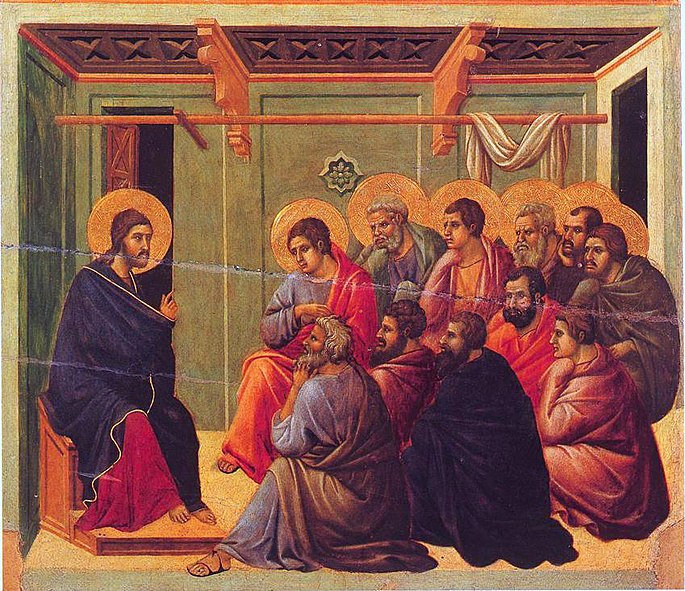
File:Christ Taking Leave of the Apostles.jpg
Duccio di Buoninsegna, Christ Taking Leave of the Apostles 1308-1311 (PD)


I’ve got bad news to share with you all today; Pastor Bob Humphrey was elected this past weekend at our Synod assembly. 

And Bob Humphrey is NO Jim Mauney!

Pending Bishop Mauney’s retirement in September, Bishop-Elect Bob Humphrey will take over the office of the Bishop of the Virginia Synod. 

This isn’t the first time congregations in our synod have received such bad news. 

In 1999, we came to discover that Bishop Mauney was NO Richard Bansemer. 

And in 1987 we were warned that Bishop Bansemer was NO Buck Moyer.

Even in 1976, everyone knew that Bishop Moyer was NO Luther Mauney. 

Yet in spite of this “bad news” our Synod seems to go on. 

Raising over 2 million dollars in a few short years, coming closer to our goal for the Forwarding Faith campaign, which will support faith formation programs for generations to come. 

Commemorating the 300th anniversary of the oldest Lutheran Church in the nation this past year, a congregation that is still a living, active worshipping community. 

And continuing to support national and international projects to combat hunger, provide shelter, educate, and share the good news with people far and wide!

But how is that possible that such things continue on as we have lost these leaders over time?

Now, hear me out because I love Bishop Mauney. 

So does my family, and Pastor Stephen, and his family. 

He has been a beloved Bishop. He has been a beloved man. 

But it is not because of Bishop Mauney or any of these other men mentioned that we go on in our mission. 

It is because of CHRIST!

~

In our first lesson today, 

God tells Moses what God envisions for this nation of slaves. 

They will become a nation of Priests!

Now, just think of what purpose a nation of priests would serve?

Would a nation of priests be called to serve themselves?!

Would a nation of warriors be called to their own nation?

No! That would be a police state!

A nation that is specifically given the collective vocation of ministry is the vocation of serving other nations, even the entire world!

Israel, a nation of priests, 12 tribes of priests. 

And how will this come to pass?

Moses is given some very specific instructions. 

He is to BE God’s voice, NOT God but God’s voice. 

He is not to speak his OWN words but God’s words. 

Moses’ call is to be nothing more than an amplifier, a sounding board FOR God. 
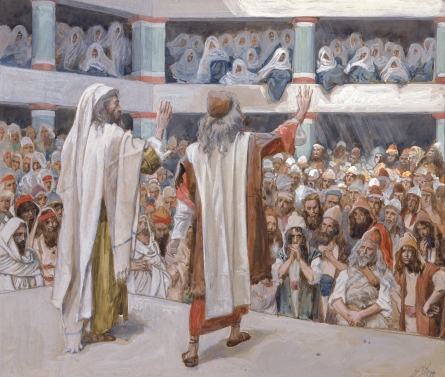
File:Tissot Moses and Aaron Speak to the People.jpg
James Tissot, Moses and Aaron Speak to the People 1896-1905 (PD)

And trust me, that is a terrifying task. 

Because the challenge to silence your own voice is far more challenging than the call to echo the voice of God, IF the word of God is put before you. 

But this is where the challenge lies. 

~

In 1952 a young pastor was just getting his start. 

He had a vision for himself. 

He believed he would create a new kind of church. 

A fully integrated church made up of many different races. 

He believed that an integrated church would serve as an example to the entire nation and put an end to segregation. 

And this vision forced him to leave many congregations. 

But he was faithful to his call, and he became a well-known civil rights leader in Indianapolis. 

Eventually, his congregation swelled to over 3,000 members!

And his church grew throughout Indiana, then throughout the country, then it expanded beyond the United States. 

Sounds amazing doesn’t it!!?

Can you imagine?

3,000 people?

If we just had a Bishop like THAT!

If we only had a pastor like THAT!

If this congregation just loved me or Pastor Stephen the way that congregation loved their pastor!

Wow, just imagine the things we could do!

We could move to Guyana and build our own town!

We could become financially autonomous and self reliant!

Maybe even form our own denomination!

We could call it… I dunno… Jonestown!

Pastor Jim Jones was a well intentioned and gifted pastor. 

But then one day his congregation loved him a bit too much. 

And he welcomed their praise a bit too much. 

Until one day, Jim Jones and his followers lost sight of who God really was. 

They lost sight of who God really was, because they came to believe that Jim Jones was God. 

On November 28, 1978 Jones ordered over 900 of his followers to drink cyanide laced kool-aid and his ministry became known for its final act in Jonestown rather than the great work they had done in Indiana. 

File:Cecil Williams and Jim Jones at anti-eviction rally at the I-Hotel, January 1977.jpg
Jim Jones at an anti-eviction rally in San Francisco in 1977,
Photo by Nancy Wong (14 Jan. 1977) Creative Commons photo

~

It is a real danger in ministry, 

The danger of “drinking the Kool-Aid.”

It was a danger for Moses and the Israelites too. 

In fact, it was probably the reason Moses didn’t enter into the promised land. 

And don’t be fooled by Joshua, he was NO Moses!

It’s a danger for the disciples too. 

In fact it is such a worry that Jesus instructs them to proclaim the good news of Christ above and beyond all other things. 

Even instructing them to silence their own lips and let God do the talking for them. 

Its a call to use the Word of God as the basis of everything they say when their testimony is proclaimed, 

When they are drug onto the witness stand. 

Which essentially is the purpose of the pulpit. 

The pulpit is considered one of the most valuable liturgical pieces of furniture in the Church. 

In the 18th century, many English speaking congregations had a triple tiered pulpit. 

The bottom level was reserved for announcements, the second level was reserved for the readings, and the third level was reserved for the Word; the Sermon. 

And there was a significant reason for this; 

It signified the authority of the one preaching. 

In fact, in Islam and Judaism, similar platforms are used to signify that the one speaking is speaking on behalf of God. 

That is the danger that draws Moses, the Israelites, and the disciples back to the Word. 

The Word is meant to remind them of whose voice they represent, the weight of that voice, the weight of that role, the weight of that authority, and the demand that their Words be precise, devout, and true.

Because to misrepresent God should be the most terrifying sin imaginable for the one who has spoken for God. 


But it is also a reminder to have confidence, trust, faith in that Word as the Word of God. 

To study that word with diligence and craft that Word in a precise way, free of error and heresy. 

No matter how grand or gifted the one speaking may be, because after all 12 disciples are certainly NO 12 tribes of Israel, 

And Moses is definitely not God. 

But Jesus IS God’s Word, THE WORD made flesh that dwells here among us. 

And while I may be no Moses, Peter, James, John, Simon, Thomas, I also know they weren’t God but they strived to craft their words to reflect God. 

Putting the Word at the center of what they did. 

Checking into this witness stand to give God their voice. 

So, the pulpit serves as a reminder of whose voice is being heard, both for the listener and especially the speaker. 

It serves as a reminder of the authority of that voice but also a reminder to the speaker of the consequences of misusing such an authority. 

~

As a boy, I used to try to catch Star Trek right around dinner time. 

It didn’t happen on every episode, but I always loved when Captain Kirk would leave the bridge of the Enterprise. 

Not because of the mission he was about to engage in or the adventure that would ensue, but because I loved laughing at Mr. Sulu’s face when Captain Kirk would proclaim; 

“Mr. Sulu, you have the con!”


Every time I saw Mr. Sulu’s face, it appeared he needed to change his underwear, as he took control of the bridge of the Enterprise, in turn taking control of the entire starship.


Sisters and brothers, this pulpit is the con and if my face doesn’t look like Mr. Sulu’s when I step into it, it should. 

Because it is a reminder that I am NO God, nor am I Jesus Christ. 

It is also a reminder that God’s Word, THE Christ is at the center of what occurs from this witness stand. 

And it is why the election of Bob Humphrey as our Bishop is just as good of news as the day Bishop Mauney was elected, 

And Bishop Bansemer before him, 

And Bishop Moyer before him, 

Because at the center of what they are called to be as Bishop is the Word, and that Word will always surpass our own if we remember its place at the center of all we do.

Amen. 

Icon Portraying the First Council at Nicaea, Author and Date Unknown (PD)

Sources

Knoll, James. Mass Suicide & the Jonestown Tragedy: Literature Summary. Jonestown Institute, San Diego State University. October 2007.

Rodenberry, G., & Freitberger, F. (Writers), & Coon, G. L., & Lucas, J. M. (Producers). 1966-1969. Star Trek [Television series]. New York, New York: NBC.



Sunday, May 28, 2017

Leaving Our Safe Spaces


Acts 1:6-14

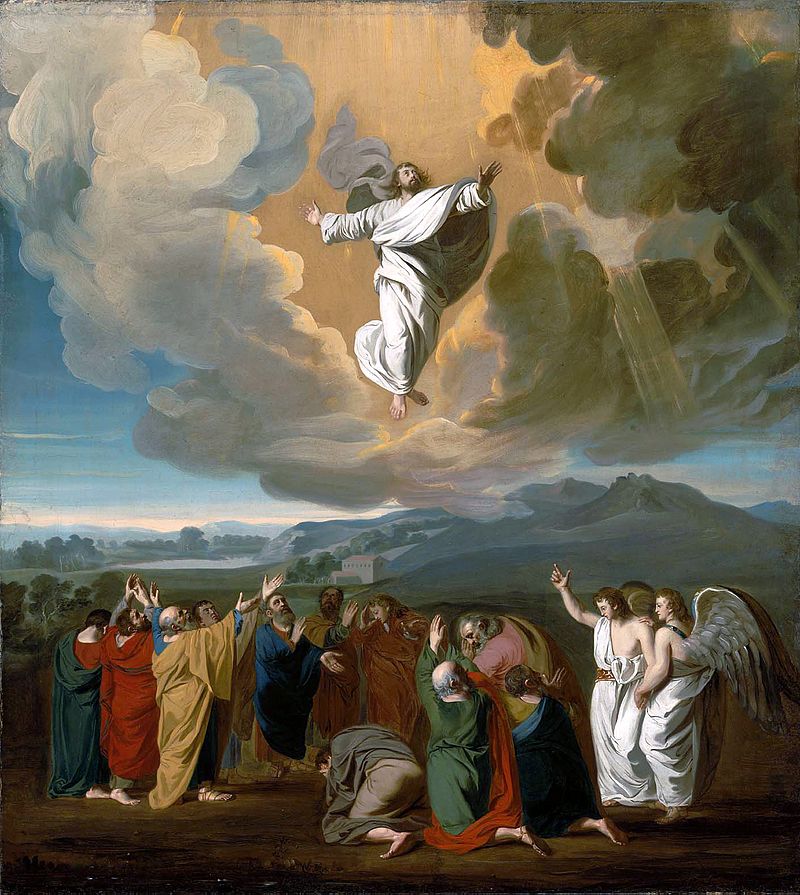
John Singleton Copley, Ascension 1775 (PD)
This is the season of graduations, commencement ceremonies, and the famed commencement address!

These days, colleges and universities seem to try and outdo one another by getting the most famous celebrities or figureheads to give a commencement address to their graduating students. 

Large amounts of money are spent to attract these figures to give speeches that motivate, encourage, or just generally entertain those in attendance. 

It is also customary to offer the individual giving the commencement address an honorary Doctorate, as opposed to a research or professional Doctorate that is given to those who work tirelessly to receive the title of “Doctor.”

In 2016, Time magazine listed the top 10 graduation speeches of all time. 

The list included the likes of Steve Jobs, Conan O’Brien, Winston Churchill, and JFK just to name a few. 

And the speeches contained all sorts of nuggets of advice to the college or university’s graduates. 

Nuggets like; 

“Sometimes life hits you in the head with a brick”

and 

“Your biggest liability is the need to always find yourself on the sweet side of the bell curve”

or my favorite

“eventually some very nice people will give you a doctorate in fine arts for doing jack squat”

In the midst of all these insightful tidbits, Jesus’ address to his disciples in our First Lesson from Acts doesn’t really make the cut. 

Earlier this year, as we began to study the Sermon on the Mount, I claimed that Jesus had the best inauguration address ever. 

I stand by that claim, but in the same breath, I have to say, this may be the worst commencement address ever, at least based on our standards today. 

Given the time of year, both in the fact that it is graduation season and it is our last Sunday of Easter, I started reflecting on this particular telling of the Ascension of our Lord. 

It really is a graduation of sorts. 

Graduation, Picture courtesy of Unsplash taken by Faustin Tuyambaze
The Ascension of Jesus was added to Mark’s Gospel at a much later date, and the only other account of the Ascension found, outside of the book of Acts, is found in Luke which is written by the same author. 

Luke’s telling is much shorter and the shortened account portrays the disciples so much more confidently. 

It strikes me as a far clumsier telling then the slack jawed disciples staring up into the heavens muttering in shock as we find them in Acts. 

After all, I think that would have been my reaction. 

But the greater problem for me, is in the response of the disciples in Luke’s account of this episode. 

They just go bouncing back into Jerusalem, whistling and skipping as if all is right with the world. 

No shock at what they have just witnessed, 

No fear of the community in Jerusalem, which still hasn’t gotten over the scene caused by Jesus or his followers. 

No grief over the departure of their friend and teacher.

But the greater concern for me in this telling, is their complete lack of hesitation to respond to the mission that they are being called to. 

Its as if all doubt, questioning, or skepticism has just been thrown to the wind carelessly. 

And given all they had seen during Jesus’ ministry, his crucifixion, and his resurrection, I find that to be a pretty hard pill to swallow. 

But the account in our first lesson, the account from Acts, portraying the disciples frozen in shock, gawking into the sky. 

That is the deeper story that I believe the author of Luke and Acts really wanted to capture in this moment. 

Because, in spite of the parties, the gifts, the speeches, and the honors bestowed at graduations, graduations leave most of us feeling a little like a deer in headlights. 

A graduation from anything implies one thing alone; you’ve received the tools necessary for the next step. 

And oftentimes that next step is a doozy. 

Sometimes that next step lands you in the basement of your mom’s duplex playing Xbox and eating cheetohs all night while wondering why employers haven’t come knocking on your door longing for your rare skillset of eastern herbology with a minor in puppetry. 

But regardless of the tools gained under the careful discipleship of another -in anything- there comes a time when one must strike out on their own. 

And kinda like the graduate that just wants to remain in the basement of their parent’s duplex, Jesus’ disciples are still looking inward. 

Inward toward the restoration of their OWN house, Israel. 

Inward for a personal assurance that Jesus is going to continue to line up their interview and put in a good word for them with the Father, the big Boss, with a capital B!

The downside is that they’ve landed the job before they even knew what they were interviewing for, 

And be careful what you wish for, because sometimes the perfect gig isn’t such a hot deal once you punch the clock on Monday morning. 

For the disciples, the perks of this gig may not be everything they dreamed of. 

But this isn’t just a gig that these disciples are called to, it is a gig we are all called to. 

Next week is Pentecost and our confirmands will affirm their baptisms before the congregation, professing their faith for themselves. 

Herrad of Landsberg, Hortus Deliciarum 1180 (PD)
And over the past year with them, I have continuously emphasized that this is not a graduation from church. 

I’m not the only pastor to make such a claim, it is a claim made by many pastors. 

But as I look at our first lesson today, I have to reconsider that claim. 

Because confirmation IS a graduation of sorts, and don’t think I haven’t anticipated that twinkle in your eyes if you are being confirmed next week!

That doesn’t mean you STOP coming to church!

It means you are charged to take church out into the world with you, this isn’t a graduation FROM some thing, it is a graduation INTO the same mission as that of the disciples!

And that is a call and a mission that we all need to be reminded of, not just our confirmands. 

Jesus’ call and charge to his disciples lands on the 40th day of Easter, creating a significant pause in the final 10 days of Easter between the Ascension and Pentecost. 

A chance to brace oneself for the mission ahead, because when the Holy Spirit arrives all excuses are off. 

Following the disciples questioning about the restoration of their own house, the restoration of Israel

The commencement address Jesus has given is short, sweet, and not very inspirational; 

Jesus basically tells the disciples that the fate of Israel is none of their business, nor are the intentions of God for the rest of the world. 

Instead, Jesus offers a consolation prize; “You will receive a power, a power unlike any power you’ve ever seen, a power that comes from the Holy Spirit”

Then Jesus tells them that when that power arrives, its time to leave the basement, its time to pack up the Xbox and the George Foreman and get to work. 

Taking the mission way beyond the safe spaces they found comfort in, far beyond the persecution they could once deflect onto Jesus. 

The mission now falls on them, on their shoulders, out in the world. 

And this isn’t just a mission given to them, but to us all. 
~

In JRR Tolkein’s Lord of the Rings he shares the story of Frodo Baggins who is a small fantasy creature called a Hobbit. 

The story follows Frodo on his journey to destroy a ring that symbolizes power and humanity’s lust for that power. 

Frodo is tasked with destroying the ring in order to save all living things and to save humanity from itself. 

Tolkein obviously was offering a different slant on the Gospels. 

At the conclusion of these books, following many battles and the destruction of the ring, Frodo and the three other Hobbits who accompanied him on his journey take one final journey to meet a ship that will take Frodo to a place called “the Havens.”

Frodo’s companion throughout the book, Sam, is grief stricken when he discovers that his friend, Frodo, is going off to this far off heaven-like place without him. 

“Where are you going, Master?” cries Sam

“To the Havens, Sam” responds Frodo

Sam continues sharing his expectation that Frodo would remain in their village, their Shire, with him, being the only person who knows Sam the way Frodo does, 

the only one who can ever truly know him after all they went through together but Frodo explains; 

“I thought too, once -that I could remain in the Shire with you-. but I have been too deeply hurt, Sam. I tried to save the Shire, and it has been saved, but not for me. It must often be so, Sam, when things are in danger some one has to give them up, lose them, so that others may keep them. But you are my heir: all that I had and might have had I leave to you. Your hands and your wits will be needed everywhere. You will keep alive the memory of the age that is gone, so that people will remember the Great Danger and so love their beloved land all the more. And that will keep you as busy and as happy as anyone can be, as long as your part of the Story goes on.”

When the vessel departs with Frodo aboard, Tolkein’s story comes to a close, as Frodo’s three companions stand together on the shore, watching the empty sea in silence as the ship that has long since departed is no longer in sight.

Until “At last the three companions turned away, and never again looking back they rode slowly homewards; and they spoke no word to one another until they came back to the Shire, but each had great comfort in his friends on the long grey road.”

Tolkein denied the personal nature of this story, all the way to his grave. 

But Tolkein spent most of his life watching those who knew him best leave this life. 

As a young British Officer in the trenches of World War One, he watched as those who knew him best and had shared his journey, left him alone in life. 

And he could have just stood beside their graves, on the shore gazing across the sea, or staring into the heavens. 

But much like the disciples, like Sam, like us all, he was called to share a story that collected others into a mission we share. 

A mission that is not focused on our place in heaven, looking for some divine reward. 

But a mission that calls others to hear the good news and the promise that God continues to reveal through the church. 

A Church not intended to stand stagnant and look inwardly towards itself, 
Picture courtesty of Unsplash taken by Stefan Kunze
but a Church that is called to reach out to all people. 

A Church called to reach out to Samaritans and Judeans alike, two cultures of people that would sooner kill one another than share a crust of bread. 

A Church that would reach out to a people who were the very definition of unclean, the Gentiles. 

A Church that would reach out to the very empire who nailed Christ to that cross in the first place. 

A Church that reaches well beyond it’s safe spaces
~

An Op-Ed writer for the New York Times, Bret Stephens, was asked to give the commencement address at Hamden-Sydney College a few weeks ago. 

Stephens focused his speech on the rise of “safe spaces” on college campuses and he described them as; 

“a place, usually on a campus, where like minded people - often sharing the same race, gender, sexual orientation, or political outlook- can spend time together without having to encounter the expression of any ideas or opinions that they do not endorse.”

He went on to point out how we all retreat to our safe spaces, conservatives by watching Fox News and liberals by watching MSNBC, some by only subscribing to periodicals and columns that endorse our views, and oftentimes even surrounding ourselves with social media that is a digitally structured “safe space.”

The speech closed by proclaiming passionately that “Safe spaces, physical and intellectual, are for children. You are grown-ups now. If your diplomas mean anything, it’s that it is time you leave those safe spaces behind forever.”

Sisters and brothers, this is the final Sunday of Easter. 

Next week is Pentecost and that is the time when the church is given a power like no other, 

it is a call to stop crying out in celebration that HE IS RISEN, 

it is a call to go out into a world, well beyond our own safe spaces and proclaim the good news to all people, people that may not even think they need to hear it. 

And not with our eyes fixed on the sky for some heavenly reward, but because it was the gift first given to us and it is therefore, certainly a treasure that we are called to share. 

Amen. 


Picture courtesy of Unsplash, taken by Mike Wilson


Sources

Stephens, Bret. "Leave Your Safe Spaces: The 2017 Commencement Address at Hampden-Sydney College." The New York Times. May 15, 2017. Accessed May 25, 2017. https://www.nytimes.com/2017/05/15/opinion/leave-your-safe-spaces-the-2017-commencement-address-at-hampden-sydney-college.html?ref=opinion&_r=0.

Tolkien, J. R. R. The lord of the rings. Boston: Houghton Mifflin, 2005.


"Top 10 Commencement Speeches." Time. Accessed May 25, 2017. http://content.time.com/time/specials/packages/completelist/0,29569,1898670,00.html.

Sunday, May 14, 2017

We Don't Promise a Rose Garden

Acts 7:55-60
The Martyrdom of Stephen

File:Rembrandt-Lapidation-Saint-Étienne-MBA-Lyon.jpg
Rembrandt, The Lapidation of Saint Stephen 1625 (PD)

When the military draft ended in 1972, every branch of the United States Military had to reconsider their approach to recruitment and retention. 

Following the war in Vietnam, not to mention Korea, few saw military service as a viable career option. 

Even prior to the end of the draft, as each branch of the service was instructed to draw down the number of personnel, an extremely steep decline caused concern about the safety and defense of our nation. 

Anticipating a deeper decline, given the reputation of the Marine Corps rigid culture and hard lifestyle,

the Marines launched a new recruiting strategy in 1970, beginning with a commercial that featured a young corporal “storming the beach” as he drops onto a beach blanket next to a beautiful young woman.

As that scene closes out, the narrator proclaims that “some Marines even get to drive tanks” as the same young corporal sits down into mustard colored Corvette. You know the beautiful 70’s snot/grey poupon shade?

But statistics regarding recruitment and retention were staggering. 

Regardless of troop drawdowns, recruitment was in a tailspin for all branches of the military and with government cutbacks, the Marine Corps was looking at a crisis. 

The incentives introduced in their 1970’s Corvette commercial offering beautiful women and fancy cars not only didn’t boost recruitment, but it dropped their projections even further.

Being the smallest branch of the military they couldn’t match the incentives being offered by the Army, Navy, or Air Force. 

And holding the reputation as one of the less “accommodating" or enjoyable branches of the service to join, there wasn’t an awful lot to attract the numbers they needed to sustain their recruitment objectives. 

It appeared the crisis couldn’t be avoided by using the conventional means of recruitment, and it seemed there was no way out. 

~

Our first lesson for today comes from Acts 7, and it is the story of Stephen. 

Stephen who is known better as one of the first leaders of this early religious movement known as the Church. 

File:Jean Fouquet - Etienne Chevalier with St. Stephen - Google Art Project.jpg
Jean Fouquet, Étienne Chevalier and Saint Stephen 1420-1480 (PD)
 A movement also struggling with its retention and recruitment, not only because of how new it is but because this leader also becomes its first “martyr.” 

Today, a martyr is known better as an individual who dies for their religious or other beliefs. 

That would seem like a fairly broad definition, and being such a broad definition it could open the door to fanaticism, generalizations, and abuse. 

In fact, it is probably a title we have come to associate less with Christianity and more with acts of terror.

And while I am not suggesting that Christians should be able to corner the market on the term martyr, I think we would have a healthier understanding of the term if we defined it the way it was defined for Stephen and in the story we heard today. 

The death of Stephen and the events that occurred in the midst of his stoning are the focus of the first lesson today, but we didn’t get to hear how these events came to pass in the preceding 53 verses of this 7th chapter of Acts. 

An event that solidifies his title of martyr far more than his demise. 

Stephen is arrested and brought before a religious tribunal, a court that has set out to squash this religious movement and has made no secret about it. 

Stephen knows the odds are against him, he also should have known it would be much wiser to go with the safe answers when asked about the authority of the religious elites and the role of the Temple. 

But Stephen uses the story of Israel, all the way back from Abraham, to Joseph, to Moses and on to explain how the God of Israel is meant to be the God of the world. 

It is not a testimony that is unique to Stephen. 

In fact he cites Micah and Jeremiah and Isaiah who also share a prophecy of the God whose intention is to be in relationship with ALL people. 

But the Temple had come to serve as a jar, something that could bottle up God and release the Divine in small doses to those who made sacrifices, obeyed the religious elites, and affirmed the authority of men rather than God. 

Micah, Jeremiah, Isaiah, and Stephen are not opposed to the Temple, but they are opposed to the notion that human beings have authority or control over God. 

These prophets recognize that God is not meant to be controlled, because God desires to be known, loved, and have a relationship with ALL people. 

But the role  that the religious elite who are opposing Stephen have taken on,  is to dictate just who is worthy of the Divine and to protect God as if God is their own possession. 

It isn’t a means of protecting God, it is a means of protecting themselves and their authority. 

But Stephen isn’t interested in undermining them, he is interested in protecting them.

Because God is not meant to be bottled up, and if any human authority should try such a thing it would be to their own detriment. 

Ever hear of the saying “A bull in a china shop?”

Well, lets just say God can be a fairly sizable bull, just ask Jonah, ask Job. 

So, Stephen’s testimony serves to protect this tribunal judging him as much if not more than the protection of the early Church. 

And this is the true nature of a martyr, a word that originally stood for one who bears witness to the truth, oftentimes a truth that is meant to benefit the one hearing it. 

So, Stephen is not defending himself in this court, nor is he defending the Church that he is leading. 

He is bearing witness to the very prosecution standing against him. 

The prosecution condemning him. 

The prosecution that is about to stone him to death. 

File:St. Stephen before th... - Google Art Project.jpg
Mariotto di Nardo,
Saint Stephen Before the High Priest and the Elders of the Sanhedrin 1408 (PD)
And in his dying breaths he will not call for them to be cursed for their actions, but forgiven!?

Certainly a hard frame of mind for us to reconcile today, is it not?

Not only our unfamiliarity with this notion of martyr, but our unfamiliarity with Stephen’s notion of forgiveness, his notion of mercy!

What could drive such an illogical response to one’s own persecution?!

~

A little over a week ago an executive order was passed concerning what has been dubbed the Religious Liberty Order. 

This order was developed in response to what many considered to be the targeting of Christian communities, even the bullying and silencing of them over the past eight years.

This order was deemed to be “a measure that would give our churches their voices back.”

It will supposedly free clergy and religious leaders to endorse candidates and sway parishioners views, regarding partisan issues. 

But, as many of you have heard me say from this pulpit, in newsletter articles, in classes, in private, and quite publicly; 

That is not my job. 

My call as an ordained minister in the Church of Christ is to preach and teach the Word of God and the doctrines of the Church. 

And Sisters and Brothers if I ever exhaust the doctrines and teachings of the Church in my proclamation of God’s Word, I will reconsider presenting my political views to you from this pulpit, but I don’t see that happening in the years I have left in this life. 

What is more, I not only believe I do not have the authority to dictate to you how you should vote, but Article 28 of the Augsburg Confession outlines specifically where the line of my authority is drawn, and the realm of civil authority is clearly behind that line. 

But what troubles me most about this whole thing, is that in the most powerful and wealthiest nation in the world, where Christianity is claimed as the predominant religion by 70.6% of the population; does our Christian persecution really look anything like Stephens'?

And just where is this 70.6% that is supposedly fighting the persecution of Christians on a Sunday morning? 

Are they waging this struggle alone in the comfort of a recliner in their living room every Sunday morning?

A friend of mine who is a Doctor and a Muslim came to me one day to inform me that he had a Christian medical student from the Middle East who needed help. 

The student’s visa was about to run out when he graduated as a doctor, and he was terrified to return home with his family where Christians were being truly persecuted. 

My friend wanted to know where this young man could go in the Christian community to get support. 

Not because the Muslim community was unwilling to provide him with support, but because he had been turned away by so many in the Christian community since he didn’t look quite Christian to them. 

What does our own persecution even look like when we are the persecutors of our very own Christian brothers and sisters?

What is more concerning still is what that kind of witness looks like to a world that needs a Church that will be martyrs of the Truth of Christ, witnesses of the Truth of Christ. 

But, it isn't always easy, and I don’t want to make it out to be after all, look where it landed Stephen. 

~

I would argue that Stephen’s witness to Christ is unparalleled anywhere in scripture. 

File:Vittore carpaccio, Sermon of St Stephen.jpg
Vittore Carpaccio, The Sermon of St Stephen 1514 (PD)
Although the tone of the lesson seems dulled, blunted by time and language. 

The reading for today closes out with a description of a barrage of stones. 

Alluding to a prolonged stoning, a far less preferable method of execution. 

Most often the condemned were meant to be executed by the first several stones, which were larger than we usually imagine. 

But if the condemned would not fall, the entire community would take part in this public spectacle and the longer it took, the more people would come out to take part. 

And so, a barrage of stones not only implies a painful and prolonged death, but truly a lonely persecution by a large crowd that is only growing larger as they gather against Stephen. 

Yet, as this crowd grows in number and in rage, Stephen’s voice rings out with the final breath he will ever take, offering the final petition to God that he will ever make; 

“Lord, do not hold this sin against them!”

A final petition made on the behalf of his own persecutors, his own executioners. 

And I can only imagine that for Stephen, looking out on this crowd, it must have seemed that the whole world had truly gathered together against him. 

For us today, listening to this story, appalled by what transpired, horrified by the barbarity of the scene, it is hard to imagine this incident as anything but a defeat. 

A witness that falls on only deaf ears.

And yet on the edge of the crowd stands Saul, trusted by this crowd to guard their most valuable possessions and soon trusted enough to continue the persecution of the Church that Stephen is proclaiming. 

A young man who will soon take on the name Paul, taking on the witness of both Stephen and Christ as he carries the Gospel far beyond the walls of Jerusalem, to the ears of people not meant to know such a God as the God of Israel. 

Paul, the martyr who brings this message to those considered unworthy, people like you and me, after encountering Christ for the first time at the stoning of Stephen rather than on the road to Damascus. 

If we are not daring enough to be martyrs, witnesses, to the Gospel of Christ in the face of persecution, then the world may only ever hear silence. 

And if we demand protection in order to bear such a witness, then how much do we truly believe in the witness made to us. 

~

In 1973, after re-evaluating their recruiting ads, the United States Marine Corps went out on a limb. 

They found a photograph of a Drill Instructor named Sergeant Taliano, glaring up into the face of a young terrified Marine Recruit. 

File:USMC-10529.jpg
Chuck Taliano with a copy of the now famous poster
U.S. Military Stock Photo, 14 February 2006 (PD)
They released a new series of ads. 

No Corvettes or super models this time, just gritty pictures of the unpleasantries of boot camp. 

They led the campaign with the image of Sergeant Taliano, staring into the chin of this young kid as if he was about to tear his head off. 

Underneath the picture were the words “We don’t promise you a rose garden.”

The TV spot even included Lynn Anderson’s country hit "Rose Garden", and as she sang, still framed pictures of miserable young men started to scroll across the screen. 

Retention and recruitment froze, then they experienced a bump until the Marine Corps numbers plateaued out. 

The Marine Corps has rarely had recruiting shortfalls since that campaign. 

They found people believed that if there was something truly worth believing in, truly worth being part of, it would not be easy.

In fact it may even be unpleasant at times. 

It’s what landed me on Parris Island as a Marine Recruit decades later!

~

Today, there are a lot of people demanding that the Church be protected. 

Some are even calling for the Church to call the shots, dictating who should be in power and how things should be run. 

I have to admit that I myself would love for our politicians to hold onto any kind of religious or ethical system to guide them, heck, even a fortune cookie would be okay!

But if Stephen could believe in the Church in its infancy as stones rained down on him, how can I not stand by a Church that has been built on the cross of Christ and stood tall for over 2,000 years, oftentimes without protection of any kind!

We see in the promise of the Gospel that the Church will continue on, no matter what challenges stand in our way, but we should be careful what authority we claim. 

After all, it was not only the religious authorities that directed the civil execution of Stephen, but it was the religious authorities that directed the government-led persecution of another man,

and that case landed God squarely on the cross. 

Amen


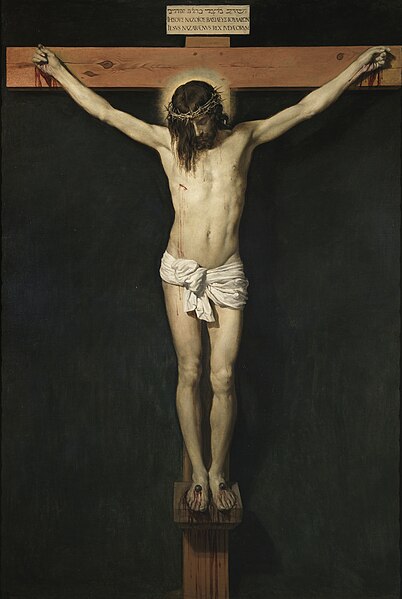
File:Cristo crucificado.jpg
Diego Velázquez, Christ Crucified 1632 (PD)
Sources

Boyer, Dave. "Trump Gives Churches ‘their Voices Back’ with Approval to Take Part in Partisan Politics." The Washington Times. The Washington Times, 04 May 2017. Web. 10 May 2017.

Coleman, David. "U.S. Military Personnel 1954-2014: The Numbers." Research. History in Pieces, 30 July 2014. Web. 10 May 2017.


Wormald, Benjamin. "Religious Landscape Study." Pew Research Center's Religion & Public Life Project. Pew Forum, 11 May 2015. Web. 10 May 2017.