Sunday, April 30, 2017

Going the Distance


Luke 24:13-35

Robert Zünd, Gang nach Emmaus 1877 (PD)

He IS Risen!!

—————-

Well, I suppose that was how Cleopas and the unknown disciple felt as they were walking toward Emmaus as well. 

Who can blame 'em?

Things must’ve seemed a bit off after hearing the resurrection story from the women who had returned from the tomb that same morning.

And seven miles may not be that far in a car but for most of us today, seven miles is a pretty far distance on foot. 

Perhaps not as bad for a first century Palestinian, but if we consider what they’ve just been through, it could have been a pretty tough jaunt for them as well. 

There have been circumstances where I have found just a few short miles have been more than I thought I could bear. 

I used to run marathons, back before I went to seminary, and it's an interesting event to take part in. 

It's an even more interesting event to prepare for, because it involves as much dietary strategy as athletic strategy.

Marathoners claim that once you have completed the first 20 miles of the 26.2 mile event, you have reached the halfway mark.  

This is due to the fact that the average runner can carry enough glucose -a simple sugar that circulates through the blood as fuel- to keep them going for 13 miles. 

The above average runner can store enough glucose to carry them up to about twenty miles, but it is nearly impossible to store enough glucose in the human body for anything farther than twenty miles. 

This is why few marathon training plans call for runs over twenty miles. 

It is why the legend surrounding the first marathoner ends in his collapse and death in 490 BC after running from Marathon to Athens to announce the Greek victory in battle over the Persians. 

Luc-Olivier Merson, Le soldat de Marathon 1869 (PD)
The human body is not meant to endure a running event of that kind of distance. 

So once one runs for twenty miles, the human body begins to deteriorate and breakdown. 

Seems fairly obvious why marathoners claim twenty miles is the halfway mark for a 26.2 mile event.

Simply put, the tank is too small and there is only so much fuel you can put back in the tank for those last few miles. 

So, seven miles may not seem too far for some, but I guess perspective is everything. 

~

Cleopas and this unnamed disciple don’t seem to have much left in their tank. 

In fact, the old adage of “If you were going any slower you’d be going backwards” could certainly be applied here. 

In Matthew’s Gospel, the disciples are told to meet the resurrected Christ in Galilee but in Luke’s Gospel, this is the first appearance of the resurrected Jesus. 

No one has been given instructions yet. In fact everyone seems to be fairly certain that the jig is up. 

The women’s proclamation of “He IS risen” has yet to receive an enthusiastic response, kind of like ours today. 

He IS risen seems to be met with far more enthusiasm on Easter morning, which is ironic because it is now, during the Easter Season that Jesus continues to be revealed to us

And to Cleopas and the unnamed disciple as well, but much like these two travelers we aren’t always all that certain about this whole resurrection thing. 

What’s more, even if we do believe it, the enthusiasm wears out after that long twenty miles of Lent, not to mention the exhaustion of Easter morning. 

Next stop is Pentecost, Memorial Day, then; the goal -

Our own Emmaus, Summertime!

After Lent and preparing for Easter, we seem to be ready to put it all behind us. 

Make a little distance between ourselves and Lent, Holy Week, and yes, even Easter. 

Not much different for our two participants in our Gospel's little “marathon”. 

They aren’t just “going” to Emmaus. They are creating distance between themselves and Jerusalem. 

After all, there isn’t much left for them there. 

They’re not members of Jesus’ immediate circle, the eleven disciples. 

And even as fringe members of this group, they state quite clearly in the Gospel for today that they believe they have either bet on the wrong messiah or something has gone awry with God’s plan. 

Because, for them, their messiah was meant to bring about the liberation of Israel. 

A nationalistic vision limited to the people of Israel, not the world. 

A vision of liberation from Rome, rather than a liberation from our broken relationship with God. 

So, as they trot along on an empty tank, they are reflecting back on where, how, why, and who they’ve exhausted all their energy on. 

Then, they are caught from behind by another participant in this distance event. 

Jesus himself seems about ready to lap them, although they don’t recognize him there is some obvious irritation. 

He seems fairly clueless, yet in no time at all has caught up to them in more ways than one. 

When asked what they are discussing, they are so shocked by the question that they are brought to a dead stop. 

And in response they lay out all the facts for this apparent stranger. 

Nothing they say is inaccurate. 

Their disappointment is ground in sound reason. 

File:Brooklyn Museum - The Pilgrims of Emmaus on the Road (Les pèlerins d'Emmaüs en chemin) - James Tissot.jpg
James Tissot, The Pilgrims of Emmaus on the Road 1886-1894 (PD)
Israel is still under Roman rule, perhaps worse off than it ever was. 

As followers of Jesus, they are probably fairly certain that they and the rest of Jesus’ followers are under risk of being arrested and persecuted, not unlike their teacher. 

Jesus, if in fact he was a messiah at all, had been persecuted by the people that these two believed Jesus had been sent to redeem. 

And now, the women from this circle of followers are stirring up even more trouble with this outlandish story of resurrection. 

So, this stranger is presented with the facts, plain and simple. 

But what their report is lacking is the truth of the resurrection. 

This is not an account of Christ proving the validity of his resurrection. It is a story that interprets the meaning of Jesus’ death, resurrected as THE Christ, and just what that means for this new Church these two travelers are being called to lead. 

The flaw in their thinking is in their interpretation of the facts.

Because the truth of Christ’s resurrection is a declaration of a new hope for not only Israel, but all of the world. 

Those beyond the immediate community of Israel, an extended family that includes all people!

And it is not a truth that has come fully into reality yet, for these two travelers or for us today, it is a truth that is continually coming into our lives, into this world, into the Church. 

A truth so expansive that it warrants a “to be continued” episode that leads us into a Pentecost that is not just a day but an everyday!

But that is a level of enthusiasm and energy that is hard to maintain, and when we approach exhaustion we can slow down, become distracted, or sometimes just veer off the course altogether, perhaps even heading in the wrong direction. 

~

Marathoners call this “The Wall”.

And it truly does feel like a wall when you hit it. 

When your glucose stores are completely depleted, your body starts using your muscles and organs as backup fuel. 

Your legs begin to feel like lead, your head begins to spin, and you just want to lie down on the side of the road. 

Photo taken by Martins Zemlickis, Courtesy of Unsplash

The first marathon I ever ran, I hit the wall at mile 24 as I was coming in thirty minutes ahead of my goal. I ended the marathon missing my goal by one minute!

This is why many use supplements like sports drinks and packets of sugary gels to provide quick bursts of energy. 

But these sugar saturated supplements only provide short bursts of energy, compared to carefully planned meals that store long term fuels that can be gradually drawn from, like the pasta parties so many plan the night before a Marathon. 

~

We use all kinds of supplements to get us through our own journeys. 

Supplements that give us the short bursts of energy we have come to rely on, yet these don’t sustain us for the long haul. 

Sometimes we even find ourselves dependent on these supplementary means of getting through our own journeys. 

This is when they become mere mirages of truth and sometimes even addictions.

At times, they can be actual substances that we abuse or perhaps distractions from our own relationships that deserve our attention.

Anything that drives a wedge between ourselves, other people, and God. 

In fact, running marathons became just that for me. 

In 2010 and 2011 I ended up running four marathons in one year before I was confronted about my obsession with running. 

I came to find that it was a way to avoid talking about painful memories. 

It was also a physical way to refocus and repurpose my life.

And while there may be more unhealthy ways to distract ourselves and supplement our need to avoid the reality of our lives, I was living my life, literally like a hamster on a wheel and it was taking me nowhere. 

It may have kept me out of a bottle or something much worse, but where was it taking me in relationship to my family, my wife, my community, or most of all God?

Like so many distractions and addictions, it was taking me down a road in the wrong direction. 

~

Emmaus, rather than being the finish line in this story, becomes the halfway point. 

Imagine, reaching what you think is the finish line, completely exhausted, only to be turned around to go back in the other direction. 

Back toward a finish line you never really envisioned in the first place. 

The finish line in Luke’s Gospel is right back in the least likely place for the Church’s roots to take hold;

Jerusalem, the most brutal leg of the journey for all of Jesus’ followers. 

The city of his trial, the city of his execution, the city of his disciples likely persecution, the city that serves as the seat of power for the temple and Roman authorities who forwarded this agenda in the first place. 

The city where the very Temple that was dedicated to God, ended up casting a shadow on God as he drew his final breaths on the cross. 

That is far from the ideal place to turn back towards, especially when finding yourself exhausted and disappointed by the journey behind you. 

But something amazing happens, not only on the way to Emmaus, but upon arriving there. 

These two weary travelers are given their own pasta party, a feast that will fuel them in not only their return journey, but as they begin laying the cornerstones of God’s Church. 

File:1602-3 Caravaggio,Supper at Emmaus National Gallery, London.jpg
Caravaggio, Supper at Emmaus 1601 (PD)
And again, this story doesn’t offer proof of ANYTHING!

Unlike other stories of Jesus’ appearances, Jesus doesn’t seem to actually partake in this meal at Emmaus. 

He fuels Cleopas and his fellow traveler for the journey ahead, with words of Truth, a meal that will truly sustain them, and what I find even more powerful is that God again walks with God’s people. 

In the garden God physically walked with Adam, and later on God comes face to face with Abraham, but throughout scripture God seems to grow more and more distant over time until the only place God’s people think they can seek God’s presence is in the Temple. 

But on the road to Emmaus, God again walks, maybe even RUNS with us

God’s Word is present with us

and God is present with us in the meal

Sustaining us in the Truth of this story, rather than just the facts of our situations. 

The Truth that we find in the Word and this meal gives us the confidence, the perseverance, the hope, and THE FAITH to go any distance and to face ANY Jerusalem that we'd rather just leave behind us

Because sisters and brothers; God is with us and He IS risen….


Photo taken by Mahkeo, Courtesy of Unsplash


Sources

"History Of The Original Classic Marathon | Athens Marathon". Athensmarathon.com. N.p., 2017. Web. 27 Apr. 2017.

"The New Rules Of Marathon Nutrition | Competitor.Com". Competitor.com. N.p., 2017. Web. 27 Apr. 2017.

Craddock, Fred B. 1990. Interpretation--Luke. Louisville, KT.: John Knox Press.


Sunday, April 16, 2017

Don't Fear the Serpent

Matthew 28:1-10

File:Hubert van Eyck or Jan van Eyck or both - The Three Marys at the Tomb - Google Art Project.jpg
Jan van Eyck and/or Hubert van Eyck, The Three Mary's at the Tomb 1425-1435 (PD)
One beautiful spring day, much like this one, I sat in front of a panel of professors, pastors, and lay leaders from the Lutheran Church in Virginia. 

It was the final step in the long process of becoming an ordained minister. 

This final step, known officially as the “approval panel” is the most intimidating moment of the entire four year process. 

You’re judged by this panel based on your theological, biblical, and liturgical proficiency following the completion of your seminary education.

All members of the committee are permitted to ask you any number of questions after reviewing an essay which is written by the candidate in response to specific questions from the Church. 

Its a daunting hurdle in the process, but on this particular day, I felt confident, if not a bit cocky. 

I had spent countless hours reading above and beyond the course syllabi, even studying with retired professors outside of my classes. 

The committee was well aware of this and therefore crafted their questions to see how I would respond to a BASIC theological question. 

They believed I would overshoot my response, providing a heady theological answer that would be confusing or maybe even uninspiring. 

And they were RIGHT!

When asked quite simply why Jesus had to die, I began to explain the three prevailing theories of atonement theology. 

“Well, the predominant model of atonement theology in the Christian Church is substitutionary atonement. Most often understood under the penal substitutionary model.

Then, you have the moral atonement model, which has been one of the more theologically sound models following the age of reason and the philosophical thought of that era. 

And then, there is the Christus Victor model of atonement, which helps to draw a more biblically and historically sound view into our theological claims. 

So, I would argue that the Christus Victor and Moral models of atonement offer a sound blend of historical, biblical, and theological claims that communicate the hope in the assurance of the risen Christ.”

As I straightened out my tie and crossed my legs arrogantly, during what seemed like a full minute of silence, I received a firm reply

“That’s great, Nate. So, why did Jesus have to die?!”


Knowing that I had fallen into the trap of giving a complete NERD answer, I followed up by giving the STUPIDEST answer imaginable! 

“Are you all familiar with Chuck Norris jokes?” I asked

Then I proceeded to share a few,

“Chuck Norris can make fire by rubbing two ice cubes together.”

“Chuck Norris has a diary. It’s called the Guinness book of world records.” 

“When Chuck Norris was born he drove his mother home from the hospital.” 

The looks on the panel’s faces spoke for themselves, so I brought it all to a close when I asked; 

“What if we took out the name, Chuck Norris, plugged in the name Jesus Christ and shared my favorite Chuck Norris joke to explain all this,”

“Jesus Christ was bitten by a snake once. After three days of pain and agony… the snake died”

This illustration probably didn’t do me any favors that day but I stand by it, as the hope that we cling to on this day of all days. 

The serpent in the garden of Eden has come to signify the undoing of the world, sin, pain, and most importantly death.

File:Michelangelo Sündenfall.jpg
Michelangelo, The Fall as depicted in the Sistine Chapel 1475-1564 (PD)
And on Good Friday, Jesus THE Christ exposes himself to be stricken by death. 

Exposing himself to the serpent and then in turn exposing and defeating that serpent

Sin and death, the power that draws us into a state of fear, a state of compliance. 

Susceptible to those who are strong enough to prey on the weak. 

Those who are cruel enough to use sin and death through oppression, terror, and intimidation. 

A power that continues to be used and abused today; 

This past week in Egypt, San Bernardino, and so many other places around the world. 

And regardless of the story we hear today, we remain afraid, we are afraid, and that power of sin and death, continues to hold us in a way that the story of Jesus Christ has yet to fully overcome. 
~

There could be a number of reasons for this, but in Matthew’s Gospel, perhaps it is because Matthew seems to be a lousy lawyer!

Matthew’s account goes out of its way to build a case that presents Jesus Christ as THE Messiah. 

The author of Matthew’s Gospel builds a watertight case from the birth of Jesus all the way to Jesus’ crucifixion.

It is a magnificent defense of Jesus, defending him through the prophecies of the Hebrew scriptures. 

Clearly defending Jesus’ title as the Messiah. 

Matthew claims six times throughout the gospel that; 

THIS EVENT occurred to fulfill the prophecy, 

THIS WORD was said to fulfill the prophecy, 

THIS ACTION was taken to fulfill the prophecy. 

Of all the gospel accounts, Matthew seems to be the most intent on proving Jesus is the Christ but today when we get to his closing argument, its almost as if he has thrown in the towel. 

In Mark, Luke, and John’s accounts, the resurrected Christ goes out and FINDS the disciples!

But not in Matthew. 

Matthew leaves it up to the disciples to go and meet the resurrected Christ in Galilee. 

It falls on them to seek out Christ, to have faith that Christ will be there waiting for them. 

And this may not seem like a scary venture, but the disciples were likely in hiding from the Roman authorities, even covering their tracks in fear of the same fate as their teacher.

So, if you are going to send an invitation to anyone,

Or if you have a story to tell, evidence to substantiate a story or a claim

Like lets say BEING the Messiah,

There is a good rule to follow in first century Palestine; 

Don’t ask a woman to do it!

Now, before you start thinking either Matthew or I have anything against women let me beg you to give Matthew and I the benefit of the doubt. 

Because the role of women in first century Palestine was severely limited, especially among the Hebrew courts. 

Women were rarely called to any Hebrew court to present evidence and if they did, it held no merit. 

So, if Jesus Christ, resurrected and calling all people to a new life in him, were seeking the most promising messengers, it makes little sense to appear to the two Mary’s. 

It doesn’t mean they weren’t smart, willing, capable, or even worthy of being witnesses to the Apostles much less the world. 

It means that this was a day and age in which regardless of their desire or ability, the story of Jesus’ resurrection shouldn’t have made it much farther then their own lips. 

And while that may not be the case in the other Gospel accounts, 

There is an important message for us to hear today in Matthew’s telling. 

That message begins with a question, 

So why would the author of Matthew or Jesus, for that matter, have made so much effort to carefully build a case using prophetic scripture, 

only to give up the ghost by dropping the story at the feet of two women who could never bear witness to this event outside of the this tiny circle of disciples?

After carefully building up this case from chapter one, 

Beginning with a genealogy that would be the envy of an ancestry.com customer and then rounding it out with what would have been the most viable witness possible, 

File:Lucas Cranach d.Ä. - Der Hauptmann Longinus unter den Kreuzen Christi und der beiden Schächer (Aschaffenburg).jpg
Lucas Cranach the Elder,
The Converted Centurion under the Cross
1539 (PD)
an officer in the Roman Legion, the centurion guarding the cross who proclaims “Truly, this was God’s Son!”

But nope, when seeking out a messenger to deliver this unbelievable resurrection story it is not the credibility of a Roman Officer, a Roman Soldier, a Pharisee, a Priest, a disciple, or just some random dude that is sought after in Matthew’s Gospel 

Its two women, Mary and Mary, who would more than likely discredit the story completely by ever speaking a word of it. 

Why them?! Why in this way?!

The answer is about as straight forward and reasonable as anyone can imagine. 

It isn’t meant to be a likely story, nor is it meant to be a story that points or proves to the most obvious or convenient of truths. 

It is a story for ALL people and it is a story meant to point to THE Truth which we find in the resurrection and hope of THE Christ. 

~

For the past few years I’ve been following a TV show called Black Sails and they just finished the final season. 

The series follows the history, the myth, and the literature that surrounds the unique story of the Golden age of Piracy. 

Blending  Robert Louis Stevenson’s novel, Treasure Island, with the stories surrounding real life Pirates like Edward Teach, Anne Bonny, Jack Rackham, and Charles Vane. 

In college, I had studied this period of history closely and throughout the series I marveled at how they blended all these stories together. 

One thing troubled me until the final episode though. 

I kept wondering when and if they would introduce the famous pirate, Mary Reed. 

But in the final scene of the final episode, this Mary, Mary Reed is seated at a table across from “Calico” Jack Rackham, asking for details of his adventures as a pirate. 

And as the details become a bit muddled between what Mary had heard and what Jack is telling her, he ties the whole story together when he proclaims; 

“A story is true, a story is untrue. As time extends it matters less and less. The stories we want to believe, those are the ones that survive. Despite upheaval and transitions and progress. Those are the stories that shape history, and then what does it matter if it was true or when it was born?! Because now, it has found truth!”
~

Matthew’s account of the resurrection of Jesus Christ is not meant to be an open and shut case. 

Neither is Mark, Luke, or John’s!

It is the story of Jesus the Christ!

A story that has survived all efforts to silence those who seek him out in Galilee!

That is why Jesus appears before two witnesses whose testimony is barred from the courts and the communities where they live. 

Because the story of Christ is the story that finds Truth in US.

That is why Christ is the object of our faith. 

But the reward in our belief is also more abundantly clear in Matthew’s Gospel than in any other Gospel. 

“Do not be afraid!”

Jesus’ crucifixion sends a clear message to the Jewish community, the disciples, the entire Roman Empire, and us today as well;

“Be afraid, be very afraid.”

The irony and truth of this story is as true today as it was in Jesus’ day. 

Those who wield the greatest power are those who control the power of death. 

It is why my parents grew up cowering beneath desks as they awaited “the Big One” and today why my own children are now trained to cower beneath their desks to prepare for another kind of “Big One”

Are we really hearing the message that is heard at that tomb on that Easter morning?

DO NOT BE AFRAID.

This is not a call to be brave, because bravery requires one to face their fear. 

It is a call to acknowledge that death is no more and our FEAR of death is therefore no more. 

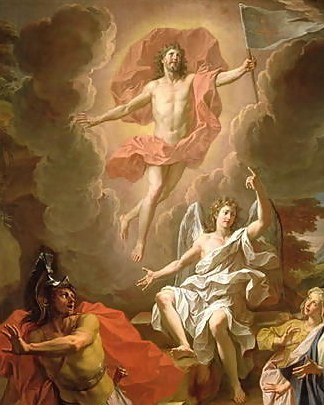
File:Noel-coypel-the-resurrection-of-christ-1700.jpg
Noël Coypel, 

Resurrection of Christ 1700 (PD)
Jesus’ resurrection tells Rome that an authority and power rooted in the threat of death has been undermined by a peasant itinerant preacher. 

It is a call to cast off the shackles of fear in the face of those who wield the power of death, because death is now a sheath absent a sword, 

It is a gun is devoid of ammunition


It is a boogeyman that has vacated the closet. 

However, discipleship is still scary, 

But we aren’t called to be brave disciples, we are called to be fearless followers of Christ

And on that Easter morn, it is the venomous strike of death that has turned against a serpent who has bitten the wrong prey. 

So, we are told to no longer be afraid, because in the resurrection the reason to fear death has been removed. 

And yet, both Mary’s leave the tomb in fear and I doubt they lived the rest of their lives, free of fear. 

~

A few weeks ago I climbed up to my roof to clean my gutters, 

Afterwords, one of my children asked why the bible always says not to be afraid. 

After talking about the difference between being brave and not being afraid

My child asked me the most obvious question. 

“Then why are you afraid of heights Daddy?”

The answer was too simple to avoid; 

Because I am still finding my faith beside that empty tomb and on my own journey to meet Christ at Galilee.

 And my fear falls away bit by bit when I consider the real Truth of this story

And that Truth is simple, He IS risen, Alleluia. 

File:Mantegna, Andrea - La Résurrection - 1457-1459.jpg
Andrea Mantegna, The Resurrection 1457-1459 (PD)

  • Sources
  • Robert Levine and Johnathan E. Steinberg (Producers), Johnathan E. Steinberg (Director).              
  • (2 April 2017). Black Sails [Television series]. Meridian, CO: Starz.


Sunday, March 26, 2017

Turning a Blind Eye

John 9

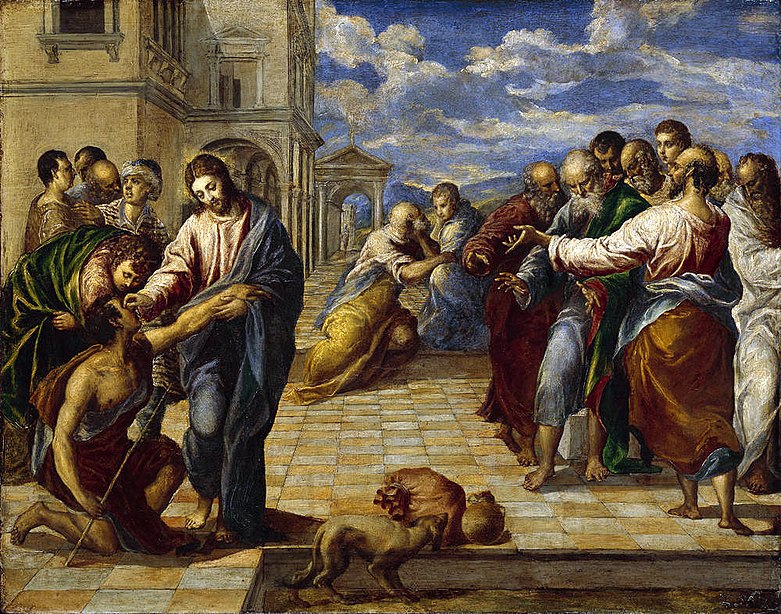
File:La curacion del ciego El Greco Dresde.jpg
Christ Healing the Blind, El Greco 1567 PD


What are you; BLIND!?

This is a question that has been adopted as a phrase to voice our discontent with behaviors and actions we don’t really approve of. 

As a parent when I ask my children to clean up, I seem to find myself asking this question flippantly, 

Usually receiving the response from my children which proves sarcasm should not be wasted on the young; 

“Why no, Daddy, I can see just fine!”

I also find myself asking this question as I drive from place to place, observing drivers that are either incapable of driving courteously or sometimes incapable of driving at all. 

Interestingly, I find myself asking and even making accusations of blindness more often during this particular month every year or so. 

During March Madness, whenever the West Virginia Mountaineers make it far enough into the NCAA Tournament, I find myself becoming a basketball fan. 

Basketball, a sport which has rules that I honestly know about as well as the rules for cheese rolling or cricket. 

Yet, if WVU ends up in the Sweet 16, I seem to find myself becoming the foremost authority on the game, which I have not only never played but avoided for fear of looking like a fool. 

But there I am, sitting on the couch accusing the officials of blindness and demanding that the officials give my Mountaineers a free kick, an additional 15 yards for roughing the passer, or just outright appalled that the ball was called foul despite the fact that it was clearly not over the line. 

In spite of how all this sounds to you, I honestly have no idea how to play basketball, I just want to root for my Mountaineers. 

Yet, as incompetent as I am when it comes to basketball, I seem to make pejorative claims of others ability to see. 

Thinking that I know so much more than I really do, that I can see so much clearer than anyone else. 

Sitting on my couch in my own home, I can’t help but wonder, who do I think I am fooling?

No one, just myself….
~

Our gospel for today addresses blindness. 

It also addresses sight but not just sight.

File:Healing of the Blind Man by Jesus Christ.jpg
Healing of the Blind Man, Carl Heinrich Bloch 1834-1890 PD
It addresses intuition, a word rooted in Latin that really means to look into, or inside of something. 

It is more than just seeing that is being addressed in our gospel today. It is a deeper perception of something below the surface of what is before us. 

It is also a LONG gospel reading. 

Forty one verses to be exact, with only two verses (7&8) describing the miracle itself. 

Yet we find ourselves doing what we always do, focusing on the miracle and losing sight of the surrounding story. 

A story that contains thirty five verses that reveal the beauty of the slow process of this man’s sight being FULLY restored. 

Thirty nine versus that also illustrate the degrees of blindness in others, as well as ourselves. 

There is a progression to the restoration of the beggar’s sight because Jesus comes to the beggar faceless at the time of their meeting, because the beggar is still blind. 

He does not know the face of the one who performs the miracle, only the name; Jesus. 

So, when he is brought to the Pharisees by his neighbors in order to discover the source of this miracle, perhaps even the validity of it, he has very little to go on. 

Questioned first by his neighbors as to the identity of the man who has healed him, he simply refers to Jesus as “a man called Jesus.”

In the midst of his interrogation at the hands of the Pharisees though, he seems to have looked deeper into what has transpired, looking deeper into just who Jesus is. 

The beggar, upon being asked what he himself has to say about this man, further reflects on just what has happened, and it dawns on him that this must be the work of God. 

Ironically, this realization seems to have come to him as much from the skeptical questioning of the Pharisees as it has from his own heart. 

He is an honest man, responding to the questions with not only integrity but with his own sense of curiosity. 

A desire to know just what has transpired for himself. 

And when he returns to the Pharisees, his certainty of Jesus’ work as the work of God is affirmed. 

Not by his own deep questioning, but by receiving more of the skeptical and even militant questioning of others. 

Standing by his claim to the point of scorn and mockery, even being driven out of this Pharisaic court for no other reason than the persistence of his belief. 

Ridiculed because he was willing to process the evidence of what has been shown clearly to him, not by Jesus, but by his inquisitors. 

Evidence that he is willing to truly see, even as others turn away. 

Because, others have learned to close their eyes to what they choose not to see. 

Perhaps, because they have seen too much? 

And maybe that has made them blind? 


Another image that is found in this passage is one we have heard several times since Christmas. 

It is a persistent theme in John’s Gospel; Jesus as the light of the world. 

In all honesty, given the frequency with which we have talked about this theme I wasn’t certain it was important to address this week. 

At least not until I considered the role light plays regarding our sight. 


Photo by Nelly Volkovich, Picture provided through Unsplash


Science is not my strong suit, but you don’t have to be a scientist to appreciate the incredible nature of the human eye. 

Not only because of what the human eye can do, but what we have done with the human eye. 

Human beings are the only creatures on earth that are as capable of seeing as far beyond of what they can comprehend as we are. 

We are also the only creatures that can see as deeply into the things around us as we can, even our own bodies. 

We can see beyond our own planet, even the galaxy, in which we live. 

We can see our own cells, viruses, even atoms!

And yet the more we see, the more curious we are and the more we want to see. 

And the key to all this is LIGHT. 

They say that eyes are the windows to the world. 

And that is more true than we sometimes realize. 

Because the lenses on our eyes allow the light that is reflected off the world to enter into the eye and our pupils control the amount of light that enters into the eye, controlling our focus. 

The light that is reflected from our surroundings is projected onto our retina and that is what allows us to see the world. 

It is in this same way that Jesus Christ reflects the Incomprehensible into our world, into our lives. 

God, which is so far beyond what we can grasp is reflected into our lives by Christ. 

But only if we are willing to open our eyes to that light, because if we shut our eyes tightly in spite of that light or to the world around us; 

We might as well be blind. 

~

This story offers a deep contrast to the unveiling of the beggar’s own sight. 

There are three other groups that seem to be struggling with sight through most of the scenes in this story where Jesus and his disciples are mostly absent. 

The crowd who cannot believe what they are seeing. 

Seeking excuses and reasons that deny what is clearly standing before them. 


Perhaps having seen so much of the reality of the world around them, that they refuse to believe such a good thing as this could occur to such a man. 


Denying his very identity, even accusing him of being a stand in or lookalike. 

Perhaps jaded by what they have seen in the world. 

So pessimistic that they have come to refuse that God can be at work in so low of a place as the eyes of a blind beggar. 

Refusing to reconcile a God that can be at work for good in all things, even those things the world seems to have lost interest in or has no time for, like the poor. 

Then there are the parents of the beggar who do not deny their son. 

They admit that it is their child and that he has come to find his sight, but they turn their own blind eye to the situation. 

Turning a blind eye to the questions of not only others but their own questions. 

They must know that such questions will not go away and yet they refuse to even entertain the most basic question; how such a thing as this has occurred?

File:Duccio di Buoninsegna - Healing of the Blind Man - WGA06779.jpg
Healing of the Blind Man, Duccio 1308-1311 (PD)
Certainly not avoiding the question because it has not arisen in their own minds, but because they fear the answer. 

An answer that will cast them out of the synagogue, out of their social circles, out of the worldly graces of their own society. 


Far too risky of a question to ask if it can be avoided. 

So they choose to deny the very reality of what has happened, retreating to a position of blindness. 

And then we have a group of Pharisees who have organized themselves into a kangaroo court. 

They have made their judgment before the beggar even arrives in their court on his first visit.

Then on his second and final visit even dictating TO the beggar what has “officially” transpired during his healing. 

Sharing the good news with the beggar that he HAS been healed by God and should give glory to God but advising that such a judgment by the court will include the accusation of Jesus as a sinner. 

The court doesn’t offer a judgement to the beggar, they offer two options:

Confess that Jesus is a sinner and a fraud

Or 

Oppose the court’s judgment and be accused and cast out himself as a sinner. 

And so; 

the beggar is driven out. 
~

So, where do we find ourselves in this story?

I would say that a healthy dose of skepticism in the midst of our faith is merely a reflection of authenticity and honesty. 

The same authenticity and honesty that leads the beggar to find himself slowly confessing his faith to Jesus when he gazes upon Christ’s face for the first time. 

A faith that is tested by honest and thorough questioning. 

But that is a fine line to walk, isn’t it?

Because if we see too much of the world, we find ourselves blinded by how broken it all is. 

Refusing to believe in anything. 

This is a far cry from healthy skepticism, it is unbelief and it leads to hopelessness and despair. 

So, we could always protect ourselves with naivety and an overabundance of optimism. 

Now this, this is what we love as the church. 

Rose colored glasses and care bears sliding down rainbows. 

But is that the reality of the world outside the walls of the church?

A world where only sinners are tried by the afflictions of the world and we chosen few are protected by God’s merciful hand as compensation for our regular attendance and generous donations?

Sisters and brothers, I am CERTAIN there are a few of you out there who cannot accept this to be true, I know I can’t. 

The fact is that we see what we WANT too see of the world. 

And this leads us into either a blindness of unbelief or the invisibility of irrelevance. 

We are called to be a church that is faithful to the promise that is true AND relevant in a world that needs that assurance now more than ever!

And if we board up the windows of our sanctuary, it may deny the ugliness of the world outside, but it will also deny the light of that same world that shines so brilliantly through, bringing us the hope that WE so crave!

www.stockphotosforfree.com/

We are all blind to certain realities.

So jaded, we refuse to see the beauty of the world.

So naive, we refuse to see the ugliness of the world.

So superstitious, we refuse to question.

So pessimistic, we refuse to believe.

But for us to truly see we must not only see the world but see into the world, embracing a promise from the Kingdom of God that exists also in the broken Kingdom of man. 

Because true sight is the wholeness of seeing two kingdoms. 

This leads to seeing it all together and when it is all brought together, the wholeness of the world can lead us to seeing the holiness of God, 

And that is not only a faith that is tested but a faith that is authentic, honest, and rooted in the cross of Christ +. 
~

This past week there was a lot going on. 

In the midst of a busy week, my wife and I received a number of messages on Tuesday morning, concerning some close family friends, one of which was far more than just a mentor to me. 

We came to discover that their daughter had died after a struggle with addiction. 

Addiction to a drug that I regularly encountered as a police officer, a drug that became my worst fear after encountering both the substance and its victims. 

And when I heard the news my heart sank into the pit of my stomach. 

I’ve struggled to think clearly this week because I found myself asking how?

How for so many years did I not see? 

Even as I was executing search warrants, dealing with others who were  addicted to that substance? 

How was I so blind as I interacted with their daughter almost weekly?!

If only I had seen, I could have done something, maybe I could have supported them more than I did. 

But I didn’t see, even now, looking back, I cannot see it. 

As a police officer, we used to talk about the bubble that the rest of our communities live in, isolating themselves from the world in a state of ignorant bliss. 

It didn't take long after my resignation from the department to find myself comfortable in that bubble, even admitting to old friends that I now willingly ignored what I knew was going on in the neighborhoods that were just a block from the seminary where I was studying. 

Now, I am not sharing this story to gain your sympathy, but I need you to hear that no matter how much we see or how much we think we know, we all turn a blind eye to what we don't want to see. We all have a tendency to see what we WANT to see and perhaps this Pharisee has chosen blindness too long, because Christ’s light needs to be seen in those dark places that we turn a blind eye to, and in our baptisms we are called to be the candles that carry that light into those places. 

Amen. 

Free Commercial Use from Pixabay (No attribution found or required)