Sunday, July 1, 2018

Fear and Death


Mark 5:21-43

File:Voskreshenie docheri Iaira (1871) by Vasiliy Polenov.jpg
Vasily Polenov, Resurrection of Jairus' Daughter 1871 (PD) 

Three friends were sitting in a bar one day and somehow they got onto the topic of what they want their friends and family to say about them as they look into their caskets at their funerals.

The first said, “I want my family to look down at me and tell everyone that I was a good father and a good husband.”

The second said, “I want my friends to look down at me and say that I was kind and I was successful.”

The third said, “I want everyone to look inside my casket as say ‘Hold on a minute, he’s moving!’.”

~

Today’s Gospel is all about fear and death. 

Not only fear and death, but who gets to dictate to us what to fear and who gets to dictate to us what things are actually dead. 

We are presented with two options in these two miracle stories; 

Jesus or the popular majority. 

Things haven’t changed all that much since Jesus’ day either. 

For the most part, the popular majority gets to dictate to us all just what is living and what is dead. 

The popular majority also gets to dictate to us all what we should fear and what we should not. 

And at times, the finger of that majority is pointed squarely at our own foreheads. 

WE are the ones to be feared. 

That is exactly what occurs in today’s gospel as this woman, who has been suffering from twelve years of blood surging from her body, attempts to reach out in desperation for Jesus. 

I know you’ve been told this before, but -in Jesus' day- the flow of blood coming from this woman, any break in the skin, or anyone who was bleeding even slightly, meant they were to be isolated. They were contagious. They were unclean, and they were to be feared until the problem was contained. 

So, when this woman sneaks in behind the crowd, she isn’t sneaking up on Jesus, she is trying to sneak in behind the crowd, avoiding the crowd's judgement. 

She is trying to avoid their fear, their condemnation, their persecution. 

A fear that has not only been dictated to the crowd, but it has been dictated to her as well. 

She believes that it is acceptable for them to be in fear of her. She knows she is unclean, and she believes they have every right to be in fear of her. 

She doesn’t know the cause of her ailment. 

She has exhausted every resource at her disposal to alleviate the problem, yet it has only gotten worse. 

In desperation, she reaches out to Jesus. 

She hopes to go unseen, unnoticed.  

This is one of those “better to ask for forgiveness than permission moments,” because if she asks Jesus directly to heal her ailment, she will announce her ailment before the fearful crowd's scorning gaze that has surrounded them both. 

Sneaking into that crowd would have had consequences. 

Much like the lepers in other stories, it is her responsibility to maintain her distance from others, to isolate herself from the rest of society. 

But this is a story of desperation. 

It is a story that shows us all, that fear cannot deter desperation. 

The most desperate will always muster up the courage to confront the fears others impose as deterrents. 

It is also a story about what we should truly fear. 

Because what we should truly fear is not the fears imposed by the popular majority, it is the fear and trembling that drops this woman to her knees before Jesus. 

One piece that gets lost in translation, is that Jesus’ eyes are locked upon this woman after he scans the crowd and asks just who has touched him. 

It is well within Jesus’ power to expose this woman, revealing the unclean and unlawful act that she has committed.

Yet, she is no longer in fear of the crowd. She is in awe of the power of God that has been revealed in Christ. 

Before Jesus even has the opportunity to proclaim her healed, she should have fled the scene in fear of the crowd, 

But she remains, unable to move, only able to confess to Jesus and the crowd surrounding them both the whole truth of her situation. 

Freed from her fear of being exposed to this crowd, freed of her fear of the consequences!
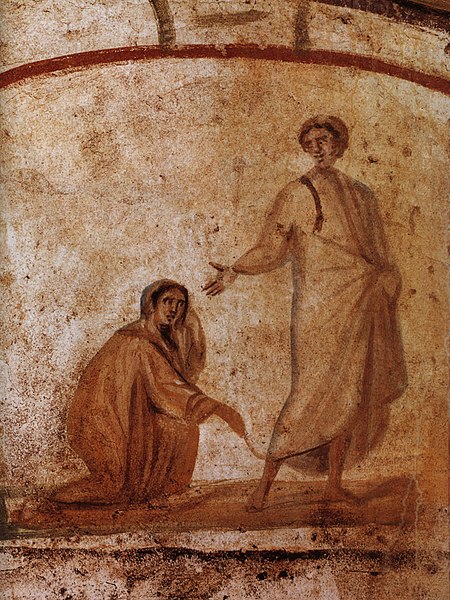
File:Healing of a bleeding women Marcellinus-Peter-Catacomb.jpg
The healing of a bleeding woman, Rome, Catacombs of Marcellinus and Peter.
4th ct. A.C.

Fear is as alive and well as it has ever been. 

We are coming up on two years since our last presidential election. 

Out of all the sermons I have preached in this place, I remember that Sunday, following the election as clearly as almost any Sunday I have preached since. 

The Gospel was from Luke 21:5-19

Jesus’ prediction of the temple’s destruction. 

A destruction that Jesus accurately predicts occurring from not only within the temple walls but within that temple community. 

I recall being a little intimidated with the task of preaching on that Sunday and that moment in our nation’s history, trying to figure out what to say and how to say it in light of that powerful text. 

Preaching a word of warning against becoming a nation divided, much like that community that tore down their most holy of holies. 

Today, I’m a bit less intimidated, having preached far more than nine sermons to this congregation like on that particular Sunday. 

But this text speaks to this moment in our nation’s history in a unique and a powerful way that I cannot avoid. 

Because our fears are dictated to us by the popular majorities of our nation, today more than ever. 

Our popular majorities and crowds select ringleaders to muster up fear and division among each and every one of us. 

We buy into it, we repackage, and we sell it as our own. 

Whether we tune into Sean Hannity, Rachel Maddow, Laura Ingram, or  Lawrence O’Donnell,  

-just to name a few, but there are many others out there-

We muster up fear in our own respective crowds. 

We are so busy trying to find our like minded crowds, we forget that each and every one of us is probably carrying some kind of disease or sin in our own lives. 

Sin and disease that could turn our own crowds or tribes against us at the drop of a hat, if it were to slip out into the crowds, tribes, and parties where we feel so at home. 

Yet we subscribe to that tribalism and devotion to our own crowds with a sense of loyalty, that far surpasses the loyalty, devotion, and  LOVE that we should have for the whole, for ALL people. 

A whole nation of people, with different views, diseases, and sins, that make us whole. 

I love my country, but the symbol of our flag, our pledge, our national anthem, it just means so many different things to so many different people today. 

I really want to believe these are all still symbols that unite us, but I don’t know if that is something that holds the same power to draw us together anymore. 

We are far too devoted to our own tribes and our own crowds, rather than a united sense of community and DECENCY! 

Yet, there is another symbol revealed to us and that is the Word and witness of  Christ Jesus. 

If we are really honest about that symbol, that reveals God to us all,
perhaps we can be freed of our own fear and expose ourselves without shame amongst those crowds?

Perhaps our nation can heal and be made whole once more? 

Photo by Jason Zeis on Unsplash

This second healing story is split in two by the healing of the woman who reaches out to Jesus in the crowd. 

Jesus ends up being sidetracked on his way to Jairus’ house, to heal his daughter who is on the verge of death. 

And here we see another crowd attempting to dictate to Jairus and Jesus just who and what is to be declared dead. 

It isn’t hard to imagine the anguish Jairus feels in the pit of his stomach or the pain revealed upon his face. 

After all, this is a man that is no less desperate than the woman who desperately reaches out to just brush her hand upon Jesus’ garment. 

This man, too, has fallen upon his knees at the sight of Jesus in desperation at the very beginning of the story. 

And when his daughter is declared dead, his worst fear is dictated to him by another crowed of messengers. 

Jesus’ statement to Jairus is not a command or a suggestion but an urging, perhaps even a plea, that he continue to hold to his belief and not give into the temptation to fear the worst. 

Jesus attempts to quiet the crowd’s mourning upon reaching the house.

A crowd that is attempting to stir up and evoke emotional chaos, a fervor of grief and anxiety. 

He attempts to silence their irrational rambling and senseless commotion by announcing that the child is not dead but is in fact sleeping. 

Isn't it odd how Jesus can command the howling winds and turbulent sea, but when confronting the crowd they only respond in laughter and disbelief?

Perhaps when we gather into our own crowds, guided by the beliefs of our own tribes, we are far less faithful than even the elements of nature?

And as simply as Jesus commanded the elements of nature on the sea of Galilee when he says “Peace, be still” in our gospel last week, 

He again uses just two measly words, “Child, rise.”

File:Gabriel Max - The Raising of the Daughter of Jairus - Walters 37170.jpg
Gabriel von Max, The Raising of the Daughter of Jairus  (PD) 1881

One of the downfalls of humanity, is that we give up far too easily. 

Not necessarily giving up on ourselves, but on hope. 

We are far too willing to give up on each other, on our potential to be good and loving and kind. 

We are far too willing to give up on the ideals that make us united as countrymen. 

We are far too willing to declare others diseased, tainted, or blighted because they seem like a threat to us. 

We are far too willing to ignore the humanity of each and every person in our midst, in spite of how precious we all are in the sight of God. 

As we commemorate Independence Day this week, I’m not so sure we can look to our nation’s symbols to unite us any longer. 

I don’t think those symbols are dead, I truly believe there is life left in those symbols that represent who we really and truly are, much like the daughter of Jairus.  

It makes me sad, but not hopeless. 

I still believe that we as a nation have tremendous potential. 

I still believe that we as a people can stand for something far more powerful than just a strong military and a strong economy. 

I still believe that we as a nation will not only survive, but we can be a symbol of new life, if we just believe in a hope beyond our own survival, a hope beyond our own crowds. 

Maybe, just maybe, there is a symbol powerful enough to show that death is in God’s hands, not our own. +


Amen

Photo by Chris Dixon on Unsplash


Sunday, June 17, 2018

Sowing Seeds of Life


Mark 4:26-29

File:The Sower.jpg
Vincent van Gogh, The Sower (Sower at Sunset) 1888 (PD)
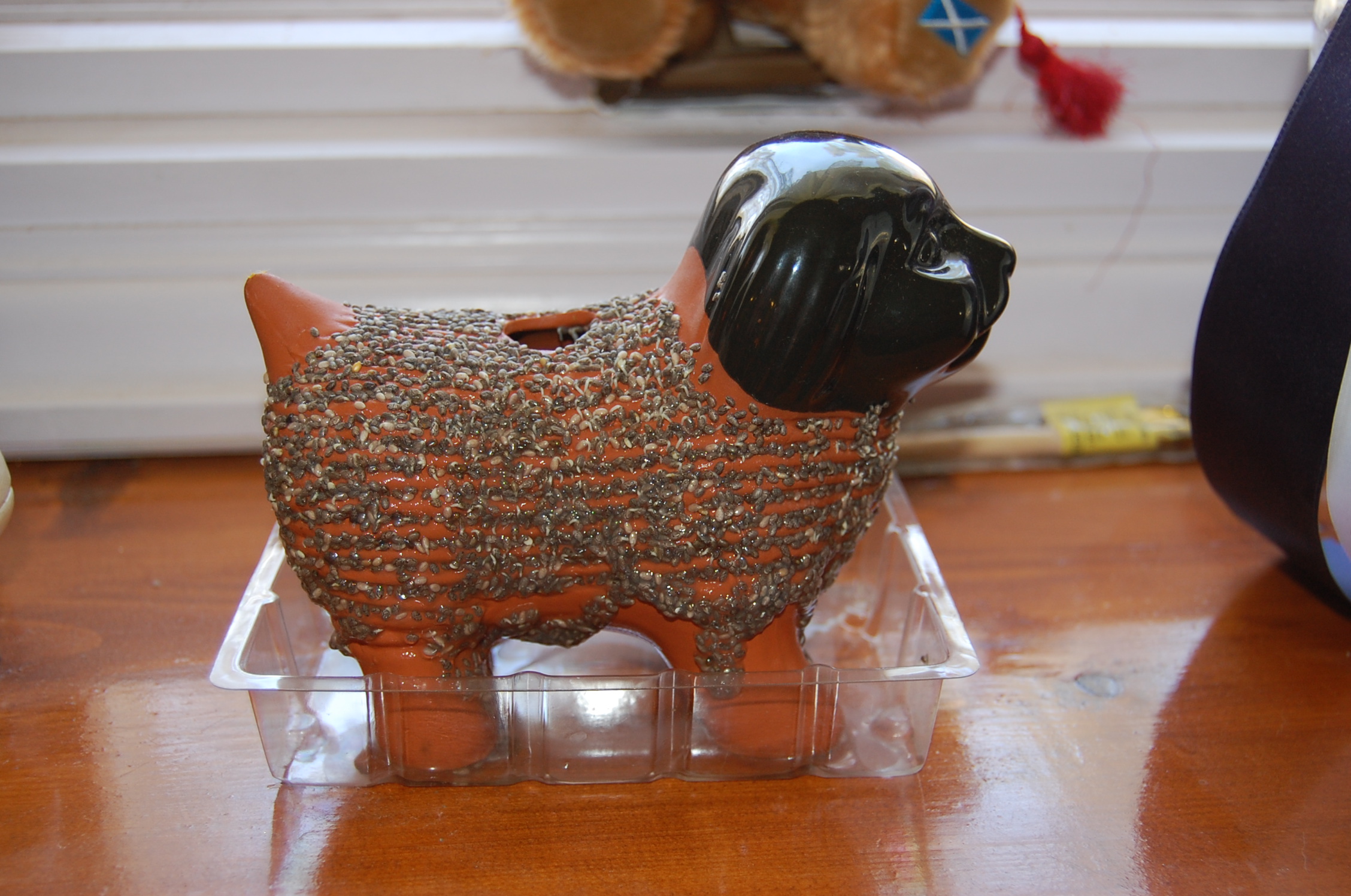
Right around the age of ten, I received a chia pet one Christmas. 

It wasn’t a special edition chia pet like you see around today, just the standard one, which I guess is a ram or something like that. 

It wasn’t my favorite gift that year but out of all the gifts I remember it the most clearly. 

I remember it, because like all my Christmas gifts when I was that age, I had to try each one out that afternoon. 

It probably wasn’t the best gift idea for a ten year old who was more interested in He-Man than horticulture, 

but I still had to give it a shot after my father had finished putting castle Grey Skull together and teaching me new words. 

I recall soaking the seeds in water and smearing the mucus-like substance into the grooves of the ceramic animal. 

Looking at the box, I was moderately excited to see what this weird critter was going to look like with a big bushy green coating of plant fur all over it. 

I was not excited enough to water it though, even though is was placed right next to the sink in the bathroom. 

A bathroom that was right next to my bedroom. 

I would sleep and rise night and day, splashing a little water on it, but by the end of the day it always looked like a dried up old booger. 

It finally got to the point where my mother couldn’t take it anymore and it landed in the garbage. 

I was irate when I discovered it had been thrown out, demanding to know why she threw away my prized chia pet. 

She only needed to give one answer; “Because it was gross”

I have no idea, to this day what went wrong. 

I haven’t had a chia pet since then, 

But every time I see one I am reminded of that Christmas gift. 

Related image

Today’s gospel reminds me of that chia pet too. 

Supposedly, all you had to do with the chia pet was soak the pottery critter in water, smear the gross seed slime all over it, then just poor water into the opening, and it would grow. 

Seems pretty simple, but I recall the water never seemed to soak through the pottery and watering it like any other plant didn’t help. 

So, I ended up just leaving it where it was, on the back of the toilet growing a layer of mold and algae inside, and a crusty layer of complete grody on the outside. 

Seems I had better luck growing things inside the chia pet than on the outside of it. 

Not exactly how it was advertised, that is for sure!

Jesus seems to be about as versed in growing things as I was with that chia pet. 

It’s hard to be anything but skeptical about Jesus’ limited edition “kingdom of God” chia pet. 

Sounds like a disaster waiting to happen; 

Just scatter the seed on the ground and watch it grow!

No other instructions what-so-ever!

This is probably why this parable we hear in the gospel for today is the only section of Mark’s Gospel that has no equivalent parallel in Luke or Matthew’s accounts. 

Out of all the sayings of Jesus, all the ministry he performed, this is the ONLY portion of Mark that you cannot find in either Matthew OR Luke!

Because these are TERRIBLE instructions!

This isn’t how you should grow ANYTHING!

And I’m not just talking about this parable as literal farming instructions either. 

Let’s address what Jesus is talking about in this parable; metaphorically speaking. 

Jesus is talking about the Word of God, right?

I think most people -even across different faith traditions and different theological leanings- can all agree that the seed as THE Word of God, is what Jesus’ instructions are attempting to illustrate. 

The Word is the seed and once that seed is scattered, SHAZAM! 

So, how many Pastor’s, Deacons, Bishops, Church consultants and Church growth “experts” do you think walk into struggling congregations slap a bible down in the middle of a table and proclaim, 

“Well, there’s your answer!”

The solutions we propose have far more to do with financial planning, revisioning our mission, community outreach, restructuring staffing, committees, councils. 

The magic bullets are young pastors, catchier music, tossing the smells and bells out the window. 

Unless a study comes out that the ever elusive millennial has been spotted at a more “catholicy” kind of church. 

Then we pump our next stewardship campaign into a brand new organ and some gothic stonework wallpaper. 

We can all laugh, we can roll our eyes, we can point fingers at all those OTHER folks who do this, 

But, if we are honest we have to admit that we ALL do it. 

We are all so consumed with growing our numbers, longing for those packed pews and the full offering plates to roll in the door, that we forget who the soil is in this story; 

US. 
Photo by Gabriel Jimenez on Unsplash

The seed is planted in each and every one of us, that is where that seed will germinate and that is where that seed will grow. 

Right here and right now. 

So the question isn’t how can “we” -the collective WE grow- but how am I -PERSONALLY- growing in faith by the Word of God?


As a pastor, this is something that really and truly weighs heavily on me, 

in every Sunday school class I teach, every bible study, and in every sermon I preach. 

I struggle with wether or not God’s Word is really reaching those I’m called to serve. 

It is why I say a prayer for illumination before every sermon, asking that the words of my mouth and meditations of our hearts be pleasing to God (Psalm 19:14)

A prayer that is itself right out of the psalms. 

I don’t say this prayer because I want to get a raise or I am trying to keep everybody happy. 

Frankly, if I am preaching the truth of God’s Word, there are some Sundays that there ain’t any of us that are gonna walk out of here happy. 

But it is the hope that the seed of the Word is planted in each and every one of us who is listening

And even, sometimes especially,  the one who is preaching. 

Because even though these are words that my own hands have put on paper, 

sometimes I don’t even realize why or how they ended up there or how they will be received. 

My prayer is that these words are NOT received with MY best intentions, because my best intentions are never good enough. 

My prayer is that God’s Word is received through my flawed lips. 

My prayer is that God’s seed is planted, in spite of the unworthy and sinful hands that attempt to scatter that seed. 

It eats at me and I struggle with it every single time I step into this pulpit. 

But it is also a joy to wrestle with God’s Word, and it is a sincere hope that that same joy can be shared with each and every one of you. 

Some days it does feel like a total flop though. 

Sometimes when you look out across the congregation and you think, 

“Wow, I think every single person in this sanctuary is thinking more about their lunch plans or those donuts in the fellowship hall than the words I am speaking”

Somedays, we know that’s the case. 

Its funny, its kinda like being a parent. 

How to be a good parent; I’ve talked to my wife about it more times than I can count. 

Our biggest fear, is that the seeds we have planted just wont take hold. 

We want our kids to grow into faithful people, who love others and God. 

But I wont always be able to call them home or drag them to church. 

One day they’ll leave and I will only be able to hope and pray that those seeds have taken hold. 

Its all I can do as a Dad. 

Its all any Father, Mother, or any guardian can hope for, 

And I know it doesn’t just eat at me, I know it eats at many of you.

Especially on Father’s day of all days. 

But take hope in something that is clearly illustrated in today’s parable. 

Again, a parable that ONLY Mark shares. 

There is nothing living about the ground, dirt, mud, soil. 

There is life in it, but the substance itself, it is NOT alive. 

Photo by Zbysiu Rodak on Unsplash
Life is found in the seed, and that seed is what gives life to that soil. 

We are all soil, lifeless in sin, flawed by unnatural sin that feels so natural to each and every one of us. 

But it is the Word that is planted in us that brings forth life. 

Just as the seed of Jesus’ broken body is planted in the soil of a lifeless, cold, and empty tomb. 

I bet nobody thought life would sprout from that one, did they?

Just as God’s Word is spoken and sown over and into the waters of our baptisms, taking another lifeless substance and bringing forth life from it. 

Just as Jesus’ Words are spoken and sown over and into the lifeless bread and wine, bringing forth the real and living presence of Jesus’ body and blood. 

If God can bring forth life in all those lifeless things, 

than how can we not believe that God brings forth life through the seed of God’s Word into anything, 

no matter how hopeless or dead we may think it is. 

God’s Word will eventually take root and blossom, bringing forth a new creation and new life, in even the most dead of things. 

Thanks be to the God who scatters and sows seed and life across the soil of all of creation, into the lives of all people. 

Amen

Photo by Francesco Gallarotti on Unsplash


Sunday, June 3, 2018

The Expectation is Participation, not Perfection


Deuteronomy 5:12-15 and Mark 2:23-38

Photo by Chris Karidis on Unsplash


Like many, I played Little League when I was younger. 

On my best days I payed attention through the entire game, watching for pop ups in the outfield, rather than chasing butterflies or throwing my mitt up in the air and catching it repeatedly. 

On my worst days -I am not too proud to admit- I cried in the dugout because I struck out or missed the countless pop ups, that I allowed to turn into double or triple runs rather than an easy out. 

One of those worst days was particularly bad for me as a young boy. 

One of my teammates had just hit what should have been a triple but instead turned into a scoring run, due to an outfielder that had a attention span similar to my own. 

He scored this run right after I had struck out. 

Upon entering the dugout, he plopped down onto the bench right next to me and proclaimed to our entire team; “That’s what happens when you go to church every Sunday!”

Taken aback by this and reacting to the comment with little thought of my own I proclaimed; 

“I go to church every Sunday and I just struck out”

“What church do you go to?” he asked

When I told him what church and what denomination I was part of, he was able to diagnose exactly what the problem was for me. 

Needless to say, he didn’t think it was my swing. 

That day stuck with me as you can tell, since I am referencing it as my opening illustration for the sermon today. 

It’s also a story I have shared with our confirmands. 

I don’t share it out of self pity or out of resentment for my teammate - he actually remained a friend of mine into our high school years-

I share it because it addresses the “why” of worship. 

Obviously, my Little League career never blossomed into the majors, the minors, College, or High School baseball for that matter. 

To be honest, I didn’t even play a second year of Little League. 

It wasn’t because I didn’t enjoy baseball or I didn’t want to play, 

I just lost interest because I didn’t feel like I had the talent for the game. 

Regardless, I never believed that if it was even possible for me to worship more often, or in a way that was more “correct” according to the standards of others, that I would improve as a baseball player. 

Besides that, my potential as a baseball player or anything else for that matter wasn’t the reason I worshipped. 

I worshipped because worship was first presented to me as an expectation. 

Later on, the sabbath and worship was revealed to me as a gift. 

Worship as, not an action that promised a reward, but an event that was rewarding in and of itself. 

Photo by NeONBRAND on Unsplash

The Gospel for today is preceded by our first reading from Deuteronomy which is the presentation of the third commandment, remember the Sabbath and MAKE it holy (øv√;dåq). 

The Hebrew word  øv√;dåq  means so much more than just KEEPING it is to take something and set it apart from everything else. 

It is a verb, it is an action that we are commanded to take something and make it special. 

Much like my childhood experience with worship, the Hebrew people are being presented with worship as the expectation. 

The practice of worship is commanded but the gift of worship may not be fully revealed to the people yet. 

First they need to learn what it means to worship and how to worship. 

They need to learn how to see one day as a special day, to set that day apart from all other days. 

Once they are familiar with this, the gift of worship, the joy of worship is intended to be revealed to them, through the actual practice of worship. 

An order for worship is outlined and specific methods of practice are handed down. 

These rules for worship are meant to make this day, this sabbath, a special day set apart from all other days. 

A day when something unique, something out of the ordinary, takes place. 

Something you wont experience anywhere else or at any other time. 

Its the experience of being in the very presence of God. 

Its why we sing hymns and liturgical settings that are closer to Bach than the Rolling Stones. 

For that matter, it is why I would prefer to listen to the Rolling Stones than hymns when driving back and forth from home and church. 

Because we are rolling out the red carpet, our most formal, our very best, for a very special guest in our midst in those moments in which we worship!

It sets our time apart from all other time, but if we see these radical differences as something we must perfect we are missing the point. 

The expectation to worship is not a command to perfect worship, it is the command to participate in worship. 


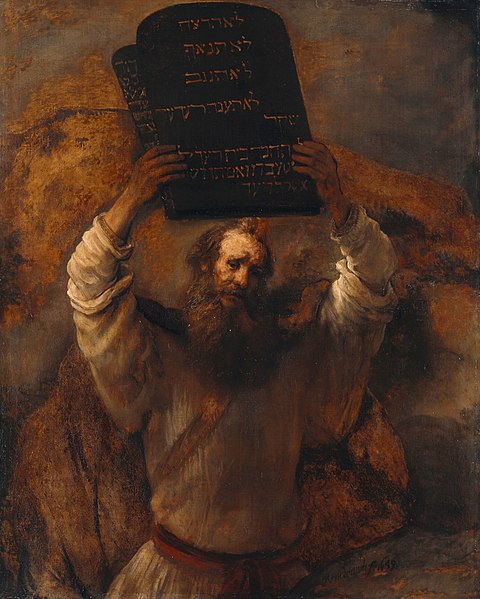
File:Rembrandt - Moses with the Ten Commandments - Google Art Project.jpg
Rembrandt, Moses Smashing the Tables of the Law 1659 (PD)
A couple weeks ago, nearly 30 million Americans set their alarms so that they could participate in a very special event. 

30 Million, that is half the number of people who worship in the United States, just once at ANY point during the week, on a weekly basis. 

The event occurred at 7:00 AM on a Saturday morning. 

It was the wedding of Prince Harry and Duchess Meghan. 

Following the wedding, media and social media continued to set this event apart from any other wedding, any other event for that matter. 

People oohed and ahhed over the event for all its pomp and circumstance. 

Many marveled at the elaborate attire, the cathedral-like chapel at Windsor Castle, the stained glass windows, and the priests who gathered to preside in detailed garb. 

And for as much as the Bishop of the US Episcopalian Church, Bishop Michael Curry attempted to draw attention to God in his homily, 

The wedding had far more to do with the Prince and the Duchess than it had anything to do with God, for those watching. 

A colleague shared her own thoughts when she proclaimed; “We do this every Sunday, so if you really enjoyed the formality of worship, please come see it for yourself this Sunday.”

We recognize many events and occasions. 

We strive to make them special. 

Birthdays, anniversaries, sporting events, 

Sometimes we even have weekly routines, when something special is planned, like a family meal  or a special night for a movie. 

This is particularly true with children, yet we have seemed to place worship at the bottom of that list. 

Whether we talk about sports, television ratings, recreational activities, movies, etc

The expectation that we participate in worship one day a week is no longer as valuable as that television show we can’t live without. 

And if we cannot find time to for that expectation, we may not be able to know the joy of the gift worship is intended to be. 

Photo by Mpho Mojapelo on Unsplash


It’s interesting just exactly who the Pharisees choose to attack in the Gospel today. 

They aren’t really attacking Jesus, they are attacking his disciples. 

They are attacking his followers, who Jesus is taking to participate in worship!

But these Pharisees aren’t concerned with participation, they are concerned with perfection. 

The issue is not the action of the disciples, the issue is what the Pharisees find to be the most holy, the most sacred. 

The Pharisees have come to a crossroads that we all come to at some point, deciding what is sacred. 

For the Pharisees, the rules, the perfection of worship is what they find sacred now, not the reason for worship. 

If the reason for worship was what they found the most sacred, they would be less concerned with the perfection of the practice and more concerned about how to reveal God to the rest of the world. 

Its the reason Jesus arrives on scene anyhow, to reveal God the world and if the world truly knows God, how can the world really do anything but worship?

Jesus’ words in this gospel account set Mark’s telling apart from Luke and Matthew. 

For me, it is the most powerful part of the Gospel for today. 

The sabbath was made for the people, the people were not made for the sabbath. 

Sabbath is a gift, it is meant to be handed down to our children, to those who don’t even know how to worship, to all people. 

But expressing the joy of being in God’s presence doesn’t require explaining the rules, it is a call to express the joy of the event. 

File:Duccio di Buoninsegna - Christ Accused by the Pharisees (detail) - WGA06802.jpg
Duccio di Buoninsegna, Christ Accused by the Pharisees 1308-1311 (PD)
In the past few years, I’ve heard the claim that we are a Christian Nation with greater frequency

Yet, out of 54 countries we fall in the bottom half of countries whose citizens worship once a week. 

Christianity in our country is also more diverse than in any other countries, offering a variety of Christian expressions of faith and practices to choose from,  

yet Nigeria, Liberia, Honduras, the Congo, and Columbia -just to name a few- all have a higher percentage of regular weekly worshippers than our nation!

So, I have to ask, how do we define what is Christian today?

How do we define what is a Christian nation if just one day, set apart and made Holy for God is too much to ask?

Because it is far easier to judge how the rules are perfected than it is to devote ourselves to the simple call to participate it would seem. 

We all pass things on to our children. 

Rings, books, music. 

But once our children know the joy of worship, it is a joy they can carry with them throughout life. 

It is a joy that they can share with others. 

Not because it will keep the institutional church alive, let it die for all I care, but because it will keep God’s Church alive when they really and truly know and see the gift of God in their own lives. 

Amen. 

Photo by Hanna Morris on Unsplash


Sources

Cooperman, Alan, Gregory A Smith, and Stefan S Cornibert. “NUMBERS, FACTS AND TRENDS SHAPING THE WORLD,” n.d., 266.


“Fast Facts about American Religion.” Accessed June 1, 2018. http://hirr.hartsem.edu/research/fastfacts/fast_facts.html