Sunday, September 3, 2017

Finding Our Place in Line

Matthew 16:21-28

Photo by Paul Dufour on Unsplash
An attendant at a busy airline desk was frantically attempting to assist a number of airline passengers who were trying to check in, following a cancelled flight. 

As the attendant was helping the frustrated passengers, one irate customer toward the end of the line began weaving through the line toward the front. 

After storming to the front of the line, dropping his bags, and slamming his palms against the counter, he demanded that the attendant immediately issue him a new boarding pass and transport him directly to the gate. 

In shock, the attendant just stared at him blankly, then after a few moments took a deep breath, looked him in the eye and exclaimed; 

“Sir, as you can see, there are a number of passengers that were waiting ahead of you. I apologize for the inconvenience but if you can just wait patiently like everyone else I will get to you as soon as possible. Please, get back in line.”

Enraged by this response, the irate customer slammed his fist on the counter and shouted; “Do you know who I am!”

Calmly, the attendant leaned forward and pulled the PA microphone toward their face and announced; 

“There is a Delta customer at the outgoing flights check in desk who is unsure of who he is, if there is anyone who can identify this individual, and help him back to his place in line, please step forward. Thank you for flying Delta!”

I don’t like waiting in lines. 

In fact, I have a tendency to avoid lines altogether. 

I tend to eat last during cookouts and church functions. 

Some of you may have noticed this. 

The lines I experienced in the military were so long and frustrating that I vowed I would avoid lines at whatever the cost upon returning home. 

Some lines are unavoidable though, like a Harris Teeter check out line just before cyclone ten strikes Virginia Beach. 

But sometimes you have to consider the up side to those long lines.

It gives you the opportunity to take a few test nibbles of the cookies in your cart, 

Catchup on the latest gossip in the magazine racks, cause it's always nice to know who has given birth to the latest half bat - half child in Arkansas.

You can even test your will power by staring at that half pound Reese cup until your turn to check out comes; it truly is the ultimate test of willpower. 

But why do we despise lines sooo much?

Because, when we look up and down the length of a long line, we always know that somehow or someway, we are more important than everyone else waiting ahead of us. 

This is how we all feel in check out lines, airports, even in lines when we are waiting to board a ride in an amusement park on vacation.

And here in Virginia Beach, we all know how it feels waiting in line whenever we are waiting to pass through that tunnel. 

Always the tunnel, right?

Photo by Nabeel Syed on Unsplash

~

Today’s gospel immediately follows Matthew’s account of Peter’s confession to Christ that we heard last week. 

But the most significant part of that story is the place in line bestowed upon Peter. 

Peter hears the Lord proclaim that upon that ROCK, the Lord will build the church. 

Now, the rock spoken of could signify either the literal rock they are standing on at that given time, the cliff above the shrine where the pagan god Pan was worshipped

Or

It could signify the confession that is made by Peter, declaring Jesus to be the Messiah, and the Son of the living God. 

Or 

It could signify Simon Peter himself, whose name Peter literally means rock. 

It could mean all three, and for Matthew there is significance to all three of these approaches to this text. 

But what is most important about this text is that Peter, and we, forget what is said about this place in line. 

Jesus declares that the church WILL BE built on that rock. 

Jesus declares that the keys to heaven WILL BE given to Peter.

Jesus does not declare that these things have taken place or that they are taking place at that particular time, 

He declares that those things WILL take place. 

But Peter puts the cart before the horse, weaving his way to the front of the pack, assuming that he is a pretty big wheel among the disciples.

But as my father has always warned me, be careful of big wheels because big dogs always pee on big wheels. 

Peter assumes his position a bit prematurely without realizing the threat this assumption poses to Jesus’ own ministry. 

The account of Peter’s confession at Caesarea of Philippi marks a shift in Jesus’ ministry. 

He has completed his ministry in Galilee and he is now beginning the final leg of his journey

TOWARD Jerusalem

TOWARD the Temple

TOWARD courts that will condemn him

TOWARD Golgotha and the cross that will be planted there.

So, while Peter sees an opportunity to inch toward the front of the line, he not only does so a bit prematurely but he goes a bit too far. 

Placing himself between Jesus and Jerusalem both literally and figuratively as a stumbling block. 

Because Jesus cannot be declared the Messiah and face such a demise as this, and Peter knows that there is nothing in scripture that will substantiate a claim of a persecuted Messiah. 

And while I do not want to discredit Peter’s authentic care and love for our Lord, let there be no doubt, this serves as a double edged blade to Peter, 

Not only endangering Jesus’ role as THE Christ, but endangering Peter’s role as THE rock. 

Peter tempts Jesus with a detour

A detour away from Jerusalem and a detour around the cross. 

The same detour that tempts Christ when he is tested in the wilderness, the same detour that tempts Christ in the garden on the eve of his crucifixion. 

~

Jackie Robinson is a national icon. 

And it could be debated as to whether he is a national icon because of his role as a baseball player or because of his role as a civil rights leader. 

I hate to say it but this makes me kind of sad, because I admire Jackie for his role as a Brooklyn Dodger.

I admire Jackie Robinson for his role as part of that team. 

Jackie Robinson said very little about being the first black man in baseball. 

He said very little about much of anything. 

He was relatively soft spoken and went out of his way to draw very little attention to himself. 

Jackie wasn’t really even a flashy ballplayer. 

He didn’t play in a way that drew attention to himself or declared him the leader of that team. 

He solidified his place in baseball by being a member of the team, an integral piece of that group of ballplayers that became the finely tuned, well oiled machine, that won the pennant in '47, '49, '52, and '53 before winning the World Series in 1955. 

He took his place among the other members of his team, not by putting himself in the front of the line but by pushing his fellow ballplayers to the front of the line, all the way to home plate, 

leading the league in sacrifice hits and stolen bases, driving his teammates home for scoring runs 48 times in his first year!

The Dodgers, including (from left) Wayne Terwilliger, Jackie Robinson, Pee Wee Reese, Preacher Roe, Chuck Dressen and Carl Erskine, celebrate in the clubhouse after defeating the Phillies in 14 innings to tie the Giants for first place in the National League on Sept 30, 1951.
The Dodgers, including (from left) Wayne Terwilliger, Jackie Robinson, Pee Wee Reese, Preacher Roe, Chuck Dressen and Carl Erskine, celebrate in the clubhouse after defeating the Phillies in 14 innings to tie the Giants for first place in the National League on Sept 30, 1951 Charles Payne/NY Daily News Archive via Getty Images
And he did it all while being called every name in the book, names so vile and offensive that I have spent most of my life believing they would remain a thing of the past, until this year. 

The most beautiful thing about this team was the bond that grew between the other players and Jackie. 

It took time but they became well known as more than just a team, they became a family. 

In the film "42", which depicts the first year of Jackie’s career, Harrison Ford plays Branch Ricky, the general manager of the Brooklyn Dodgers who brought Jackie into the Major Leagues in 1947. 

In one scene Ricky and Harold Parrott, the Dodger’s publicity chief, are meeting in the general manager’s office where Parrott has been infuriated by the vile things that are being said publicly about Jackie. 

As Parrott concludes outlining his plans of physical violence against the Phillies dugout in their upcoming game, Ricky just laughs.

To which Parrott questions “Did I say something funny?”

Ricky responds by stating,

“When I first told you about Robinson, Harold, you uh, you were against it. Now all of a sudden, you’re worried about him. I wonder how that happened?”

He then explains exactly how when he states; 

“Sympathy, Harold. It’s a greek word, it means to suffer. 'I sympathize with you’ means ‘I suffer with you’ and that Philadelphia manager, he’s doing me a service, he’s creating sympathy on Jackie’s behalf.”

Then Ricky follows up this observation with another observation of complete irony, explaining that Philadelphia is also a greek word that means “brotherly love”.

In his autobiography, Harold Parrott confessed that the moment when a fellow Dodger, Pee Wee Reese put his arm around Jackie during warmups before his Kentucky hometown crowd in Cincinnati, it was a turning point. 

It was a turning point because no one wanted to cut Jackie in line anymore, no one wanted to send Jackie to the back of the line anymore, and Pee Wee Reese was booed by his hometown crowd because he was willing to take Jackie’s cross onto his own shoulders.

And that was what made the Dodgers the powerhouse team of the 40’s and 50’s. 

No one carried their own cross, they carried one another’s. 
~

Sisters and brothers, I try my best to point to that cross every Sunday. 

This is intentional, because the gospel points to that cross every single time we hear it. 

And today, in most congregations you will hear a call to pickup your own crosses but if that is what we hear we’ve missed the most important call of them all in this text. 

We are called to deny ourselves first. 

We are called to stop standing by and proclaiming “Oh well, that doesn’t effect me!”

We are called to stop looking down the line and finding out how we can inch our way ahead of the next one in line. 

We are called to stop pushing those we feel are pulling us down or are the root of our problems to the back of the line. 

We are called to deny the urge to put ourselves before others, regardless of whether we know them, we like them, or we think we have anything in common with them

Peter and the other disciples are called to deny themselves if they intend to follow Jesus, and this word for deny only comes up in Matthew’s Gospel three more times. 

Matthew Chapter 26 in verses 34, 35, and 75. 

Anybody wanna guess what the context is?

It isn’t Peter’s denial of himself, it is the warning and acknowledgement of Peter’s denial of Jesus as he is sentenced to death. 
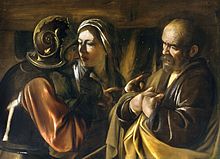
The Denial of Saint Peter, by Caravaggio 1610 (PD)
Peter, the disciples, and we are called to deny ourselves the same way that Peter denied Jesus. 

WOW!

Tell me that doesn’t make you want to check the footnotes or hold your nose through the rest of the service

And I’ll be honest with you, I’m not entirely comfortable with it either. 

Don’t think that just because I’m a pastor I don’t want to push others to the back of the line or inch myself up closer to the front. 

But if we value our own lives above all other things and people, can we ever truly know anything that may be of equal or greater beauty than ourselves?

What would this world look like if it looked exactly like what I see in the mirror daily?

In all honesty, it would look pretty useless and bland, because I know that I am not the pinnacle of God’s creative power and in order to fully see that, I may need to find a way to be comfortable in the back of the line… for once. 


Amen
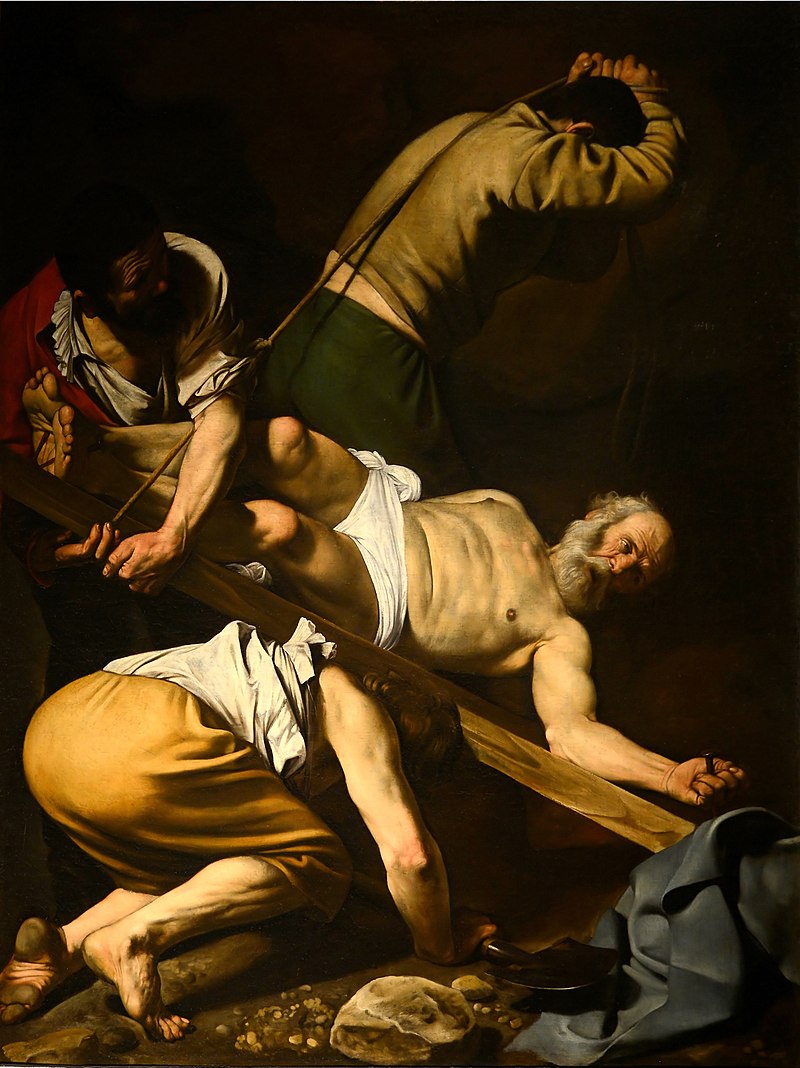
The Crucifixion of Saint Peter (1601) by Caravaggio (PD)

Sources


Helgeland, Brian. 42. Directed by Brian Helgeland Burbank, California: Warner Brothers, 2013. DVD.

Krell, David. "Harold Parrott: The Lord of Baseball Public Relations » The Sports Post." The Sports Post. February 01, 2014. Accessed August 31, 2017. https://thesportspost.com/harold-parrott-the-lord-of-baseball-public-relations/.

Sunday, August 13, 2017

Don't Give Up the Ship!

Matthew 14:22-33

File:16 Lorenzo Veneziano, Christ Rescuing Peter from Drowning. 1370 Staatliche Museen, Berlin..jpg
Lorenso Veneziano, Christ Rescuing Peter From Drowning 1370 PD
One summer during college I tried my hand at being a river guide on the lower Youghiogheny river. 

Guiding whitewater rafting trips is a fairly complicated skill. 

Professional white water boaters know the commands and techniques that allow them to maneuver around obstacles and dangers. 

When the guide shouts LEFT BACK!, all those on the left side should paddle backwards while the right side would continue to paddle forward, maneuvering the vessel like a tank to the left, as if the paddles are the tracks of a tank. 

When you have a good team of boaters, the guide can just dip their paddle in the river like a rudder, sit on the back of the boat, and steer the vessel around dangerous obstacles. 

Obstacles like the lower Youghiogheny’s “Dimple Rock,” a large undercut rock, where the water sucks things down beneath the rock; paddles, life vests, boats, and yes, people. 

If you didn’t gauge your approach to Dimple just right, you would drive your raft into the rock and the waves would fold your vessel like a taco, in fact when this happens it is referred to as a “taco”.

I perfected this technique, so well in fact that many would ask me if I realized I was working as a river guide, not at Taco Bell. 

I got a lot of jokes about tacos before I quit guiding whitewater boats. 

(cc) David Berkowitz - www.marketersstudio.com / www.about.me/dberkowitz
But that fall I continued boating, taking a class on whitewater boating. 

I borrowed a friend’s whitewater canoe and found that I actually could steer a boat pretty good on my own. 

I could read the water, the waves, the current, and the rocks well. 

What I came to find, was that it wasn’t my paddling, reading the water, or my skills as a boater that made me a bad guide.

It was my ability to guide others. 

I couldn’t anticipate how others would or were paddling. 

If someone in the boat was just dipping their paddle in the water or furiously paddling, I couldn’t tell the difference. 

Because I trusted them to paddle forward, obeying the commands, propelling the boat forward. 

Without forward momentum, the river would toss you into rocks and sometimes even hydraulics, which are large stationary waves that just continuously roll back on themselves, pounding against boats and trapping the passengers until the boat either capsizes or you experience what is known as a “bus stop” because everyone exits “the bus”.

Forward momentum was, and is, one of the most important ways to get through rapids, without it, boaters can be stuck in waves, fallen trees and limbs, or even undercut rocks like Dimple, sometimes trapped in holes so deep that people are never recovered. 

~

In our Gospel today the disciples seem to have lost all forward momentum as they are crossing the sea of Galilee and having been in a similar circumstance, I cannot imagine how terrified one would be trapped for six hours or more on rough waters in a small boat like theirs. 

Jesus doesn’t come to the disciples until the fourth watch of the night. 

The night was split into four three hour watches in Roman society. 

This was how attacks were prevented, thievery was deterred, and people were able to protect their property and community from existential threats. 

File:Rembrandt Christ in the Storm on the Lake of Galilee.jpg
Rembrandt, The Storm on the Sea of Galilee 1633 PD
So by the time Jesus comes to the disciples it is somewhere between 3 and 6 in the morning, and they have already been struggling against these waves on the open water for six hours AT LEAST.

The boat isn’t just being battered by the waves, the boat is being tormented and tortured by the waves. 

The disciples could only have been hanging on for life, clinging to the vessel, prayerfully hoping it wouldn’t come apart beneath them. 

And for the early Christian community hearing this story, the boat represents the Church. 

In fact, that is why we see so many church buildings with arched ceilings and supports. 

Traditional church structures are built to represent an upside down boat. 

And the church truly can take a beating by the waves outside our walls sometimes. 

A beating so serious that we find ourselves shouting at one another at times. 

LEFT BACK! DIG DEEP! ALL HANDS! LEAN IN!!

And when we feel that we are the only ones digging deep, we can become so discouraged that we decide to go it alone. 

Feeling betrayed, abandoned, or even enraged with those that we just don’t think are paddling hard enough to get us out of this rut. 

I still feel like I can read the waves and handle the boat, but I have to be honest, I still can’t read how other folks are paddling. 

I’m not sure Peter could either. 

He was the first to recognize Christ by responding to Christ’s call to not be afraid, shouting above the waves and the wind, “Since it is you, command me to come to you!”

Knowing that this vessel has no forward momentum, 

Peter abandons the ship. 

~

Now some would say that Peter was a coward by the time we get to the conclusion of this episode, but if you take one thing away from this story today please know this; 

I don’t know too may people who would have gotten out of that boat. 

But if the boat isn’t providing the forward momentum to follow Christ, sometimes we may need to dig deep on our own, take a chance, and abandon the ship. 

If we leave the ship behind for our own gain, without regard for those who've been tossed about in the waves with us, 

Well, then we are only serving ourselves, not the Church. 

But there is a tension in this story between Peter and the ship. 
~


Now, I remember my own fear of the water as I was struggling  to learn how to swim as a child. 

Once while I was visiting my father's parents when I was young, we were spending our day at their swimming pool in Luray, Virginia. 

Frustrated with my hesitation, fear, and resistance to respond to the swimming instruction my parents were providing, I recall Mabel, my father’s mother, picking me up under my arms off the deck and throwing me into the deep end of the pool as she demanded; 

“Oh, just swim already would you!”

Me in all my glory beside that memorable swimming pool
It is one of my earliest memories. I recall looking up at the surface of the water as lounge chairs fell into the pool, just before my mother and father dove in after me. 

I believe, “Are you out of your mind?!” was but one of the questions my mother asked that day. 


I recall the tension in my father’s expression, as he tried to figure out how to smooth this one over between his wife and mother 

*a look I saw on his face nearly every visit*.

What I remember most of all was the panic that I felt. 

Right up until both my parents grabbed me underneath my arms, simultaneously pulling me up to the surface.

I did learn how to swim.

I actually became incredibly comfortable in the water in spite of this experience, perhaps because of the things that I remember the most about that day.

I remember the panic that set in as I reached to the surface of that water.

But what I remember most of all is the trust and confidence I felt when my mother and father’s hands wrapped around my arms.

I knew, even before I was pulled to the surface that I was safe. 

Because I trusted in their love, I had confidence in their love, I had FAITH in that love.  

~

When Peter cries out “Lord, Save me!!” there is a definite tone of fear and dread that we may not fully realize. 

And while some of us may have a phobia or a fear of the water, the disciples have an even greater fear than we. 

Even fisherman and sailors in those days had a deeply seeded fear of water. 

It was believed that the depths of any body of water contained evil that was lurking beneath the surface. 

Chaos occupied the darkness of the seas, oceans, and lakes,

Often personified as sea monsters or terrifying godlike creatures. 

We even find references to them throughout scripture. 

So, this story contains a deep, dark, and foreboding evil that is lurking and preying on those above. 

Just think of the impact of “Jaws” in the summer of 1975 after its release that June. 

So the very act of stepping out of that vessel is an incredible display of faith on Peter’s part. 

Alessandro Allori, St Peter Walking on The Water 1590 PD
It illustrates an important thing for us to consider, not only as Christians, but as Lutherans. 

Faith may be a gift from God, but faith is NOT a NOUN, faith is a VERB.

Faith is not a possession, it is an ACTIVITY.

Faith is not intended to whither and die on the vine, it is meant to be tasted and lived. 

Faith is a chance we are called to take, sometimes outside of the boat, into the storms, following a truth we are constantly reaching toward but we cannot fully grasp. 

And you may choke on a little water, you may get a little scared, but if the boat cannot move you closer to the object of your faith you may need to take matters into your own hands. 

But this doesn’t mean that we give up the ship. 

Peter isn’t being scolded when Jesus says, “You of little faith, why did you doubt?” 

Peter is being coached during this swim lesson by the One who loves him even more than my own parents did as they pulled me out of that water. 

And even as Peter was distracted and wrestled with his doubt, he still knew where to look when he cried out to who….?

The Lord! Jesus THE Christ!

Ironically, this story ends where it began; in the boat. 

It ends in the boat because we don’t give up the ship, even if we have to strike out on our own from time to time when the ship loses momentum. 

We don’t give up the ship if it loses its momentum.

We get out and we lead the ship if it loses its way or the crew takes its eyes off that compass +

Because even if we are arrogant enough to think we don’t need the ship, the ship needs us. 

We are called to live in community and to support one another, especially when our vessel stalls in the waves. 

Because sometimes the ship won't follow Christ into hell and when that happens we may need to lead the ship into the storms of hell, 

because if Christ was willing to follow us into the deep waters of our sin and death, aren’t we called to do the same for all those who are tormented by the waves of bigotry, fear, hatred, and death?

So, sisters and brothers, grab a paddle or grab a bowline, but let us not shy away from the storms because we are called to seek out all those struggling against the waves. 


Amen. 
File:Christ Walking on the Waters, Julius Sergius Von Klever.jpg
Julius Sergius Von Klever, Christ Walking on the Water 1880 PD


Sources

Hare, Douglas R. A. Matthew. Louisville, Ky: John Knox Press, 1993.

Sunday, August 6, 2017

Thanks for the Reservation

Isaiah 55:1-5 and Matthew 14:13-21

File:Giovanni Lanfranco - Miracle of the Bread and Fish - WGA12454.jpg
Miracle of the Bread and Fish, Giovanni Lanfranco 1620-1623 PD
When my Dad was a boy, he was invited to attend a friend’s birthday party. 

Now back in those days, being invited to a birthday party was a pretty big occasion. 

If you were invited to attend, you would dress in your Sunday best and you were instructed on the importance of manners and birthday protocol. 

Please and thank you were emphasized and children were taught how to follow each possible scenario in accordance with the expected etiquette. 

No one wanted their child to be the center of gossip in the town for their poor manners or offensive demeanor. 

Compliments on a child’s disposition were a rare but a coveted reward at the local beauty parlor, and my father’s mother, Mabel, certainly always had her eye on THAT prize. 

After dressing little Jimmy up in his bow tie and suit, then handing him the neatly wrapped gift he would take as a birthday offering, she gave him one final word of instruction. 

“Now, Jimmy!” exclaimed Mabel,

“You be sure that when you leave that birthday party, you thank that little boy’s Mother for inviting you to attend such a wonderful event as this, do you understand me?”

“Yes Ma’am” came the only response Mabel ever heard until 1979 when I was born. 

Hours later, after little Jimmy returned home for supper, they were sitting around the dinner table and after saying grace they began to pass the meal around the table as the interrogation began. 

Each question, regarding little Jimmy’s conduct at the gathering was met with either a nod of approval or a shrug, which was the signal that the action would neither damage nor help the family’s reputation. 

Relatively pleased with his report, Mabel asked little Jimmy the final and most important question; 

“And when you left the party, did you tell that little boy’s mother ‘Thank you for inviting me to such a wonderful event as this’?”

“Well, actually…” offered Jimmy, those two words that I myself have found as a parent foreshadow a problematic clause. 

“…the boy that was leaving in front of me said, ‘Thank you for inviting me into your beautiful home to attend this wonderful party.’ 

She said ‘Don’t mention it!’ So, when it was my turn to leave… I didn’t.”

~

Believe it or not, “Thank you” is a foreign concept in ancient Hebrew. 

In modern Hebrew, a similar but different language from that of Isaiah’s audience, the word “TODA” is used to express thanks. 

But in biblical Hebrew, despite the translations we read most of those words are closer to “giving praise” “making an offering” or “making a confession.”

And believe it or not, this has more to do with what the early Jewish community believed as much as the language they spoke. 

For instance, the word “Shalom” is often thought to mean “Peace” but what it actually means is far deeper. 

It means “May everything be restored to you as God intended it to be.”

As God intended things to be before sin, before suffering, before hate and anger and selfish pride. 

So, the phrase “Thank you,” in ancient Hebrew serves no purpose

Because if we are participants in God’s creation, the kindness we share with others is what we were meant to be doing in the first place. 

Now, I’m not suggesting we don’t say “thank you,”

But what the Gospel and our reading from Isaiah seem to illustrate today are two banquets of plenty, yet not a single “thank you” seems to be offered up. 

And while Isaiah’s banquet appears to be a feast of plenty, hosted in a place reserved for royalty, the Gospel tells of a feast of fish and bread, a meal that was common among the working class peasants of Galilee. 

File:Lambert Lombard 001.jpg
The Miracle of the Loaves and Fishes, Lambert Lombard, 16th Century PD

There is another piece of this story we lose sight of, due to not only our history, but our own cultural place. 

To host anyone in a bedouin middle eastern culture, carries enormous expectations. 

When someone knocks on your door, even if such a guest is unexpected, the host will exhaust every pantry and cabinet to ensure that the guest receives the best of what the host has to offer. 

If the host were to fail in providing the guest every courtesy, they would suffer a shame similar to that which Mabel hoped to avoid when my father attended that party as a boy. 

So, when the disciples come to Jesus they advise him from a place of scarcity, knowing they are in a deserted place without any supplies, pantries, or food stores. 

It is safe to assume, that Jesus is off the hook as the host. 

The most reasonable option is to send them away, without any encore or last call, just the simple exclamation of “You don’t have to go home but you can’t stay here.”

But Jesus’ reply to his disciples is almost shockingly forceful when he exclaims, “They need not go away, YOU give them something!”

There have been many claims about why it was so important to Jesus to feed this crowd. 

Obviously, his compassion,

the desire to continue his teaching,

another of the famed miracles to ohhh and ahh the crowd, so they recognize him as God made flesh. 

But Matthew’s Gospel is far different from Mark and Luke’s accounts. 

In both Mark and Luke, Jesus begins this episode by withdrawing to this deserted place to provide respite for the disciples who've just returned to him after all their hard work, just before the crowd finds him. 

Matthew’s account of this event isn’t preceded by the return of his own disciples from a hard day's work, but John the Baptist’s disciples. 

They’ve just returned from another banquet, not one they were invited to but one they are cleaning up after. 

It is the scene of Herod’s birthday celebration, a birthday banquet that included fine foods and wines, much better than the fish and bread being offered by the disciples. 

A banquet that included some pretty good dancing, so good, in fact, that it was rewarded with the head of John the Baptist. 

When John’s disciples have finished caring for John’s remains, they come to Jesus to share the news. 

The Feast of Herod, Filippo Lippi 1452-1465 PD
News of not only John’s death, but news that requires no divine foreknowledge to see how all this is going to end for Jesus. 

John’s death signals a clear alarm to all who do not submit to the authorities of the Temple, the authority of Herod, and the authority of Rome. 

But I don’t think Jesus sought solace out of fear. That’s not the Christ I’ve come to understand in scripture. 

It’s hard to say why he withdrew, but I wonder if he withdrew in order to prepare for the second half of his ministry? 

An event that falls at exactly the halfway point in Matthew’s Gospel, Jesus must prepare to serve a community that will flock to him with their needs. 

Needs to be healed,

A need to find hope,

A need to know that their redemption and salvation was near,

A need, that if Jesus provides for, won't even warrant a “Thank you” for our host,

But rather, under the best of circumstances, silence, as Jesus bleeds and dies on that cross. 

And silence truly is the best this crowd will offer, to include his own disciples. 

No one will confess on his behalf, 

No one will protest the cries to crucify him. 

So, I cannot help but wonder if Jesus is bracing himself to host a feast to all those who will declare him and his ministry an enemy of Rome, the Temple, Herod, and even the very ones who he has fed. 

Literally, biting the hands that have fed them as those hands are being nailed to a cross. 

And yet, he calls out to us, all of us, 

Then, 

Now, 

And always to gather at this banquet, eating what is good, delighting in rich foods, without merit or condition, without money or price, without so much as a “Thank you”.

But this isn’t just a meal being hosted for us, if we are truly followers of the Christ, it is a meal hosted by us. 

Jesus does not directly distribute this meal, he distributes the meal THROUGH his disciples. 

And this poses a challenge, because we expect a thank you if we are the hosts, don’t we?

Not only do we expect a thank you, but we need to weigh our resources first. 

Given  a couple loaves of bread and some fish, there is no way we are even going to try and host 5,000 people plus women and children who have not been counted!

We are going to make sure we have plenty first and only then can we even justify hosting others. 

But at the very least, we can make sure that these are people like us. 

Similar values and mindsets, because after all these people gathered around Jesus are, in fact followers of Christ.

At least while they are being fed. 

Yet, this isn’t the case in Isaiah. 

Isaiah 55 is a poem written during the conclusion of a second period of Israel’s exilic history. 

A period in which the Israelite people have caravanned over 900 miles through the desert to return to Jerusalem from their exile in what is modern day Iraq. 

File:Tissot The Flight of the Prisoners.jpg
The Flight of the Prisoners, James Tissot 1896-1902 PD
Following a war that has decimated them culturally, socially, and literally. 

Returning to a home they have not seen in nearly a century and some of them have only heard about in stories. 

Leaving behind a people who have treated them as second class citizens, if they were lucky!

And many of them were far from lucky, because when Jerusalem was invaded and the Temple was destroyed, those considered lucky were the ones who had died on the battlefields at the hands of the Babylonians. 

So, Isaiah provides a poem that assures a banquet of the finest foods. 

An unconditional feast, without any cost what-so-ever. 

A feast that will mark an everlasting covenant as they return to their homeland, 

Welcoming them …..

…and all nations?

It’s a tough one to read. 

And I would warn you that if you don’t like the way it sounds, don’t read the footnotes either, because when Isaiah claims this is a feast for all nations, 

It includes the one that has destroyed their holiest place, the Temple. 

It includes the one that has killed their sons and fathers. 

It includes the nation that has enslaved their wives and children. 

The same nation who banished them from their homes for nearly a century before.

The Persians and Cyrus the Great gave them permission to caravan through one of the most miserable places on earth

only to return home to a place of smoldering ash. 

Sound like someone you’d like to ask to “please, pass the butter” at such a banquet?

I never much liked this reading until I experienced it. 

During my second year of seminary I took a trip to Israel and Palestine. 

Our first night was spent in Bethlehem, a Palestinian controlled town. 

We were instructed to travel nowhere alone, but when I first got to my hotel room, I went out on the balcony and heard the call for prayer as I overlooked the city’s skyline. 

It had been just over seven years since my combat tour in Iraq and as I looked out over the city, I felt uneasy yet drawn to this city. 

I wanted to walk the alleyways and hear Arabic being spoken in the bustling shops as the minarets blasted out the prayers over the loudspeakers. 

It was partly nostalgia but it was also partly confronting my own fear, my own anger, my own hate. 

I had lost two close friends during my deployment and my battalion had suffered the loss of 46 others. 

And although Palestine is not Iraq and its people are not the same either, the similarities in that town brought memories flooding back to me. 

As I walked down the street alone, in the darkness, unarmed and scared, I saw a coffee shop that was open after I had walked to the center of the street's traffic circles and was returning to my hotel. 

I walked in to find two young men sitting with an older man in the corner while two of the cafe’s baristas were standing behind the counter. 

I ordered a coffee that is common in the middle east; Turkish coffee. 

It's a sweet concoction of strong coffee with lots of sugar that leaves a thick coating of grounds in the bottom of a plain glass when you’ve finished. 

When my coffee was made, the barista patted a plastic chair next to him and invited me to watch soccer on the tv with him. 

The seat left my back exposed to the door as well as the men sitting in the corner. 

I hesitated but I found myself sitting next to him as we discussed soccer and I finished my cup of coffee. 

As I was paying for my coffee I tipped him the price of another cup and he objected as I began to walk out the door. 

I told him that he deserved it because it was the best cup of coffee I had ever had, and I love coffee. 

I have to be honest, it was good but not the best I had ever drank. 

It was my hosts who made that coffee so good. 

My time in that cafe and with the people in Bethlehem healed many wounds. 

They were all kind to me that night and the next day, Epiphany, when instead of attending worship, I again walked Bethlehem’s city streets. 

That night, before I returned to my hotel, I found a Catholic church which had a nativity scene in their open courtyard with a kneeler. 


It was the last stop I made when I fell to my knees and I prayed. 

I thanked God for that cup of coffee, given to me through the hands of that man. 

A cup of coffee that I hope I can share at the table that God will provide for both those I love and those who fear and hate me. 


Amen