Sunday, August 6, 2017

Thanks for the Reservation

Isaiah 55:1-5 and Matthew 14:13-21

File:Giovanni Lanfranco - Miracle of the Bread and Fish - WGA12454.jpg
Miracle of the Bread and Fish, Giovanni Lanfranco 1620-1623 PD
When my Dad was a boy, he was invited to attend a friend’s birthday party. 

Now back in those days, being invited to a birthday party was a pretty big occasion. 

If you were invited to attend, you would dress in your Sunday best and you were instructed on the importance of manners and birthday protocol. 

Please and thank you were emphasized and children were taught how to follow each possible scenario in accordance with the expected etiquette. 

No one wanted their child to be the center of gossip in the town for their poor manners or offensive demeanor. 

Compliments on a child’s disposition were a rare but a coveted reward at the local beauty parlor, and my father’s mother, Mabel, certainly always had her eye on THAT prize. 

After dressing little Jimmy up in his bow tie and suit, then handing him the neatly wrapped gift he would take as a birthday offering, she gave him one final word of instruction. 

“Now, Jimmy!” exclaimed Mabel,

“You be sure that when you leave that birthday party, you thank that little boy’s Mother for inviting you to attend such a wonderful event as this, do you understand me?”

“Yes Ma’am” came the only response Mabel ever heard until 1979 when I was born. 

Hours later, after little Jimmy returned home for supper, they were sitting around the dinner table and after saying grace they began to pass the meal around the table as the interrogation began. 

Each question, regarding little Jimmy’s conduct at the gathering was met with either a nod of approval or a shrug, which was the signal that the action would neither damage nor help the family’s reputation. 

Relatively pleased with his report, Mabel asked little Jimmy the final and most important question; 

“And when you left the party, did you tell that little boy’s mother ‘Thank you for inviting me to such a wonderful event as this’?”

“Well, actually…” offered Jimmy, those two words that I myself have found as a parent foreshadow a problematic clause. 

“…the boy that was leaving in front of me said, ‘Thank you for inviting me into your beautiful home to attend this wonderful party.’ 

She said ‘Don’t mention it!’ So, when it was my turn to leave… I didn’t.”

~

Believe it or not, “Thank you” is a foreign concept in ancient Hebrew. 

In modern Hebrew, a similar but different language from that of Isaiah’s audience, the word “TODA” is used to express thanks. 

But in biblical Hebrew, despite the translations we read most of those words are closer to “giving praise” “making an offering” or “making a confession.”

And believe it or not, this has more to do with what the early Jewish community believed as much as the language they spoke. 

For instance, the word “Shalom” is often thought to mean “Peace” but what it actually means is far deeper. 

It means “May everything be restored to you as God intended it to be.”

As God intended things to be before sin, before suffering, before hate and anger and selfish pride. 

So, the phrase “Thank you,” in ancient Hebrew serves no purpose

Because if we are participants in God’s creation, the kindness we share with others is what we were meant to be doing in the first place. 

Now, I’m not suggesting we don’t say “thank you,”

But what the Gospel and our reading from Isaiah seem to illustrate today are two banquets of plenty, yet not a single “thank you” seems to be offered up. 

And while Isaiah’s banquet appears to be a feast of plenty, hosted in a place reserved for royalty, the Gospel tells of a feast of fish and bread, a meal that was common among the working class peasants of Galilee. 

File:Lambert Lombard 001.jpg
The Miracle of the Loaves and Fishes, Lambert Lombard, 16th Century PD

There is another piece of this story we lose sight of, due to not only our history, but our own cultural place. 

To host anyone in a bedouin middle eastern culture, carries enormous expectations. 

When someone knocks on your door, even if such a guest is unexpected, the host will exhaust every pantry and cabinet to ensure that the guest receives the best of what the host has to offer. 

If the host were to fail in providing the guest every courtesy, they would suffer a shame similar to that which Mabel hoped to avoid when my father attended that party as a boy. 

So, when the disciples come to Jesus they advise him from a place of scarcity, knowing they are in a deserted place without any supplies, pantries, or food stores. 

It is safe to assume, that Jesus is off the hook as the host. 

The most reasonable option is to send them away, without any encore or last call, just the simple exclamation of “You don’t have to go home but you can’t stay here.”

But Jesus’ reply to his disciples is almost shockingly forceful when he exclaims, “They need not go away, YOU give them something!”

There have been many claims about why it was so important to Jesus to feed this crowd. 

Obviously, his compassion,

the desire to continue his teaching,

another of the famed miracles to ohhh and ahh the crowd, so they recognize him as God made flesh. 

But Matthew’s Gospel is far different from Mark and Luke’s accounts. 

In both Mark and Luke, Jesus begins this episode by withdrawing to this deserted place to provide respite for the disciples who've just returned to him after all their hard work, just before the crowd finds him. 

Matthew’s account of this event isn’t preceded by the return of his own disciples from a hard day's work, but John the Baptist’s disciples. 

They’ve just returned from another banquet, not one they were invited to but one they are cleaning up after. 

It is the scene of Herod’s birthday celebration, a birthday banquet that included fine foods and wines, much better than the fish and bread being offered by the disciples. 

A banquet that included some pretty good dancing, so good, in fact, that it was rewarded with the head of John the Baptist. 

When John’s disciples have finished caring for John’s remains, they come to Jesus to share the news. 

The Feast of Herod, Filippo Lippi 1452-1465 PD
News of not only John’s death, but news that requires no divine foreknowledge to see how all this is going to end for Jesus. 

John’s death signals a clear alarm to all who do not submit to the authorities of the Temple, the authority of Herod, and the authority of Rome. 

But I don’t think Jesus sought solace out of fear. That’s not the Christ I’ve come to understand in scripture. 

It’s hard to say why he withdrew, but I wonder if he withdrew in order to prepare for the second half of his ministry? 

An event that falls at exactly the halfway point in Matthew’s Gospel, Jesus must prepare to serve a community that will flock to him with their needs. 

Needs to be healed,

A need to find hope,

A need to know that their redemption and salvation was near,

A need, that if Jesus provides for, won't even warrant a “Thank you” for our host,

But rather, under the best of circumstances, silence, as Jesus bleeds and dies on that cross. 

And silence truly is the best this crowd will offer, to include his own disciples. 

No one will confess on his behalf, 

No one will protest the cries to crucify him. 

So, I cannot help but wonder if Jesus is bracing himself to host a feast to all those who will declare him and his ministry an enemy of Rome, the Temple, Herod, and even the very ones who he has fed. 

Literally, biting the hands that have fed them as those hands are being nailed to a cross. 

And yet, he calls out to us, all of us, 

Then, 

Now, 

And always to gather at this banquet, eating what is good, delighting in rich foods, without merit or condition, without money or price, without so much as a “Thank you”.

But this isn’t just a meal being hosted for us, if we are truly followers of the Christ, it is a meal hosted by us. 

Jesus does not directly distribute this meal, he distributes the meal THROUGH his disciples. 

And this poses a challenge, because we expect a thank you if we are the hosts, don’t we?

Not only do we expect a thank you, but we need to weigh our resources first. 

Given  a couple loaves of bread and some fish, there is no way we are even going to try and host 5,000 people plus women and children who have not been counted!

We are going to make sure we have plenty first and only then can we even justify hosting others. 

But at the very least, we can make sure that these are people like us. 

Similar values and mindsets, because after all these people gathered around Jesus are, in fact followers of Christ.

At least while they are being fed. 

Yet, this isn’t the case in Isaiah. 

Isaiah 55 is a poem written during the conclusion of a second period of Israel’s exilic history. 

A period in which the Israelite people have caravanned over 900 miles through the desert to return to Jerusalem from their exile in what is modern day Iraq. 

File:Tissot The Flight of the Prisoners.jpg
The Flight of the Prisoners, James Tissot 1896-1902 PD
Following a war that has decimated them culturally, socially, and literally. 

Returning to a home they have not seen in nearly a century and some of them have only heard about in stories. 

Leaving behind a people who have treated them as second class citizens, if they were lucky!

And many of them were far from lucky, because when Jerusalem was invaded and the Temple was destroyed, those considered lucky were the ones who had died on the battlefields at the hands of the Babylonians. 

So, Isaiah provides a poem that assures a banquet of the finest foods. 

An unconditional feast, without any cost what-so-ever. 

A feast that will mark an everlasting covenant as they return to their homeland, 

Welcoming them …..

…and all nations?

It’s a tough one to read. 

And I would warn you that if you don’t like the way it sounds, don’t read the footnotes either, because when Isaiah claims this is a feast for all nations, 

It includes the one that has destroyed their holiest place, the Temple. 

It includes the one that has killed their sons and fathers. 

It includes the nation that has enslaved their wives and children. 

The same nation who banished them from their homes for nearly a century before.

The Persians and Cyrus the Great gave them permission to caravan through one of the most miserable places on earth

only to return home to a place of smoldering ash. 

Sound like someone you’d like to ask to “please, pass the butter” at such a banquet?

I never much liked this reading until I experienced it. 

During my second year of seminary I took a trip to Israel and Palestine. 

Our first night was spent in Bethlehem, a Palestinian controlled town. 

We were instructed to travel nowhere alone, but when I first got to my hotel room, I went out on the balcony and heard the call for prayer as I overlooked the city’s skyline. 

It had been just over seven years since my combat tour in Iraq and as I looked out over the city, I felt uneasy yet drawn to this city. 

I wanted to walk the alleyways and hear Arabic being spoken in the bustling shops as the minarets blasted out the prayers over the loudspeakers. 

It was partly nostalgia but it was also partly confronting my own fear, my own anger, my own hate. 

I had lost two close friends during my deployment and my battalion had suffered the loss of 46 others. 

And although Palestine is not Iraq and its people are not the same either, the similarities in that town brought memories flooding back to me. 

As I walked down the street alone, in the darkness, unarmed and scared, I saw a coffee shop that was open after I had walked to the center of the street's traffic circles and was returning to my hotel. 

I walked in to find two young men sitting with an older man in the corner while two of the cafe’s baristas were standing behind the counter. 

I ordered a coffee that is common in the middle east; Turkish coffee. 

It's a sweet concoction of strong coffee with lots of sugar that leaves a thick coating of grounds in the bottom of a plain glass when you’ve finished. 

When my coffee was made, the barista patted a plastic chair next to him and invited me to watch soccer on the tv with him. 

The seat left my back exposed to the door as well as the men sitting in the corner. 

I hesitated but I found myself sitting next to him as we discussed soccer and I finished my cup of coffee. 

As I was paying for my coffee I tipped him the price of another cup and he objected as I began to walk out the door. 

I told him that he deserved it because it was the best cup of coffee I had ever had, and I love coffee. 

I have to be honest, it was good but not the best I had ever drank. 

It was my hosts who made that coffee so good. 

My time in that cafe and with the people in Bethlehem healed many wounds. 

They were all kind to me that night and the next day, Epiphany, when instead of attending worship, I again walked Bethlehem’s city streets. 

That night, before I returned to my hotel, I found a Catholic church which had a nativity scene in their open courtyard with a kneeler. 


It was the last stop I made when I fell to my knees and I prayed. 

I thanked God for that cup of coffee, given to me through the hands of that man. 

A cup of coffee that I hope I can share at the table that God will provide for both those I love and those who fear and hate me. 


Amen

Sunday, July 23, 2017

Roots

Romans 8:12-25 and Matthew 13:24-30, 36-43


This past Tuesday I woke to find The Post and Courier, a local Charleston, South Carolina paper, on the doorstep of the vacation condo we were staying in. 

I skimmed the headlines before I started reading, and on the front page I read, “Confronting the Invaders: As South Carolina battles invasive plants on coast, study ties them to people, and wealth.”

The article discussed invasive species of plants that are choking out the native fauna that sustain the marsh and coastline ecosystem of that region. 

Supposedly, these plants have been introduced to the region by residents using these invasive species to decorate and beautify their own property.

But those plants have grown beyond their control and have literally rooted themselves into the marshes and beaches, harming species up and down the food chain along the coast. 

I had begun working on the text before traveling out of town and I couldn’t help but find myself haunted by today’s gospel throughout my vacation in light of the headline I read that morning.

And not just the headline or today’s text, but the history of that sleepy little island named Edisto, oftentimes called “Edislow” for the laid back nature of the town and its residents. 

That island’s main source of income today is tourism, but the settlement of that seacoast island has a firm foundation in one of the earliest examples of the plantation economy of the south. 

Early planters nearly stripped the island bare of its timber and game prior to the 1700’s before tilling the rich coastal soil and planting their own “invasive species.”

Beginning with cattle and indigo, settlers found this hot humid coastal island, about the size of Washington D.C.,  was ideal for farming and so they began planting a much hotter commodity; rice. 

Rice is not a crop we read much about in the history books when we discuss the history of the antebellum era of the south. 

Rice was a horrible crop to farm. 

When harvested it was far denser and heavier to bear than cotton, or most any other crop one could imagine for that matter, so it required immense strength to harvest. 

It was also planted and harvested in the muddy marshes and wetlands of the region where swarms of mosquitos, alligators, and snakes would harass those daring enough to work in such harsh conditions.


Malaria and yellow fever rampantly spread to those who frequented the marshes. 

And so, another invasive practice invaded the region; slavery. 

White indentured servants, knowing such work was a death sentence, were unwilling to work the fields while Native Americans easily escaped the bonds of slavery. 

And Edisto became a bustling plantation economy, coast to coast, carried on the backs of the most vile invasive roots of all, the slavery of African American people who became known as the “Gullah” people. 

Long before slavery became entrenched throughout the rest of the southern states, Edisto became one of the first to embrace the practice. 

It became woven deeply into the fabric of the region, almost overnight, as the only viable method of cultivating the land. 

The practice invaded the region quickly without much notice, almost like the invasive plants South Carolina is struggling to contain today. 

The same way the weeds in our gospel invade the wheat field. 

The same way sin does in both our society and our lives. 

Slavery became a system that even its opponents struggled to remedy, namely Thomas Jefferson, who in spite of his opposition to the practice continued to own slaves and expressed the complicated nature of abolishing the practice. 

Slavery is an example of how we can recognize sin for what it is, and yet accept it as an inescapable reality, far too complicated to abolish. 

Original Photograph by Henry P. Moore taken on Edisto Island in 1862;
 Photograph courtesy of the New Hampshire Historical Society
Justifying the practice by claiming that it is okay, as long as slaves are treated humanely or perhaps pointing out the harsher manner in which one’s neighbor engages the practice. 

That is what makes today’s text such a complicated one, it has been abused for far too long. 

We are far too susceptible to the temptation to point out another as the invasive weed, unequivocally accepting the title of wheat for ourselves, 

in the Christian church, 

in our own denomination,

in our own congregation, 

our own pew, 

the person sitting beside us, 

or at the very least; ourselves individually. 

But that is not the nature of this weed in our parable for today, a eurasian ryegrass known as darnel. 

It was commonly found in wheat fields, indistinguishable from the wheat until harvest time,  so much so that it became known as “false wheat.”

With roots that burrowed into the soil, intertwined with the roots of the wheat, so deeply intertwined that if you pulled out the darnel, you would also pull out the wheat, or at the very least, damage the roots of the valued crop. 

After last week’s parable it should be apparent that Jesus knows farming pretty well, but he also knows people fairly well, too. 

If only we knew Jesus as well as he does us, because we are far too eager to point out all the darnel in our midst, aren’t we?

Deceiving ourselves of the sin that resides within us, alongside that gift of righteousness from God, each and every one of us. 

Roots of the wheat burrowed deeply into our very being when we were created in the image of God, 

Roots of righteousness and faith, enabling us to be the people of God. 

Yet simultaneously finding the roots of the darnel burrowed deeply into us as well, in our selfish desires. 

Roots of sin and hubris, separating us from God and one another. 

But it is far easier to proclaim that these roots are not deeply intertwined within this parable. 

It is far easier to condemn those we claim have fallen to be bound and burned, certainly makes it roomier in the barn for us, doesn’t it?

But that is not the nature of who we are as human beings. 

We are simultaneously filled with the righteousness of God and the brokenness of our own sin which takes hold in our very first breath. 

Closely intertwined, 

both our joy and our grief, 

our love and our hate, 

our righteousness and our sin, 

both sinner and saint, 

children of both the kingdom of God and the enemy who sows the evil seed within us. 


And so we find ourselves both condemned by today’s Gospel and simultaneously redeemed, a tension that neither we nor the supporting cast in the parable seem too comfortable with. 

It is an odd addition to the 13th chapter of Matthew’s gospel for today, though; verses 36-43. 

Most likely a later addition to this chapter, supplied to help illuminate the confusing parable shared with a large crowd in Galilee, yet only explained to Jesus’ innermost circle. 

An odd break during this period of Jesus’ ministry. 

But by far, what is the most odd part of this explanation; 

Consider for just a moment, who is it that Jesus leaves out of this explanation?

The second most important characters in the entire parable!

The slaves!

The slaves who are posing the very same solutions we do daily, looking for the darnel to be condemned and bundled up, ripped out of the soil as if such a solution does not damage the harvest of God’s creation along with the weeds being pulled. 

The slaves who are asking the very same questions we do daily…

~

This past week, I visited the tiny history museum in Edisto. 

A museum that very honestly shares their history and admits to the roots of their past sins. 

After driving through the old plantation fields and ruins of plantation houses, reading the history, and seeing artifacts and pictures of that dark time, 


I had a chance to pick up a bible that was translated into Gullah, not just a cultural identity but the language of the African-Americans of the sea coastal communities of the southeastern United States. 

A dialect of English that is similar to the language spoken in the Bahamas. 

It is spoken in the coastal communities of South Carolina, Georgia, and portions of Florida by those who probably descended from west and central African people who were enslaved on these plantations. 

Their isolation from the white plantation owners allowed them to maintain portions of their cultural identities, while they were also required to attend worship on Sundays, attending services in the balconiess and the pews lining the walls of the sanctuaries. 

So, I was fascinated to read a Gullah translation of the slave’s response to the planter of the field after finding the wheat field invaded by this ryegrass. 

A translation that truly captures a tone that we may have missed, perhaps having never worked a field and even if we had, never having worked a field as a slave. 

Original Photograph by Henry P. Moore taken on Edisto Island in 1862;
 Photograph courtesy of the New Hampshire Historical Society 

“Dat man wa own de fiel, e savant dem aks say, ‘Sah, ya done plant good seed den ya field ainty? Weh de grass come fom wa da grow dey?’”

Basically; “The man that owned the field, his servant then asks, he says, ‘Sir, ya done planted good seed in your field didn’t you? Where’d the grass come from then?’”

Two things; 

First of all, when Edisto Island was evacuated following the Union blockade, only the slaves were left on the island. 

Very few ever received the education or the tools to take advantage of what was left behind. 

Without the wealthy planters to purchase the seed, the tools, or the engineering to build the ducts and dams that controlled the waterways, the rice was swept out to sea, the cotton fields were flooded, and later the boll weevils destroyed all the valued sea island cotton on Edisto. 

The Gullah people had spent centuries learning to shrimp, fish, and to farm corn and sweet potatoes. 

They had become simple sustenance farmers, relying on their own ingenuity when the Freedman’s Bureau never came through on the mere forty acres and a mule they had promised when resettling these freed Gullah people into a new “slave colony” on Edisto. 

So, in hearing this parable, the slave has no place in questioning the method of the planter, much less second-guessing the actions of the master, because that was the master’s role. 

But an even more important theme we may need to hear, is that this land is the master’s land. 

Even if, unlikely as it may be, the master had made a mistake, would the slave want to point out that mistake to the master? 

The problem in this translation is the opposite of our problem, the Gullah seem to struggle to see themselves as anything but the slave. 

They fail to recognize that they too are part of the Master’s field, both wheat and darnel. 

Cared for by a different kind of Master, loved by THIS Master. 

Not because they are a means of production,

Not because they are the wheat or the darnel of this field,

But because they have been sown into the soil of God’s womb, as we all have. 

Redeemed by God’s grace, regardless of the entangled roots of our sin and our righteousness. 

Awaiting the redemption of our bodies, set free from our bondage to sin and the sufferings of this present time. 

Longing hopefully for that day, when the weed and the wheat of our lives are fully separated and with all of creation, we are gathered into God’s kingdom where we will be joined with Christ as adopted children of God. 


Amen


Sources

De Nyew Testament: the New Testament in Gullah Sea Island Creole with marginal text of the King James version. New York: American Bible Society, 2005.

"Edisto Island (zip 29438), South Carolina Economy." Sperling's Bestplaces. Accessed July 22, 2017. http://www.bestplaces.net/economy/zip-code/south_carolina/edisto_island/29438.

Petersen, Bo. "Confronting the invaders." The Post and Courier(Charleston, SC), July 18, 2017, sec. A.
As S.C. battles invasive plants on coast, study ties them to people, wealth

The Edisto Island Museum, 8123 Chisolm Plantation Road, Edisto Island, SC 29438

Sunday, July 2, 2017

Rewards and Consequences

Romans 6:12-23 and Matthew 10:40-42

File:Probably Valentin de Boulogne - Saint Paul Writing His Epistles - Google Art Project.jpg
Valentin de Boulogne, Saint Paul Writing His Epistles 1618-1620 (PD)

I’m beat! It’s been a long couple of weeks and I have to be honest with you all, I am exhausted. 

Oddly enough, the most exhausting thing that has transpired has nothing to do with the pace of things around here or the number of things that have been on my “to do list.”

More than anything, it has to do with the synod youth event I was attending this past week called Kairos. 

Kairos has been going on in the Virginia Synod for decades and it is considered to be the pinnacle of all the youth events for our high school youth. 

There are a number of reasons for this. 

First of all, it is longer than the other events that usually only last a weekend. 

It also takes place at Roanoke College which allows the youth to stay in college dorms with roommates and eat in a college cafeteria

So, you can eat pizza and desserts until you explode. 

Most of all, as one of the youth from our synod so eloquently stated at one point, many of the youth are excited that there are so many “cute (attractive) Lutheran _______” attending the event. 

Now, as a chaperone, a father, and a pastor that perspective scared me a little bit. 

But as a middle aged man who himself once had hormones AND HAIR much like these high schoolers just a mere 20 years ago, I was TERRIFIED. 

I couldn’t help but murmur aloud how there needed to be strictly enforced rules and consequences!

I was on the edge of my seat waiting to be instructed on the technique of maneuvering a blown up balloon between teenagers as I asked them to “leave a little room for Jesus”

I even took my own pack of balloons!!!

But as you can see, I never opened them. 

Oddly enough, it wasn’t the lack of sleep or the action packed schedule that wore me out, it was my own paranoia over this passionate group losing control due to a lack of rewards for good behavior and strict consequences for bad behavior. 

You see?

While there are many rules for behavior at Kairos, they are given a lot of freedom at this event to build a sense of community with one another. 

And while there are rules at this event, they are entrusted to live by these rules. 

Surprisingly, they don’t even seem to enforce the rules for one another, “policing their own” so to speak because, for the most part, they value the trust that they are given and they honor the rules as a response to the trust and love that they have received!

Sisters and brothers, this is not a new concept, in fact it is quite biblical. 

On top of it all, I realized this past week as I wandered the Roanoke College campus with my balloons in hand, our youth were better at living out their lives responsibly, free of consequences and rewards than most of us are!

At least at this particular youth event, that was the case. 

~

Today’s second reading from Romans and the Gospel from Matthew addresses the issue of rewards and consequences. 

In the 10th chapter of Matthew, we encounter the disciples in the midst of their “new employee orientation” and much like most new employee orientations, Jesus saves the perks, the “bennies” for last. 

Duccio di Buoninsegna, Christ Taking Leave of the Apostles 1308-1311 (PD)
It is one of the five discourses of Matthew’s Gospel, known as the “Missionary discourse,” and it is focused on the mission and the immense challenges they will face. 

Consider it Matthew’s version of a disciple or employee handbook. 

And much like all new employee orientations, they save the benefits for last. 

Now, one would think that after being warned that most folks are going to slam the door in your face, you’re being sent out like sheep in the midst of wolves, and everyone is going to apparently turn into rage filled lunatics before everything is said and done, 

But, oh, by the way “Don’t be afraid because the Spirit will give you some pretty good words if you get in a pinch?”

You would think the perks are gonna be pretty amazing, right? 

A nice pension, maybe a 401k? 

A gold watch would be nice, don’t ya think?

A company car, floating vacation time, loan reimbursement, housing allowances, premium health care….

something good!

But the only perk of this deal mentioned is a nice, frosty, cold, SHORT glass of … water. 

All the other perks are anything but clear. 

It is assured that the reward will not be lost if one serves faithfully or rewards one of the disciples with a dollar menu glass of water, but just what kind of physical reward is assured?

Nothing!

~

Last week, Stephen threw something down that seemed to stick. 

In all honesty, I was thrilled he did. 

He mentioned that he wants to stop hearing that certain things that take place, both good and bad, are “God’s will.” 

And I know he said he is going to keep saying it, but I’m gonna steal a little bit of his thunder. 

I’m going to pick up what he threw down last week and take it a step farther. 

Because when we say that something bad or good is God’s will, it is not to provide comfort, it is to provide an easy answer. 

Daan Stevens;  Zottegen, Belgian; Photo Courtesy of Unsplash

Nor does it provide comfort to the one hearing that kind of assurance. 

What it does is it assures the one hearing it that their situation in life is a direct reward or consequence for their actions. 

It places us on some magical chessboard where the gods move us from square to square like pieces in some divine game. 

That isn’t a Christian view of God, that is a pagan view of those “other gods”. 

It is an easy answer to give and sometimes, when we experience good things in life, it is a nice reassurance that we have received some divine reward that no one can challenge. 

But it leaves us at odds with a God whose love comes into question when tragedy strikes, and that is a cruel action to take against another.

What’s more, it is a cruel action to take against the God whose love cannot be compared to any love we have ever known or shared. 

This past week, I saw the true reward that is promised in Matthew’s Gospel modeled, perhaps not without flaw but within that Kairos community, I saw that reward come to life. 

The reward that is promised in Matthew’s Gospel today is simple, we receive the Word. 

God’s Word, made flesh among us. 

Impacting us and our lives together. 

And in receiving that reward, bit by bit we can catch a glimpse of what such a world would look like that fully receives that Word; Jesus the Christ. 

But it is often short lived as so many of our youth in attendance claimed, when they admitted they leave the event feeling filled, only to lose that feeling within weeks or days. 

And so Kairos becomes just what the word originally meant in greek, “a short moment in time.”

~

Paul’s letter to the Romans addresses the same issue in our second reading today, only from a different angle. 

He talks about consequences rather than reward.

It would seem that the concept of a loving God who does not use negative consequences to enforce the ways Romans were living, was as difficult for them to grasp as it is for us. 

Probably because within the Roman cults that was the way their gods functioned, blessing those who offered the best sacrifices or served that particular god’s purpose well. 

For example, a Roman soldier would praise the Roman god Mars in order to be blessed in battle, but a Roman soldier’s defeat would certainly be a testament to his failure to worship Mars. 

Denarius with Mars depicted on the coin CC BY-SA 3.0

And so we can see that the Romans too believed they were pawns on this very same  chessboard. 

So Paul has his work cut out for him and this is what makes Romans Paul’s magnum opus,

Because he claims over and over and over again that we are freed from such a cold petty god as this, 

Instead being united with THE God who bleeds and dies with us, for us, and while embracing us!

And that should evoke a response, a response that is free of reward or consequences. 

A freedom to live our lives, sometimes in ways that are holy and oftentimes in ways that are sinful. 

Living lives that are both free from the bondage of sin and enslaved to it. 

Living lives in response to, not the consequences of our actions or the rewards for our deeds, but to the love of the One who first loved us. 

But, we will return to that place we always go when tragedy strikes. 

We will lose sight of our Kairos moments and justify our victories and losses by claiming that they are consequences or rewards tied directly to the spiteful will of a Roman god. 

So I will leave you with the second most powerful witness to this Truth that I know of, the first being God’s Word for today, the second being the story of Horatio Spafford. 

~

Spafford was a Presbyterian attorney who was deeply invested in Chicago real estate. 

In 1871, during the Great Fire of Chicago, Spafford's investments were burned to the ground, leaving he and his family near financial ruin. 

That same year, one of Spafford’s four children died of scarlet fever. 

Two years later, he had planned a holiday for he and his family to England but just prior to their departure he was delayed due to his attempt to recoup his financial losses from two years earlier. 

Assuring he would board the next available ship, he sent his wife Anna along with their children ahead. 

On November 22, 1873, their steamship was struck by an iron sailing vessel. 

File:The sinking of the Steamship Ville du Havre.jpg
The sinking of the steamship Ville du Havre
circa 1873,  Created and Published by Currier & Ives, New York (PD)
Upon being rescued and reaching England, Anna sent her husband a telegram with two words on it. 

It read “Saved alone.”

In response to the telegram, Horatio Spafford immediately boarded a ship to meet his wife in England and retrieve the remains of their three children. 

As he was crossing the Atlantic, he sought solace in writing and he wrote the words to the hymn “It Is Well with My Soul”

And to this day, when I hear the words to this hymn I have come to pray that I can have a faith like that of Horatio Spafford. 

Especially when he proclaimed these words in the face of events that many considered to be his own rewards and consequences;

"When peace, like a river, attendeth my way,
When sorrows like sea billows roll;
Whatever my lot, Thou hast taught me to say,
It is well, it is well with my soul.

For me, be it Christ, be it Christ hence to live:
If Jordan above me shall roll,
No pain shall be mine, for in death as in life
Thou wilt whisper Thy peace to my soul."

Amen


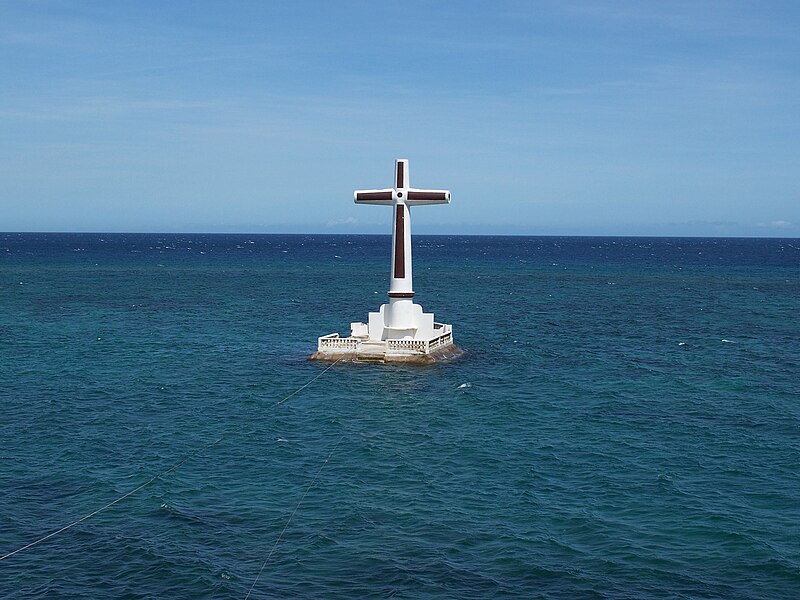
File:Sunken cemetery Camiguin.jpg
Cross marker at the sunken cemetery in Bonbon, Catarman (Camiguin).
Photo by Wolfgang Hägele, May 12, 2010 (CC)


Sources

The Library of Congress Exhibitions, https://www.loc.gov/collections/american-colony-in-jerusalem/articles-and-essays/a-community-in-jerusalem/saved-alone/, retrieved on 7/1/2017