Sunday, February 26, 2017

Coming Down Off Our Mountains

Exodus 24:12-18 and Matthew 17:1-9
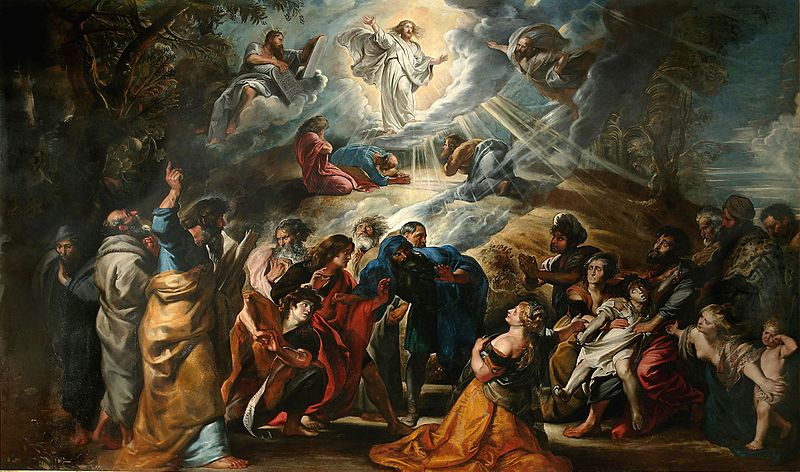
File:Transfiguration-Rubens.JPG
Peter Paul Rubens, La Transfiguration 1605 (Public Domain)

One day in the Appalachian hills of Virginia a hobo was walking along the train tracks waiting for another train to come his way.

As he was walking along, he found himself drawn to the sound of some commotion near the waters of the Shenandoah river. 

A bit intoxicated, he decided to investigate a little closer to see if his ears were playing tricks on him. 

He stumbled down the steep river bank and found a large congregation gathered at the waters edge, being plunged into the water one by one led by a charismatic itinerant preacher. 

Curiously, the drunken hobo found himself mixed in with the crowd and when he accidentally made his way to the front of the line, the preacher asked if he was ready to find Jesus. 

“…Okay…. I guess so?” came his reply.

In one swift and violent motion the hobo found himself plunged backwards into the cold water. 

As he was brought back to the surface just as violently, gasping desperately for air the preacher asked him; 

“Have you found Jesus, my brother?!”

“No, not yet!” replied the confused man.

Frustrated, yet determined the preacher again plunged the man back into the cold waters for a second time, holding him down a few seconds longer before jerking him back to the surface. 

“Have you found Jesus NOW, my brother?!!” again questioned the preacher.

Hesitant, confused, and now a bit scared the man replied; 

“Uh, I… don’t think I, um… found…”

Then WHAM, the preacher plunged the man backwards a third time into the cold water, holding him there until his legs were kicking out of the water and his arms began to desperately grasp for the preacher’s robe. 

When the man emerged for a third time from beneath the cold waters, shaking from fear as much as the cold itself, gasping for air, the preacher asked him once more; 

“Did you find Jesus?!”

The now terrified man responded, 

“I done my part and looked three times now! Ain’t nobody down there so I suggest you take the next feller a bit further up yonder!”

~

People define what is holy or sacred in many different ways. 

People also seem to find God in many different ways, different places, and at different times in their lives. 

What is holy to one may not necessarily seem particularly holy to another. 

In both the first lesson and the gospel for today, they both seem to point to similar settings as something “holy”.

They both occur on mountaintops. 

Mountaintops, places considered sacred throughout scripture but also places that continue to draw many who are seeking a spiritual encounter today as well. 

Anyone who has ever had the opportunity to hike or climb to the peak of even the most modest of mountains can attest to the splendor and majesty of a mountain overlook. 

Growing up, my favorite overnight backpacking spot was in the Minister Creek Wilderness area, near Warren, Pennsylvania. 

There is just something that seems to make us feel as if we are closer to the Divine when we are surrounded by the seclusion and immensity of a panoramic wilderness view. 

Perhaps it is being able to capture the scale of our humble stature comparatively to the immensity of such a scene?

It certainly makes us feel quite small, but then again, so should God. 

File:Gérôme, Jean-Léon - Moses on Mount Sinai Jean-Léon Gérôme -1895-1900.jpg
Jean-Léon Gérôme, Moses on Mount Sinai, 1895-1900 (Public Domain)

Maybe that is why mountaintops and high places were considered holy places by all the cultures of the ancient near east, especially the area of Palestine and Israel.

And when Moses is called to the mountaintop, each time, it is considered to be a holy place, sacred ground. 

Not just because it is a mountaintop but because God is physically present there with Moses. 

And while this is not the first private court Moses attends as God’s guest, there is a special reason for this invitation. 

Moses is given the plans for constructing the tabernacle and the ark of the covenant. 

The tabernacle which is a sacred tent that will serve as the holiest place of all for the Israelites until the Temple is built by Solomon much later. 

It is a sacred place they will carry with them throughout their wilderness journey. 

Carrying it as they march on to the land they have been promised, setting up the tent, the tabernacle, along the way so that God may be present with the people as they go along their way. 

Breaking down the tent and putting it up again, as they move from place to place. 

A tedious chore that must be completed in a specific and precise way. 

Moses is also given the blueprint for the ark of the covenant, another sacred object that is sometimes better known for its role in the story of Indiana Jones, than the one we hear today. 

It serves as God’s throne or seat. 

A royal throne for God to not only sit, but like the tabernacle, it will serve as the means by which God will be with and among the people. 

And so, we find Moses climbing to the top of the mountain, not only seeking God but being given the means to bring God to the people. 

A people who have disobeyed God already. 

A people who do not even have respect for the leader who served as their liberator from slavery; Moses. 

I can’t imagine Moses considered this to be a good plan. 

After all, serving as the medium between God and the Israelites had allowed Moses to negotiate for the people when they fell in God’s disfavor. 

But God living among the Israelites must have seemed like inviting your parents to live in the barracks or a frat house!

If we consider it from this angle, perhaps we wouldn’t ask why he remained on that mountaintop for 40 days. 

The question we should ask is why did he ever come down?

Knowing that these were a people unworthy of God’s presence. 

Unable to truly grasp what Moses experienced on that mountain. 

Unable to grasp what it meant to be in the presence of what is truly sacred, truly holy. 


File:Figures The erection of the Tabernacle and the Sacred vessels.jpg
Illustration from the 1728 Figures de la Bible; illustrated by Gerard Hoet (1648–1733) and others
published by P. de Hondt in The Hague;
image courtesy Bizzell Bible Collection, University of Oklahoma Libraries (Public Domain)

~
Our Gospel for today presents a similar challenge from a very different perspective. 

Jesus has just foretold his humiliation, crucifixion, and death. 

He has also foretold the suffering of his own disciples. 

Following this prophecy, six days later, he leads them up a mountain. 

He leads them to bear witness to something holy, sacred ground on yet another mountaintop. 

And it is there that Jesus reveals to three of his disciples, James, John, and Peter, just what and who is about to be humiliated, crucified, and killed. 

But I am not so sure that is what is on Peter’s mind at the transfiguration. 

Because this word, transfiguration, describes a completely altered physical state, one that undeniably shows Peter, James, and John that Jesus is unmistakably divine. 

The words of Jesus that they have just heard, days ago, foretelling of his death must have certainly been cancelled out at this point. 

For Peter, James, and John, this holy moment, this sacred ground changes EVERYTHING. 

Because for them, this is the promise and the hope they have longed for, since the time of their ancestor's slavery, their ancestor's exile, the occupation of their lands, and the oppression of their people. 

It is in this moment that they believe they have fully experienced the holiest ground, the most sacred point in not only their own lives but in the lives of all people. 

So why wouldn’t Peter want to build three tabernacles?

One for Elijah, the greatest of all prophets,

Another for Moses, the bearer of God’s law,

And one for Jesus, who Peter can now confirm without a doubt is THE Messiah. 

File:Duccio di Buoninsegna - Transfiguration - WGA06780.jpg
Duccio, Transfiguration 1308-1311 (Public Domain)

Because, this is the way the world wants to see it all go down. 

Today, we still want a God that rules over us, controlling our destiny, dictating our fates from a high holy throne on some mountaintop. 

Probably the very way Moses would have preferred to have it. 

We want our own sacred moments, holy mountain top experiences, to be the pinnacle of our faith life. 

We want others to recognize our holy mountain top experiences as some divine endorsement of our own special faith that exceeds the faith of others who don’t see things the way we see it. 

We want a faith that can be dictated to us, rather than a faith that calls us to participate in not only the life but the death of Jesus Christ. 

And so, I cannot imagine Peter’s disappointment as he is trudging back down that mountain knowing that what was foretold has not changed at all. 

Just like we, too, find ourselves disappointed when we declare particular moments in our own lives' pinnacle holy moments. 

Because when we plant our faith in one moment on the top of a mountain, our faith becomes unchallenged and stagnant. 

A faith based in mere feeling, unchallenged by the valleys of our sorrow, untested by the cliffs of our pain. 

That is the very reason that the transfiguration of our Lord is the Sunday that closes out the revelation of our Lord through Epiphany, and nudges us onward as be begin our journey through Lent to the cross. 

Because it is not just on the mountaintops we are called to find God, not just in our high moments, but in the low ones as well. 

~

Twelve years ago, my best friend led me up onto a rooftop. 

Not quite a mountain, but it felt like we had just climbed one together. 

Iraq 2005, Brothers

After spending months patrolling together, we had grown closer than two brothers could be. 

We had been brought back to our small forward operating base after our relief had taken our place so that we could rotate back to the states. 

After spending many months in sparse and unsanitary conditions, experiencing sickness, fear, violence, and uncertainty, we sat on that rooftop, overlooking a city we had invaded. 

A city that we weren’t sure we would even survive, much less both of us. 

And as we sat there, my best friend, my brother, said to me, 

“No matter what happens in life, nothing will ever stack up to this. You will always be able to look back at this moment, looking out over that city and know that you survived that. Nothing will ever compare to this moment, right now. Now, all we have to do is take one more ride on these roads and we are home.”

I didn’t just believe in what he said, he was using the very words I was thinking in my own head. 

It was our mountaintop experience. 

And there have been days when I’ve wanted to be sitting on that roof with him, knowing that we had survived, knowing that we had another chance to make something great out of ourselves because we’d somehow made it. 

But if we’d have always tried to get back to that rooftop, we’d have never taken the chance to become husbands and fathers.

And if we’d both lived our lives on that rooftop, we could have never shared the joy that we share together in our lives and calls today. 

To top it all off if we’d have kept trying to get back to that rooftop, I’d have never met my brother’s child for the first time this weekend. 


In New Valleys and Mountaintops, but still brothers today.
And all these valleys, hills, and yes other mountains do stack up to that moment on that roof. 

~

Sisters and brothers, we cannot place our faith, our hopes, or our expectations in a single solitary moment on a roof or a mountain. 

If we do that faith remains a stagnant dead thing and our faith is not something meant to be caged in a single nostalgic moment. 

It is a living thing meant to thrive in the valleys that will sometimes lead to the crosses we will have to bear. 

Because God is among us and God seeks us out in many more places than just the mountaintop moments.

And as we come down off the mountain today, let us prepare ourselves for the road that will lead us to that cross+ where we will find God, among us.

Amen


File:Andrea Di Bartolo - Christ on the Road to Calvary - WGA00419.jpg
Andrea di Bartolo,
Christ on the Road to Calvary 14-15-1420 (Public Domain)


Sources

Kasdan, Lawrence, George Lucas, and Phillip Kaufman. Raiders of the Lost Ark. Directed by Steven Speilberg. Hollywood, California: Paramount Pictures, 1981. Film.


Sunday, February 12, 2017

The Grace of Law


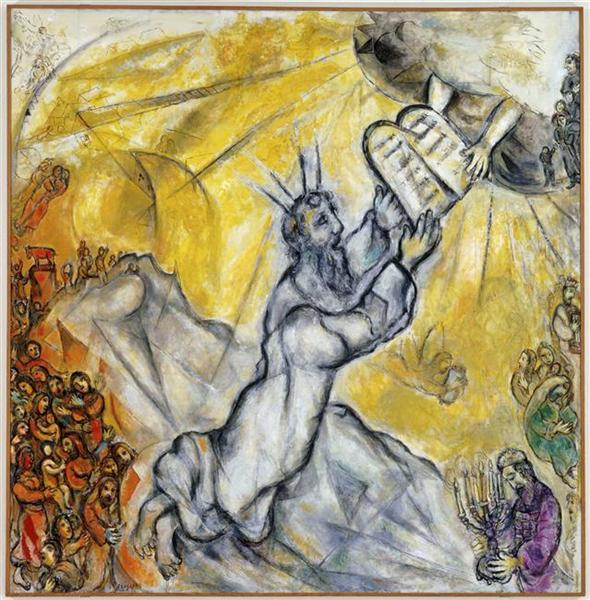
Moses receiving the Tablets of Law, 1966 - Marc Chagall
Moses Receiving the Tablets of the Law; Marcus Chagall 1966 (Fair Use 17 USC §107)

Laws and rules are commonplace throughout cultures and societies. 

They seem to serve the same general purpose within communities; 

To maintain a standard of behaviors that will encourage good order, discourage disorder, and maintain a moral equilibrium. 

This is the way the Israelites saw the law. This is the way the Pharisees saw the law. This is the way Jesus’ audience sees the law, and today, this is the way that we see the law. 

Not just religious laws but civil laws and even the laws that dictate the way we play games.

Last week, during the Super Bowl I watched as armchair referees lit up social media with complaints about the poor officiating. 

Initially, my friends who have maintained their allegiances to the New England Patriots for years, erupted with cries for justice and fairness as the first half of the game fell in favor of the underdogs; the Atlanta Falcons. 

As the second half unfolded, it is unclear what had changed for these Patriots fans. 

Maybe they believed the officials checked their Twitter feeds or perhaps had heard their cries through the television screens? 

Responding to those cries to have their eyes checked by visiting the locker room optometrists that must have been on standby?

Or maybe they believed the officials had checked up on the rule books during the halftime performance, as so many Patriots fans had suggested?

But I’m not too certain that the Falcons fans agreed during the second half of the game when outrage ensued following illegal blocks and poor ball spotting, based on Falcon fan’s observations. 

This illustrates a theme that is threaded throughout the texts we have read today; 

When the law works in our favor, we declare the law just and righteous.

But when we are convicted by the law, whether that be a religious law, a civil law, or even the laws that dictate the way we play a game,  we find ourselves crying afoul, pleading for justice, and declaring those who judge, inept, unqualified, or simply a bias voice that is out to get us. 

The Court of Chancery, J. Hill and Harraden 1808 (Public Domain)
A central tenant of Lutheran theology is a balance between law and gospel, but today our gospel reads more like law than gospel. 

Jesus declares some pretty harsh penalties for a variety of actions in the gospel today, and if you don’t find yourself in violation of any of these rules presented, well….

I would have to just say; “Thanks for joining us for worship today, Jesus! I hope the sermon was salvageable!”

Because we are all in violation of these guiding principles being outlined in the Sermon on the Mount. 

In fact, one certainly would be hard pressed to have not found themselves a bit uncomfortable with the Word Jesus proclaims each of these past three Sundays. 

And next week, we will be instructed in following the most difficult law of all; 

Loving our enemies. 

And so, we are all convicted and condemned by these laws and the consequences for our failure are pretty intimidating, explicit, and since we are all convicted how can we not stomp our feet and call these rules unfair, impossible, perhaps even unjust? 

The conundrum we find ourselves in can be summed up in one word; consistency. 

Our inconsistency is grounded in our application of the law. 

We apply the law harshly to others when it serves our own purpose.

And while this makes us feel a bit more righteous than the one we are convicting, our conviction of another doesn’t absolve us of our own sin, it only turns the conviction of the accuser back upon them. 

This is nothing more than self righteousness; the sin of hypocrisy, the highest handed sin of all. 

Regardless, our whole approach to the law is a mess. 

Because, the law is something that we can never fully obey and this is due to a much more important issue than ignorance. 

Jerry Seinfeld once asked, “What are lawyers really? To me a lawyer is basically the person that knows the rules of the country. We are all throwing the dice, playing the game, moving our pieces around the board but if there’s a problem; the lawyer is the only person that has read the inside of the top of the box.”

That isn’t too far out of line from the way Jesus’ audience interprets the role of the scribes and the Pharisees. 

They not only know the law, but they are considered experts on the law. 

So, when Jesus declared to us in our Gospel from last week that “unless your righteousness exceeds that of the scribes and the Pharisees, you will never enter the kingdom of heaven.”

This declaration suggests that righteousness is grounded in something deeper than memory verses and proof texting. 

Because that was the very purpose of the scribes and the Pharisees, to dictate the rigid literal law and judgement of others based on it, for no other reason than an empty pietistic devotion to it. 

Quoting Scripture for the sake of condemning another is not a practice that died out in Jesus’ day. It is a recurring practice that we continue to embrace today as well. 

Substantiating our moral superiority through scripture, only to find that contradictory verses and views can easily be used to substantiate the views of one's opponent. 

Taking the Bible, the instrument that is intended to reveal God’s love, grace, and mercy to a world in need, and turning it into a weapon that is bent to do our will, to vindicate us in our own ethical superiority. 

THAT is the conflict Jesus has attempted to address in today’s gospel. 

Because even when we are caught, dead to rights, embroiled in our sinful state of lawlessness there is always an excuse. 

Jesus declares quite harshly, “If your right eye causes you to sin, tear it out and throw it away; because it is better for you to lose one of your members than for your whole body to be thrown into hell.”

Anybody want to take that one literally?

How about if we consider another option Jesus presents; 

“If your right hand causes you to sin, cut it off and throw it away; because it is better for you to lose one of your members than for your whole body to go into hell.”

Any takers on that one?

Certainly not!

I’m willing to bet the crowd that heard this advice wasn’t rushing down off that mountain to complete the task either. 

I can only imagine the number of knives or swords that were chucked into the bushes when the crowd heard of this decree!

The point in this advice is to consider the root of the problem and the root of the problem is the same in Deuteronomy as it is in Matthew’s gospel. 

Neither the hand that sins nor the eye that sins is the root of the problem, the root of the problem is the heart. 

If we are to remove an arm or an eye that sins, the other will still remain in place to carry out the sin that resides, not in our limbs, but in our hearts. 

In Deuteronomy, chapter 11, within the explanation of the very first commandment it is suggested that the law, the word of God, as given to those people and yes, to us too is intended to be etched into our hearts and souls. 

File:Moses Showing the Tablets of the Law to the Israelites, with Portraits of Members of the Panhuys Family, their Relatives and Friends by Maerten de Vos Museum Catharijneconvent RMCC s94.jpg
Moses Showing the Tablets of the Law to the Israelites, Marten de Vos 1574-1575 (Public Domain)
A word we cannot fully live up to, a law we cannot live into. 

So, how can that law be a thing we could ever carry in our hearts?

Carrying our own damnation within the place reserved for affection and hope?

~

One of the most fascinating chapters of recent American political history for me has been the relationship between two of our nation's Supreme Court justices. 

In the years leading up to the death of Justice Scalia, he and Justice Ginsberg sat in polar opposite ends of the legal spectrum. 

Justice Scalia was known far and wide for his conservative views and his originalist interpretation of the United States constitution, while Justice Ginsberg remains well known for her liberal views and interpretation of the constitution as a living document. 

Yet, these two powerful opposing voices at the highest level of the judicial branch of government shared mutual interests ranging from opera to souvenir shopping. 

But it was the one passion that they shared that drew them together as best friends, regardless of their heated differences while sitting on the high court. 

Regardless of how they interpreted the law, they both had a deep passion for it. 

Both Scalia and Ginsberg believed that the law was a reflection of the best in the American people, especially the United States constitution. 

They believed in it and even in the midst of their own disagreements, they believed in one another’s love for it. 
~

Both our first lesson and our gospel are quite explicit in their call to follow the law. 

Last week, as we read from the previous versus of this chapter, Jesus proclaimed that he had not come to abolish the law, but to fulfill it. 

And this week’s Gospel furthers our initial interpretations of the law. 

Our first lesson proclaims that "If you obey the commandments of the Lord your God you will live," 

Followed by a plea from God to choose life, a life that reflects the law. 

But we don’t and we can’t. 

We fail and we deserve to be convicted for that failure. 

But is that the point of the Word today?

To walk away, knowing that we’ve failed and we are damned to continue in our failing?

I don’t think so. 

Today’s call is not to fulfill the law ourselves, certainly we know that is not possible, and if that is the expectation of Jesus I’m not certain he would have ever been prepared to be called a Savior in the first place. 

Today’s lesson is not about fulfilling the law, it is about receiving the law in our hearts. 

Because when we receive the law in our hearts as the gift it is, we receive the desire to be righteous even if that is something we are not.

Even if righteousness is not a goal we can reach on our own.

Because when we know the value of the gift offered on that cross in spite of our failures to attain it for ourselves. 

It makes both the gift of God’s law and the gift of God’s grace that much sweeter. 

And they are both gifts that God longs for us to receive, through the conviction of the only righteous man to ever fully live out that law. 

Amen

File:Marc Chagall, 1912, Calvary (Golgotha) Christus gewidmet, oil on canvas, 174.6 x 192.4 cm, Museum of Modern Art, New York.jpg
Calvary (Golgotha), Marc Chagall 1912 (PD-US)
Sources

Carmon, Irin CarmonBy Irin. “What Made the Friendship Between Scalia and Ginsburg Work.” Washington Post (washingtonpost), February 13, 2016. https://www.washingtonpost.com/posteverything/wp/2016/02/13/what-made-scalia-and-ginsburgs-friendship-work/?utm_term=.6cd6e8de1766.

David, Larry, Jerry Seinfeld, Steve Skrovan, Bill Masters, Jon Hayman, and Peter Mehlman. “The Movie” [Seinfeld]. Season 4. Episode 14. Directed by Tom Cherones. Columbia Tristar Television: NBC, 1993. Television.

Johnson, Richard. “The Internet Thinks Super Bowl 51 Was Fake News.” February 6, 2017. Accessed February 8, 2017. http://www.sbnation.com/nfl/2017/2/6/14523088/super-bowl-rigged-patriots-falcons-james-white-donald-trump.

Sunday, January 29, 2017

The Best Inauguration Address Ever


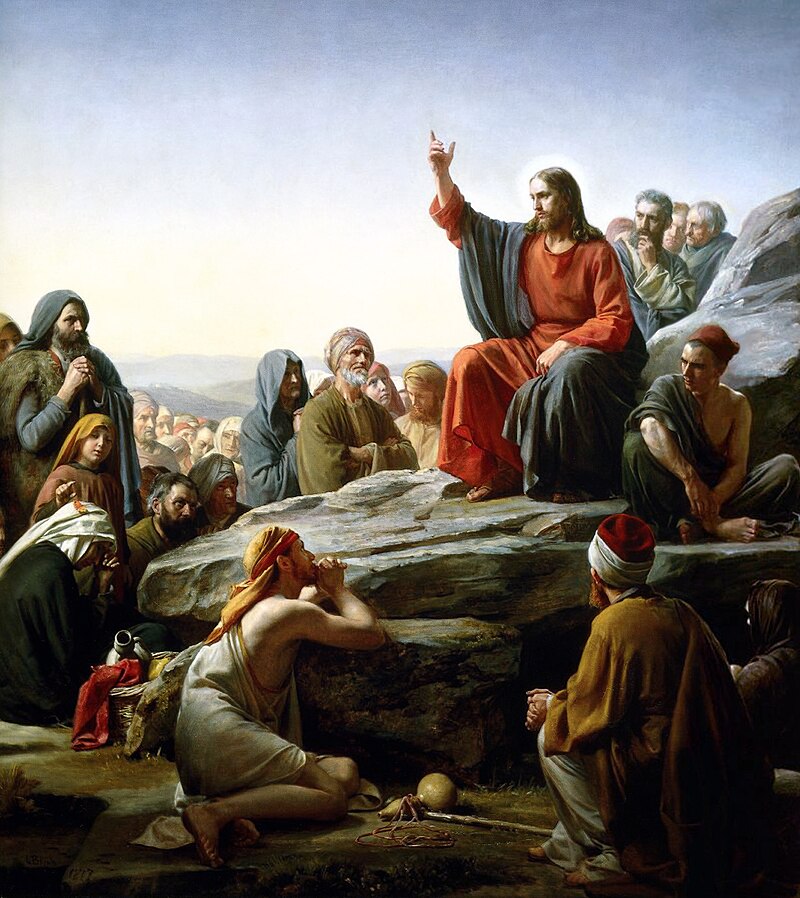
Sermon on the Mount, Carl Heinrich Bloch 1877

While I cannot say it is the largest inaugural address ever given -based on the information we have at our immediate disposal- 

the data seems to affirm that it was a pretty substantial crowd. 

The data provided in Matthew’s gospel would not only suggest that the crowd was substantial in size but by the time we get to chapter seven the crowd had grown even larger. 

Then, as the real work begins in chapter eight, the crowds had grown even more, and they followed him wherever he went, in awe of the works he did. 

And his work was not focused on healthcare, jobs, immigration, or the environment, 

-At least not exclusively-

But completely turning the entire infrastructure of God’s creation on its ear. 

An infrastructure that had begun eroding and rotting a long, long time ago. 

Not because of the Republicans, the Democrats, the bankers, or CEOs.

Not because of the Romans or the Pharisees. 

But because the whole system had gone awry. 

Not at the hands of any single person, but by the hands of every living person, to include our own today. 

Jesus’ inaugural address, the Sermon on the Mount, is not only one of the most well known of Jesus’ teachings, but it is the longest collection of his teachings. 

They get right to the heart of Jesus' mission, God’s mission. 

And in Matthew, they serve the purpose of laying out the entire mission before, not only the disciples, the people of Galilee, or the people of Israel, but Jesus’ disciples around the world, in every time and place. 

This collection of nine blessings, bestow more than just a blessing, but a title that is bestowed upon the hearer; a judgement that is rendered by Jesus, declaring such a title as….blessed. 

It’s a very different title than the one we use today, far more formal than a response to a sneeze or a more spiritual form of wishing good will on another who has graciously held the door. 

This is a title, an honor bestowed to those who have, will, and are presently in the act of participating in the will of God. 

This portion of the Sermon on the Mount has been described as the most masterful collection of wisdom literature to ever draw ink to paper. 

Philosophers, priests, and spiritual leaders of all sorts have described it as one of the most beautiful sermons ever written. 

Mahatma Gandhi, the Indian leader and activist even claimed its special place in his own life as a Hindu and revered figure in world history. 

So, how on earth could I improve on such a thing today?

In all honesty, I won’t because I can’t. 

In fact, preaching is not an art of improving on Christ’s Word. It is the art of inviting you to immerse yourself into those words.

And that is the very point of this text as an introduction into Jesus’ ministry.

It is to pull you into the poetry of the Beatitudes and to be lost in those words. 

That is the power of the inspired word of God,  to invite us into the impossible task, the task of not only living into those words, but wrestling with them. 

This is not the first time words are presented to the people directly from God. 

And Matthew draws some specific parallels there. 

In Exodus 19, Moses climbs up the mountain to receive the word of God, being called there by God. 

Moses Receives the Ten Commandments from Yahweh
Cosimo Rosselli, 1480

Moses serves as the messenger of that word, the singular solitary messenger and authority of that word. 

But it isn’t a singular figure who is called to the mountain this time. 

Jesus is the one waiting atop the mountain, and it is the disciples who climb it to hear the Word made flesh, face to face. 

But there is debate concerning the size of the crowd that hears Jesus’ inaugural address. 

And it depends on the source of your information to be honest. 

I’m not saying that certain perspectives are wrong or intentionally misleading, although exact numbers cannot be cited, but it may be important to note a simple fact. 

As the word is bestowed upon the disciples, it would certainly seem that his circle of listeners grew as the crowd below is drawn up that mountain to receive this word, not a word imprinted on stone tablets, but a word that is etched on the hearts of all the disciples who hear them. 

Not just to the crowd gathered together then, but to the one gathered together today as well. 

The Beatitudes hold a special place in the Gospels, because they reflect the influence of Judaism on Matthew. 

They are Jewish poetry that can be described as both law and gospel. 

They are often interpreted as imperative orders, commands even, and yet, they are also often interpreted as healing words of grace and mercy. 

Oddly, this poetry stands as both. 

And regardless of how you read them, they are intended to lead us to the same conclusion,.

They lead us to the total upheaval of our accepted natural order. 

A natural order plagued by injustice, despair, arrogance, grief, war, pain, and persecution. 

Blights on their lives and ours that were never meant to be part of this creation, part of our lives. 

As I have already stated this text is more than a story, a speech, or a proclamation.

It is poetry and a riddle of the heart rather than the mind. 

Sermon On The Mount with the Healing of the Leper Cosimo Rosselli, 1481
The Eight Beatitudes, Cosimo Rosselli 1480

Versus 3 through 9 make a declaration of what the kingdom of God WILL be. 

So when you see this as an impossible vision, don’t feel alone, because it is. 

It is a vision beyond our reach, well beyond our cognitive grasp. 


Because we cannot envision a world where the roles of the meek and the mighty are reversed. 

And perhaps we don’t always like that vision, because after all, we fall pretty high on the pecking order compared to most places in the world, don’t we?

But certainly we find ourselves in one of these nine categories, at some point in our lives, if not daily. 

So maybe we should ask ourselves, "What would that look like? Are those the people that we truly want to share an eternal kingdom with?"

Because these are not just titles bestowed on those who KNOW God but those who NEED God the most. 

How could we not find ourselves envious of that?!

Especially if THOSE who NEED God more than they KNOW God, find themselves at the front of the line!

How many of us would declare THAT fair or just?!

I must confess, NOT I!

After all, I’m a called and ordained minister of the church of God, aren’t I?

Shouldn’t I be at the FRONT of the line!!!?

Perhaps…. If it were my vision of the Kingdom, my vision of justice.

But it is not, thankfully.

It is God’s. 

And is our place in line what matters the most, or the fact that we should be satisfied receiving the invitation at all?!?

An invitation to live into something fuller, more powerful, more hopeful; God’s vision of the Kingdom.

~

I have to admit I’ve found the past several weeks leading up to this Sunday’s text concerning and most certainly difficult. 

I once thought that due to my diverse experiences I had the most eclectic circle of friends, certainly a diverse collection in social media. 

But as people have become further and further divided, it would seem that more and more social circles have come to mirror my own. 

The divisions in our immediate communities have expanded. 

And as I was working my way through the text this week, I couldn’t help but realize the irony of the text and the tragedy of who we, God’s people, have become. 

“Blessed are those who are persecuted for the sake of righteousness because theirs IS the Kingdom of Heaven!”

“Blessed are you when others make you an object of their scorn, persecution, and mockery, when they speak every evil against you through lies for my sake!”

I’m sure many of us have felt scorned over these past few weeks and months, perhaps even years. 

And certainly it has become a bit more tense since the election and the other inaugural address we recently heard. 

But we have to ask ourselves a simple question. 

Who are the persecuted who we have been defending passionately over the past several months, 

several years, 

several decades…?

Is it those who are truly the weakest?

If we ran to the defense of those who are truly our poorest, persecuted, those who hunger for justice, and the one’s who cry out for mercy with that same passion and fervor with which we run to the defense of our nation's presidents *both past AND present*, congressmen, senators, mayors, governors, and political parties…..

What would it look like if we defended the weak with the same passion that we attack one another’s views and candidates, sometimes even severing relationships with those we care for in favor of a candidate we don’t really even know, DO WE?

What would that look like?

Sisters and brothers, one thing that we may be slowly realizing in the midst of these divisions, is that the most powerful are not necessarily the ones who need our defending. 

It doesn’t mean that we do not remember them in our prayers or provide our support to those who lead and guide our nation, but are they the ones that we are called to defend so emotionally and passionately, at the expense of our own immediate relationships?

The beatitudes call us to a vision of a kingdom in which this entire system we know has been overthrown. 

A system where we care for one another with an even greater passion than that in which we defend our own political loyalties. 

A new natural order, in which Christ’s mercy reigns supreme. 

A new Kingdom that breaks into our world through that symbol of earthly power, carried on the frail back of a broken human body that shatters the power of this world, armed with NOTHING, but the redeeming love and grace of God. 

Amen

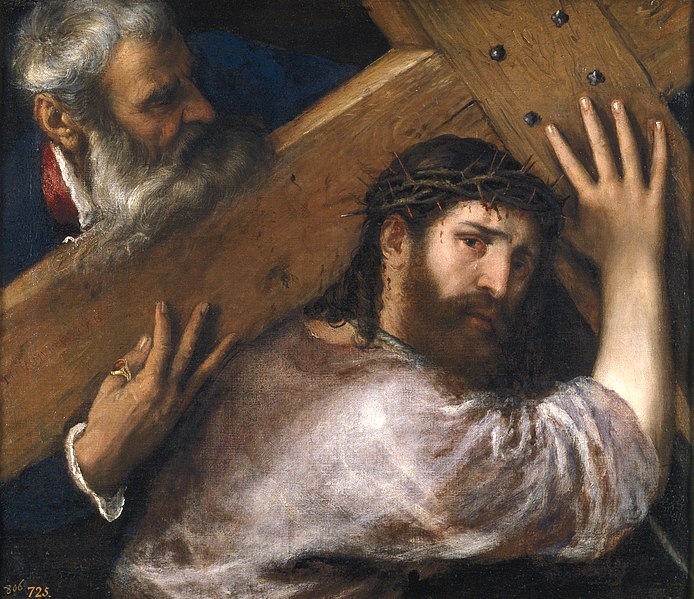
File:Titian, Christ Carrying the Cross. Oil on canvas, 67 x 77 cm, c. 1565. Madrid, Museo Nacional del Prado.jpg
Christ Carrying the Cross, Titian 1565